Cal/OSHA issued nearly $300,000 in penalties to a single municipal department in late 2025 for allowing workers to enter unprotected trenches. In this state, a single bucket bite in the wrong spot doesn’t just stall a schedule; it risks lives and invites massive regulatory heat. You need a utility trenching contractor California can trust to handle the dirt, the depth, and the red tape. Whether you’re coordinating with SCE, LADWP, or SDG&E, the stakes are too high for guesswork. One mistake can trigger an investigation that shuts down your entire operation.
Managing complex permitting and the fear of hitting high-priority lines is a constant battle for any project manager. We understand the pressure of maintaining a zero-incident job site while hitting tight deadlines. This guide provides a clear roadmap to master the complexities of modern utility installation. We’ll break down the 811 DigAlert protocols, Cal/OSHA shoring requirements, and precision site restoration. You’ll learn how to plan, protect, and perform with 100% compliance and zero site disruption.
Key Takeaways
- Master California’s strict excavation laws, including mandatory Cal/OSHA permits for any trench five feet or deeper.
- Navigate the critical 811 DigAlert process to protect high-priority infrastructure and avoid catastrophic utility strikes.
- Identify the mandatory separation requirements between wet and dry utilities to ensure long-term site safety and regulatory approval.
- Partner with an experienced utility trenching contractor California relies on for precision excavation, shoring, and complete site restoration.
- Implement engineered shoring systems to prevent trench collapses and protect your crew in high-risk seismic zones.
Understanding Utility Trenching in the California Landscape
Utility trenching is the precision excavation required to house our state’s vital underground infrastructure. While a simple hole is just a gap in the dirt, understanding what a trench is in a civil engineering context involves deep technical knowledge. It’s about creating a safe, stable environment for power, water, and fiber optics. In California, geography dictates the method. You might hit San Diego bedrock one day and Los Angeles alluvial clay the next. This volatility requires a specialized utility trenching contractor California trusts to keep projects on track. We don’t just move dirt; we manage the earth to protect the assets within it.
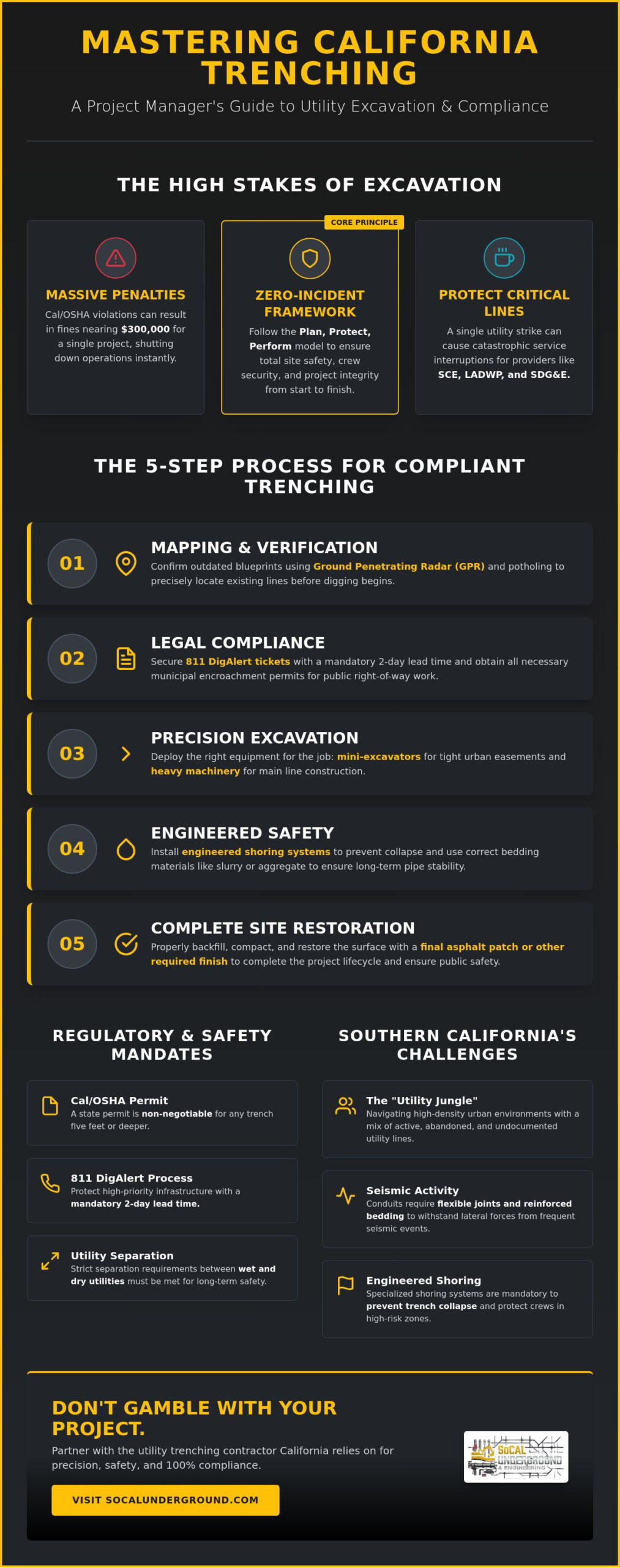
Successful projects follow a “Plan, Protect, Perform” framework. Planning involves exhaustive mapping of what lies beneath. Protecting means securing the site, the crew, and the surrounding structures. Performing is the final execution of the design to exact specifications. Expert underground utility contractors act as the backbone of modern civil engineering. They bridge the gap between architectural blueprints and functional reality. Without this precision, the systems that power our cities would fail under the weight of their own environment.
The Complexity of Southern California Infrastructure
Building in LA or Orange County presents unique challenges. It’s a high-density urban environment where every square inch of earth is already occupied. Beneath aging municipal streets lies a “utility jungle” of abandoned pipes, active high-voltage lines, and fiber optic trunks. Utility conduits in California must be engineered with flexible joints and reinforced bedding to withstand the lateral forces of frequent seismic activity. We work in tight quarters where there’s no room for error. Precision is the only way to avoid catastrophic service interruptions.
Regulatory Oversight: Who Governs Your Dig?
Safety is the law. Cal/OSHA Title 8 sets the baseline for every excavation on California soil. If you’re going deep, you’re under their microscope. Municipal public works departments and utility providers like SCE or SDG&E have their own strict standards for encroachment and installation. A “Class A” General Engineering license is non-negotiable for commercial work. It proves the contractor has the technical capacity to manage heavy loads and complex safety systems. Don’t gamble with uncertified crews. The risk of a utility strike or a trench collapse is far too high for any reputable project manager to accept.
How-To: The 5-Step Process for Utility Trenching in California
Excavation is a high-stakes sequence. You don’t just drop a bucket and hope for the best. A professional utility trenching contractor California relies on follows a strict, five-phase protocol. This ensures every foot of pipe is compliant and every square inch of surface is restored. Skip a step, and you risk fines, delays, or a catastrophic utility strike. We operate with a focused rhythm: survey, secure, and stabilize. This lifecycle approach keeps projects moving from the first survey to the final asphalt patch.
Step 1 & 2: Mapping and Legal Compliance
Before the first shovel hits the dirt, we verify the blueprints. Paper plans are often outdated or incomplete. We use potholing and Ground Penetrating Radar (GPR) to locate existing lines with surgical precision. This isn’t just about safety; it’s a legal mandate. California Government Code 4216 dictates a mandatory two-day lead time for all 811 DigAlert tickets. We handle the coordination with municipal public works to secure encroachment permits for any work in the public right-of-way. We clear the legal path so the physical work can proceed without friction.
Step 3 & 4: Execution and Engineering
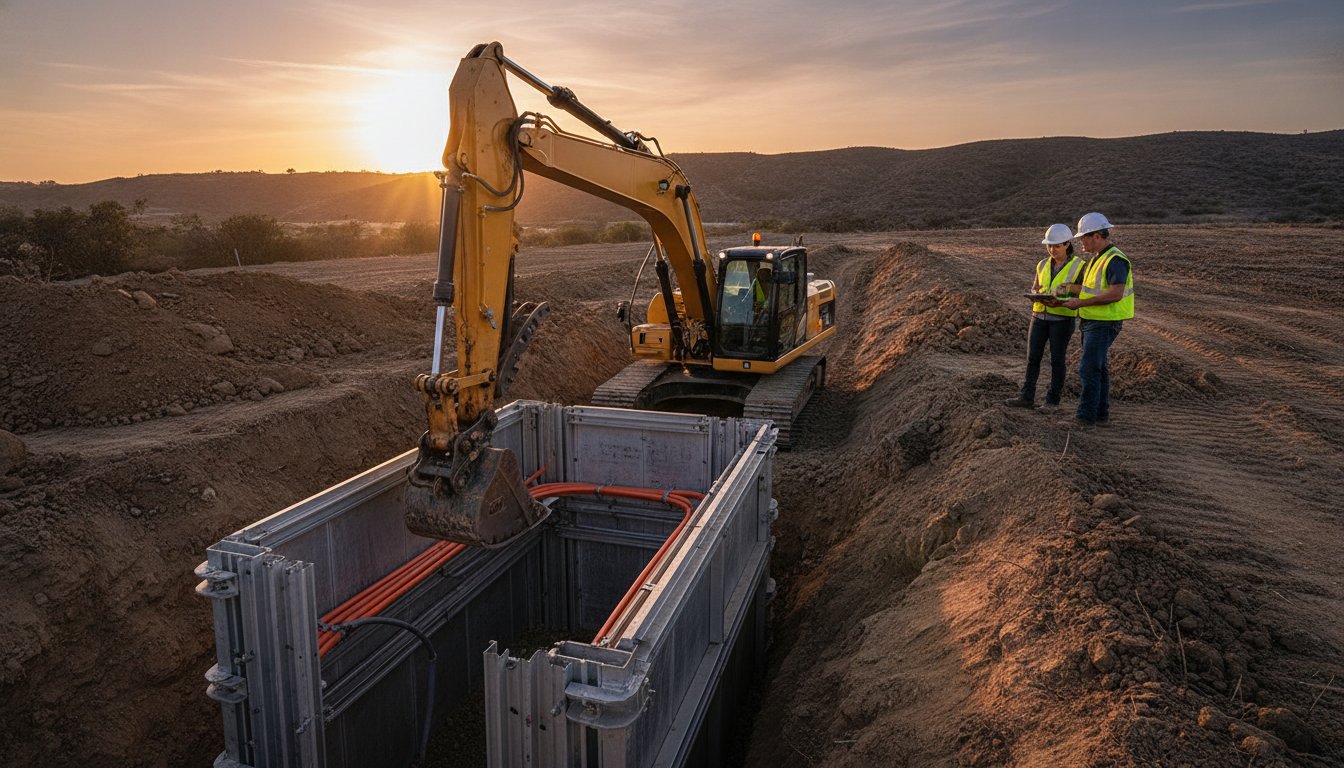
Execution begins with matching the right equipment to the environment. We use mini-excavators for tight urban easements and heavy iron for main line construction. As the trench deepens, shoring systems go in immediately. We follow the technical standards found in California’s Trenching and Shoring Manual to ensure structural integrity and crew safety.
Utility placement requires more than just dropping pipe. We focus on the bedding. Using the correct slurry or aggregate prevents future settlement that leads to pipe failure. We coordinate with purveyors like SCE or LADWP for mid-process inspections. Nothing gets covered until it’s verified. For complex projects, our team provides the heavy engineering solutions needed to overcome unexpected site obstacles and soil conditions.
Step 5: Backfill and Restoration
The job isn’t done until the street looks like we were never there. We use controlled backfill and mechanical compaction to meet municipal density requirements. This prevents the “sunken trench” that plagues low-bid projects. We finish with professional asphalt paving or concrete replacement. Most contractors treat trenching as an isolated task, but we view it as a complete civil restoration. We deliver a turn-key result that stands up to heavy traffic and regulatory scrutiny. We dig, we deliver, and we restore.
Dry vs. Wet Utilities: Managing Conflicting Trenching Requirements
Wet and dry utilities don’t mix. Wet utilities carry fluids like water, sewage, and storm runoff. Dry utilities transmit energy and data through power lines, gas pipes, and fiber optics. Placing these systems in the same corridor requires an expert utility trenching contractor California project managers trust to manage the physics of the site. You can’t just dig a trench and drop everything in. Separation is the law. Horizontal and vertical clearance prevents cross-contamination and dangerous electrical interference. We adhere to strict Cal/OSHA trenching and excavation safety standards to ensure every conduit stays in its lane. We map, we measure, and we maintain the gap.
Joint trenching is a common strategy for dry utilities to maximize efficiency. It saves time, space, and money by housing power, gas, and telecommunications in a single, wide excavation. But this requires high-level coordination. You must account for different burial depths and heat dissipation requirements for each purveyor. When the project demands connections to live municipal lines, we utilize precision wet tap services to make connections without system shutdowns. This keeps the city running while we build the infrastructure. We deliver results without the downtime.
Wet Utility Challenges: Gravity and Pressure
Maintain the slope. Sewer and storm drains rely on gravity; even a one-percent deviation in grade can lead to standing water or system failure. High-pressure water mains present a different challenge. These lines require massive thrust blocks and specialized backfill to handle internal forces. We use non-corrosive bedding to protect the pipe’s integrity and ensure long-term structural soundness. It’s a game of pressure, gravity, and precise engineering. We dig it right the first time.
Dry Utility Challenges: Protection and Access
Electrical lines generate heat. High-voltage conduits often require thermal backfill to dissipate that energy and prevent cable failure. Fiber optic lines are the opposite; they are delicate and require smooth conduit runs with minimal bends to prevent signal loss. We manage the placement of access points and vaults to ensure long-term serviceability for utility providers. Every pull box must be level; every conduit must be sealed. We protect the data and power that drives the California economy. We build for reliability.
When these critical power lines reach their final destination, homeowners often look to upgrade their internal systems to match the new infrastructure. For example, once your power is secured, you can explore Air Conditioning Installation with Nice and Cool Inc. to ensure your home’s HVAC system is as reliable as the underground utilities supporting it.
Safety and Structural Soundness: Shoring and OSHA Standards
A trench collapse happens in seconds. It is the leading cause of death in excavation work. In California, safety isn’t a suggestion; it’s a legal mandate enforced with heavy penalties. Cal/OSHA regulations require that no worker enter an unprotected trench five feet deep or greater. If the soil is unstable, that protection must start even sooner. As a leading utility trenching contractor California firms trust, we prioritize structural integrity from the first bucket of dirt. We don’t just dig; we secure. We follow the rules because we value the lives of our crew.
Every active job site requires a “Competent Person.” This individual has the technical knowledge to identify hazards and the authority to stop work immediately. They conduct daily inspections before any crew member enters the cut. This includes checking for tension cracks at the surface and monitoring water seepage. They also ensure that excavated soil, or spoil piles, are kept at least two feet back from the edge of the trench to prevent surcharge loads from causing a cave-in. We identify the risk, install the protection, and verify the safety. This disciplined approach is why we participate in events like the National Trench Safety Stand Down Week every June.
Selecting the Right Shoring System
The environment dictates the gear. Hydraulic shoring uses pressurized pistons to prevent wall movement. It’s fast and effective for standard depths. Trench shields, or boxes, provide a protective cocoon for workers in more stable conditions. For deep, complex excavations over 20 feet, we utilize slide rail systems designed by registered professional engineers. This is a non-negotiable requirement under California law. Proper shoring systems protect both the workers in the hole and the adjacent municipal infrastructure from settling or collapse. We match the system to the risk.
Soil Classification and Stability
Southern California soil is rarely uniform. We categorize dirt into Type A, B, and C based on its compressive strength. Type A is stable clay; Type C is granular sand or submerged soil that is prone to immediate cave-ins. Seismic activity in the region further complicates stability. A minor tremor can turn a stable wall into a landslide. In high-traffic areas, we use slurry backfill to provide immediate stabilization and prevent street sinkage. We also account for vibration from nearby heavy equipment which can liquefy unstable soils. We analyze the ground, select the system, and execute the plan.
If your project requires deep excavation or complex shoring, contact our team for heavy engineering services that meet every Cal/OSHA standard.
Why Expert Civil Engineering Wins: The SoCal Underground Advantage
Generic excavation isn’t enough for the high-stakes infrastructure of Southern California. You need more than a machine operator. You need a partner who understands the structural weight and technical demands of the project. Transitioning to heavy engineering solutions ensures your utility corridor is built to last. Our localized expertise across Los Angeles, Orange County, and San Diego means we know the specific soil profiles and municipal codes before we even arrive. Choosing a utility trenching contractor California project managers rely on simplifies the site development lifecycle. We don’t leave the site until the asphalt is cured and the job is closed. We plan, we protect, and we perform.
Full-Lifecycle Site Development
We eliminate the contractor gap. Most projects fail during the hand-off between the excavator, the utility installer, and the paving crew. Miscommunication between these separate entities leads to delays and finger-pointing. We manage every phase of the project from the initial survey to the final surface restoration. Our civil engineering background allows us to spot design flaws in the blueprints before they become expensive change orders. We analyze the load-bearing requirements, verify the soil compaction, and ensure the utility bedding is perfect. This comprehensive approach keeps your timeline intact and your budget on track. Every curb, sidewalk, and driveway approach we replace meets strict ADA compliance and municipal street standards. We provide a single point of accountability for the entire scope of work.
Emergency Response and Reliability
Failures don’t follow a schedule. We provide 24/7 emergency utility repair contractor services for critical water main breaks, sewer collapses, and storm drain failures across Southern California. When the city’s infrastructure fails, we move immediately. Our team is active and present on the job site at all hours to stabilize the situation and restore service. This is the handshake style of business. We provide honest, firm communication and professional accountability. We take pride in the finality and quality of our output. You aren’t hiring a distant corporation; you are hiring a high-stakes specialist who is deeply invested in the local landscape. We stand by our work and our word. Contact SoCal Underground for a precision bid on your next utility project. We get the job done right.
Secure Your Site and Deliver Results
Success in the Southern California landscape comes down to three things: planning, protection, and performance. You’ve seen how critical it is to navigate the 811 DigAlert process and maintain strict Cal/OSHA shoring standards. Precision in separating wet and dry utilities isn’t just a best practice; it’s a legal requirement that prevents future failures. Site restoration must be as professional as the initial dig to ensure long-term stability and municipal approval. Cutting corners in this environment only leads to fines, delays, and dangerous utility strikes.
We bring decades of experience to every project across LA, Orange County, and San Diego. As a Licensed Class A General Engineering Contractor, we handle the complex civil challenges that stop other crews in their tracks. We’re also ready with 24/7 emergency utility repair contractor response for when the unexpected happens. You need a utility trenching contractor California relies on for honest communication and rugged accountability. We dig with purpose and restore with precision.
Request a Professional Utility Trenching Bid from SoCal Underground to start your next project with confidence. We’re ready to get in the dirt and deliver the infrastructure our communities depend on. Let’s build it right.
Frequently Asked Questions
How deep should a utility trench be in California?
Burial depth depends on the utility type and the specific purveyor’s standards. Most primary electrical conduits require 30 to 36 inches of cover; gas lines typically sit at 24 inches. Water and sewer lines vary based on gravity requirements and local municipal codes. We verify these depths with the utility provider before the first bucket hits the dirt to ensure full compliance. We dig, we verify, and we deliver.
What is the California 811 law (DigAlert)?
California Government Code 4216 mandates that anyone planning to excavate must notify the regional notification center at least two working days before starting. This law protects underground infrastructure and prevents catastrophic strikes. Failing to call 811 leads to massive fines and total liability for any damage. It’s a non-negotiable step for every utility trenching contractor California project. We handle the tickets, the marking, and the wait.
Who is responsible for utility trenching on a commercial site?
The General Engineering Contractor or a specialized underground utility contractor typically handles the trenching. They manage the permits, the equipment, and the crew. This responsibility covers everything from Cal/OSHA safety compliance to meeting the engineer’s precise grade requirements. They bridge the gap between the site owner and the utility purveyors to ensure the infrastructure is energized on schedule.
What is the difference between trenching and excavation?
Excavation is any man-made cut or cavity in the earth’s surface. A trench is a specific type of excavation that is generally deeper than it is wide. According to Cal/OSHA, the width of a trench cannot exceed 15 feet at the bottom. If the width is greater than the depth, it’s usually classified as a general excavation. We use specialized equipment for each to maintain structural integrity.
Can I dig my own utility trench for a new service connection?
Commercial and industrial service connections require a licensed Class A General Engineering license. While a property owner might handle minor private drainage, anything connecting to municipal mains or utility provider grids must be performed by a professional. Purveyors won’t energize or connect services that haven’t been installed and inspected by a qualified contractor. It’s about safety, liability, and the law.
How do soil conditions in San Diego affect trenching costs?
San Diego is known for hardpan and caliche rock. These dense soil types require heavy-duty breakers and specialized buckets to penetrate. This increases equipment wear and extends the project timeline compared to the sandy soils found in coastal LA. Harder ground means more labor hours and higher fuel consumption for the machinery. We account for these geological factors in the initial bid to prevent surprises.
What shoring is required for a 10-foot deep trench?
Cal/OSHA requires a protective system for any trench five feet deep or greater. At 10 feet, you must use hydraulic shoring, trench shields, or a designed sloping system. The choice depends on the soil classification and the proximity of adjacent structures. A competent person must inspect the system daily to ensure it remains structurally sound. We prioritize the safety of the crew and the stability of the site.
How long does it take to get a utility trenching permit in LA County?
Permit timelines vary significantly between municipal departments. A standard encroachment permit in the City of Los Angeles typically takes two to four weeks for approval. Complex projects involving main line extensions or high-traffic corridors can take several months. We recommend starting the application process as soon as the civil plans are finalized to avoid scheduling bottlenecks. We move fast to keep the project on track.