A system-wide water shutdown isn’t just an inconvenience. It’s a massive drain on your budget and a hit to your professional reputation. When you need a wet tap contractor Southern California, you need a partner who knows the margin for error is zero. Across the 663 drinking water systems serving this region, the coordination for a shutdown is a logistical nightmare. You’ve seen the fallout. One necessary connection turns into a multi-day headache with local water districts and hundreds of angry tenants. You can’t afford the contamination risks or the cost of a dry system.
We know that keeping the water moving is the only way to keep your project profitable. This guide explores how professional wet tapping services eliminate system downtime and reduce infrastructure costs for regional utility projects. We’ll break down the mechanics of secure, leak-proof connections, the complexities of local permitting, and why zero downtime is the only acceptable result for modern infrastructure work. It’s about precision, speed, and honoring the commitment to the job site.
Key Takeaways
- Learn how “live connections” maintain full system pressure, allowing for new utility tie-ins without a single minute of service interruption.
- Understand how wet tapping bypasses the need for “Boil Water” notices and keeps critical fire protection systems active during construction.
- Identify the specific technical requirements a wet tap contractor Southern California must meet when working with diverse pipe materials and large-diameter mains.
- Navigate the complex permitting and engineering standards required by major regional authorities like LADWP and LA County Public Works.
- Discover how specialized heavy-duty expertise ensures secure, leak-proof results while strictly adhering to local utility regulations.
What is Wet Tapping and Why is it Critical for SoCal Infrastructure?
Wet tapping is the surgical method of adding a new branch to an existing, pressurized pipeline. Unlike traditional tie-ins that require draining the system and cutting out a section of pipe, this process keeps the water moving. It’s a live connection. The system maintains full operating pressure throughout the entire procedure. For a wet tap contractor Southern California, the goal is simple: zero downtime. In a region where millions of gallons of water are lost daily to leakage, maintaining system integrity isn’t just a preference; it’s a requirement for project success.
Southern California is a high-stakes environment for utility work. With hundreds of drinking water systems serving 40% of the state’s population, the logistics of a system-wide shutdown are often impossible. A single valve closure can paralyze a high-density neighborhood, shut down an industrial park, or compromise fire safety for a commercial complex. We distinguish between standard wet taps for water lines and specialized hot tapping (or pressure tapping) for other utilities. While the core physics remain similar, the equipment and safety protocols are tailored to the specific medium and pressure of the line.
The Mechanics of a Precision Wet Tap
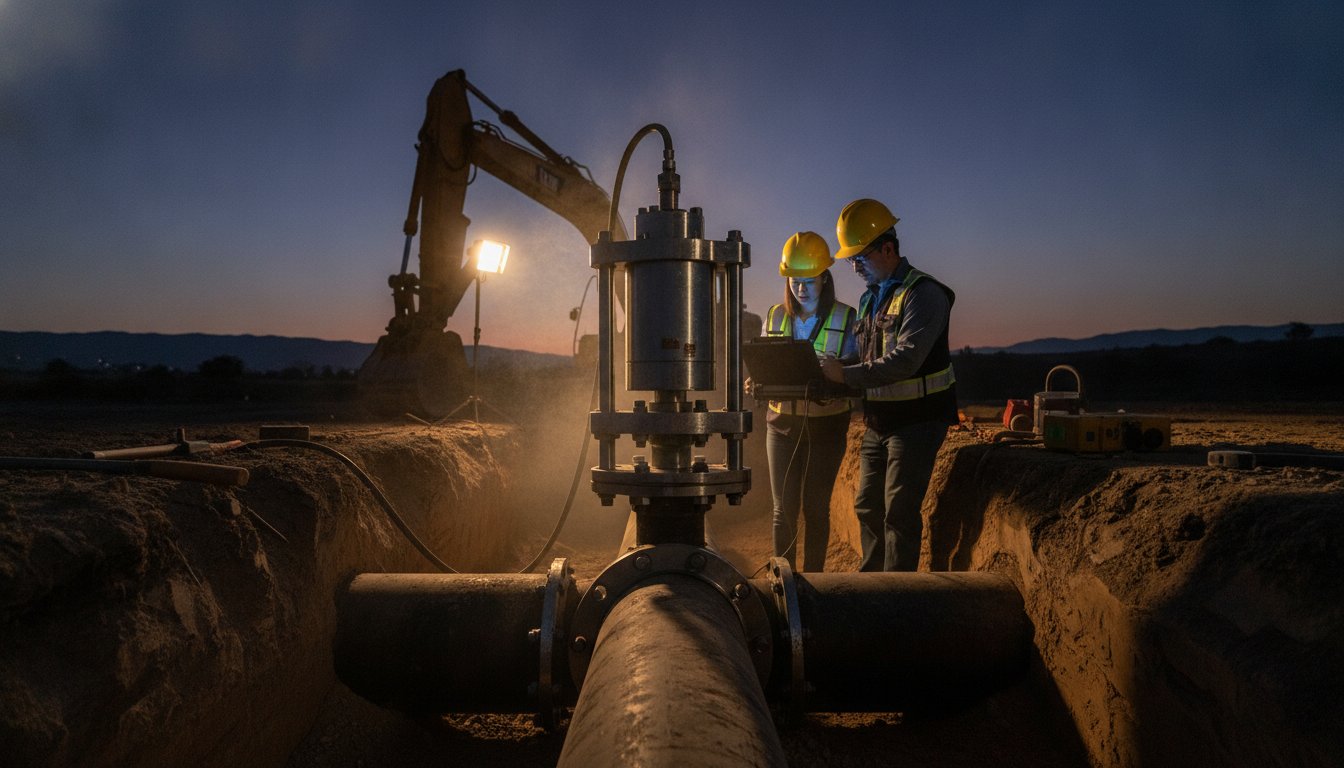
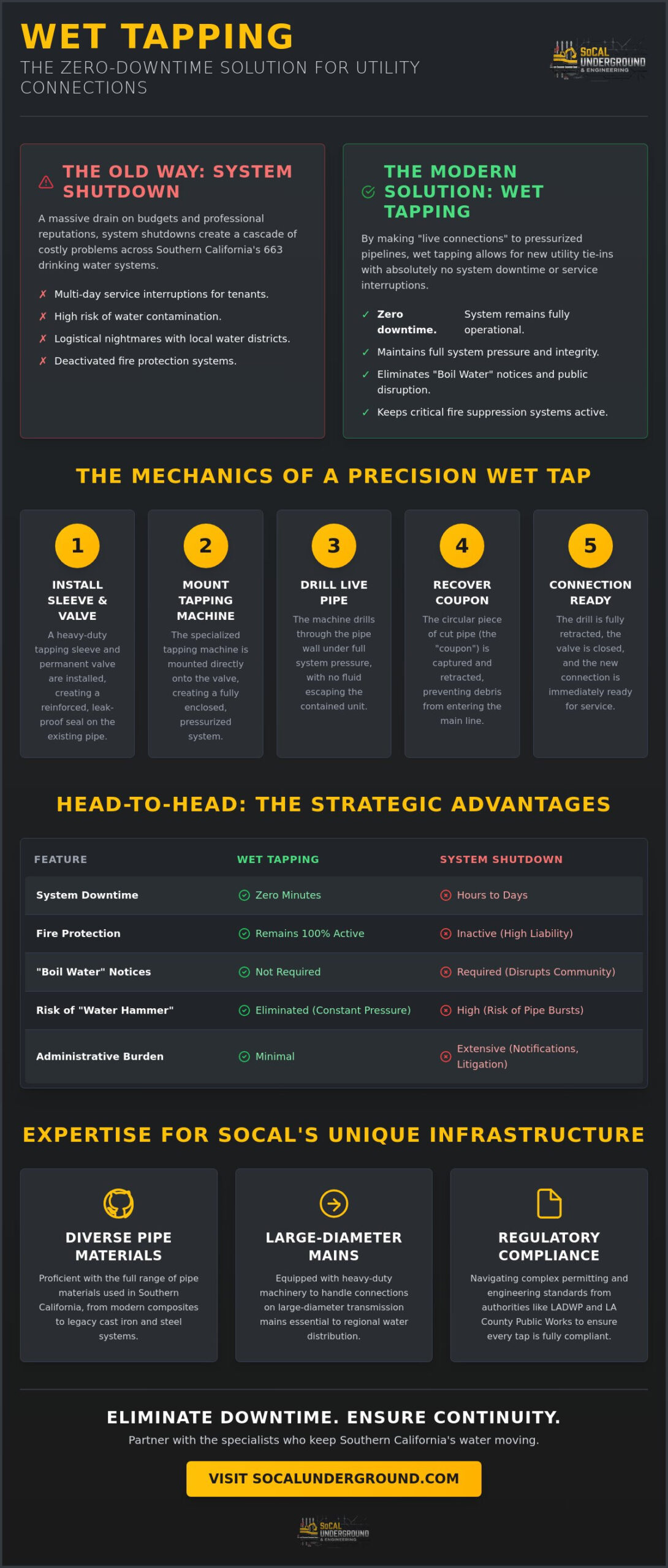
Precision is the only standard on the job site. The process begins with the installation of a heavy-duty tapping sleeve and a permanent valve. These components create a reinforced, leak-proof seal around the existing pipe. Once the valve is secured and pressure tested, the specialized tapping machine takes over. This machine operates as an enclosed system. It drills through the pipe wall while contained, ensuring no fluid escapes.
A critical step is the coupon recovery. The machine captures the circular piece of pipe wall, known as the coupon, and pulls it out through the valve. This prevents debris from entering the main line. Once the drill retracts, we close the valve and the new connection is ready for immediate service. It’s a clean, fast, and final solution for expanding infrastructure.
Wet Taps vs. Hot Taps: Key Differences
Terminology matters when you’re coordinating with water districts. In our field, “wet tap” is the industry standard term for water and sewer systems. It’s the bread and butter of municipal expansion and fire service installation. “Hot tap” usually describes work on high-temperature or hazardous lines like gas, steam, or chemicals. While the mechanics of a wet tap contractor Southern California might look similar to a gas-line hot tap, the safety regulations and material requirements are worlds apart. SoCal Underground and Engineering focuses on the water and sewer side of the industry. We handle the heavy-duty utility taps that keep the region’s water flowing without the risk of contamination or service loss.
The Strategic Advantages: Why Wet Tapping Beats System Shutdowns
Shutdowns are expensive failures of planning. When you hire a wet tap contractor Southern California, you’re buying continuity. System depressurization triggers “Boil Water” notices that disrupt entire communities and damage public trust. By maintaining live pressure, you eliminate the need for these notices and the subsequent testing required to clear them. You also keep fire protection systems active. A commercial building or industrial facility without water is a building without fire suppression. That’s a high-stakes liability no project manager wants on their watch.
Refilling a drained main is a high-risk operation. It introduces air pockets and turbulence that lead to “water hammer.” These sudden pressure surges often cause bursts in older, brittle pipes that were otherwise stable. Wet tapping keeps the pressure constant and predictable. It protects the structural integrity of the existing infrastructure while you expand it. Adhering to Southern California Water District Standards ensures that every tie-in is engineered for long-term stability rather than a temporary fix. It’s about doing the work once and doing it right.
Financial Impact and ROI for Developers
Every shutdown involves a mountain of administrative paperwork. You have to notify every tenant, resident, and business in the affected zone. That’s hours of labor before the first shovel hits the dirt. Then there’s the risk of litigation. If a restaurant or manufacturing plant loses a day of revenue because of a dry line, you’re on the hook. Wet tapping moves the project forward during standard shifts. You save on the premium labor rates associated with weekend or midnight shutdowns. It’s a faster, leaner way to manage underground utility construction without the administrative drag or the threat of service-loss claims.
Public Health and Sanitary Safety
Sanitary safety is a matter of physics. When a pipe stays pressurized, groundwater and contaminants can’t get in. As soon as pressure drops to zero, the risk of infiltration skyrockets. This is why hospitals, laboratories, and high-density residential zones demand live connections. We follow strict AWWA standards to ensure every tap is a clean, secure entry point. Maintaining positive pressure is the most effective way to prevent contamination. It’s a commitment to the health of the 1.3 million residents currently served by at-risk water systems in our region. A wet tap contractor Southern California provides a secure, leak-proof connection that honors the ethics of public safety. For property owners who want to ensure the highest quality at the point of use, you can learn more about Tradewinds Water Filtration and their residential contaminant removal systems.
Technical Capabilities: Pipe Materials and Sizing for SoCal Utilities
You can’t tap what you haven’t verified. Every successful connection begins with utility potholing or hydro excavation to expose the host pipe. We don’t rely on 50-year-old “as-built” drawings. We see the pipe, measure the outside diameter, and assess the structural integrity before any equipment is mounted. A wet tap contractor Southern California deals with a massive variety of infrastructure, from 1-inch service lines to large-diameter transmission mains. The process is a sequence of precision: verify the material, secure the fitting, and execute the cut.
Host pipe integrity is the foundation of the job. If the pipe is too brittle or corroded, it won’t support the weight of the tapping sleeve and valve. We use specialized sleeves designed to distribute the load and create a permanent, reinforced seal. This isn’t just about making a hole; it’s about leaving the system stronger than we found it. We match the equipment to the specific diameter and pressure of the line to ensure a clean, surgical tie-in every time.
Common Pipe Materials in Southern California
Infrastructure in this region is a mix of the old and the new. Ductile iron and cast iron require heavy-duty sleeves and cutters that can handle structural weight and external corrosion. For modern PVC (C900 or C905) lines, we prioritize precision. Too much torque or a dull bit can fracture the pipe wall. Then there’s Asbestos Cement (Transite). These legacy lines are common in older municipal grids. We use specialized safety protocols and slurry containment to handle Transite safely. We protect the crew, the environment, and the water supply during the entire operation.
Sizing and Custom Fittings
The job dictates the hardware. We handle size-on-size taps, where the branch is the same diameter as the main, and reduced-size connections for smaller service lines. Soil conditions drive our material choices. We use 304 or 316 stainless steel sleeves for corrosive SoCal soils and carbon steel for high-pressure industrial applications. Before the first cut is made, we perform a mandatory pressure test on the installed sleeve and valve. We prove the seal is leak-proof under actual operating conditions. Mount the sleeve. Test the seal. Drill the wall. That’s the rhythm of a professional tap.
Navigating Logistics: Southern California Water District Standards
Compliance isn’t optional. In Southern California, every water district maintains a specific set of standard drawings and approved materials lists. Whether you’re working within the jurisdiction of the Los Angeles Department of Water and Power (LADWP) or the San Diego Public Utilities Department, the technical requirements for a wet tap are rigid. A professional wet tap contractor Southern California doesn’t just show up with a machine. We show up with the exact stainless steel bolts, epoxy-coated valves, and reinforced sleeves mandated by the local inspector. Using a non-approved fitting is the fastest way to get a project red-tagged. We track the specific hardware requirements across water districts in Los Angeles, Orange, and San Diego Counties to ensure the work is final and compliant.
The role of the contractor extends beyond the trench. We coordinate directly with district inspectors to witness the mandatory pressure test and the final cut. This ensures the connection is documented and officially accepted into the municipal system. If you need a partner who understands the nuances of underground utility construction and local compliance, we are ready to move your project forward. We handle the technical heavy lifting so you can focus on the rest of the site development.
Permitting and Inspection Coordination
Approval timelines vary by agency. LADWP and LA County DPW often require weeks of lead time for plan checks and material submittals. You need a complete documentation package to get a permit issued. This includes traffic control plans for high-volume corridors, shoring plans for deep excavations, and detailed material submittals that match the district’s “approved” list. An experienced contractor anticipates these hurdles. We provide the data and the drawings required to keep the permit moving through the bureaucracy. Speed comes from preparation. We don’t guess; we verify.
Regional Soil and Environmental Factors
Southern California’s geography presents unique challenges for long-term utility health. Coastal regions in Orange County and San Diego deal with highly corrosive soils that can eat through standard fittings in years, not decades. In these zones, we prioritize 316 stainless steel hardware and specialized cathodic protection to prevent premature failure. Traffic management is the other half of the battle. Executing a wet tap on a busy Los Angeles thoroughfare requires a precise logistical dance between shoring, equipment placement, and lane closures. For deep excavations in unpredictable SoCal soils, partnering with an expert shoring systems contractor Southern California is essential to lock in site safety before the tapping machine ever touches the pipe. We manage the site so the utility tie-in stays on schedule without compromising public safety or district standards. With the region’s increased focus on the 2025 Urban Water Management Plans, efficient and leak-free connections are more critical than ever. Every project also demands strict adherence to Cal/OSHA excavation standards; understanding the full scope of utility trenching contractor California requirements ensures your crew and your schedule are protected from the first dig to the final backfill.
Partnering with SoCal Underground and Engineering for Specialized Utility Taps
Reliability isn’t something you find in a brochure. It’s built in the trench. SoCal Underground and Engineering operates with a rugged, industrial focus that prioritizes professional accountability over flowery promises. We’re a straight-shooting partner for developers and public works managers who need a wet tap contractor Southern California they can trust with a handshake. We don’t just perform the tap; we manage the entire logistical flow of the engineering project. Our team is available at all hours to handle emergency utility repairs and critical tie-ins that can’t wait for Monday morning. We bring a seasoned expert’s eye to every job site, ensuring that the physical work is backed by moral character and structural soundness.
Integrity is the internal compass that guides our work. When we take on a project, we view it as a professional commitment to be honored. This means we’re present on the site, transparent about our output, and focused on finality. In a region where spending on drinking water infrastructure has decreased by 38% since 2010, we provide the dependable, localized expertise required to keep systems running. We don’t sit behind a desk while your project stalls. We’re active and present, delivering a full lifecycle of service that moves rapidly from the initial inquiry to the final result. Every project is a commitment to the local landscape and the residents we serve.
The SoCal Underground and Engineering Lifecycle
We lead the reader through a logical progression of capability, process, and proof. Our rhythm is fast-paced and efficient. We eliminate wasted space and filler by moving directly through three critical phases of utility delivery. This mirrors the logistical flow of a high-stakes engineering project where every step must be purposeful and timely.
- Phase 1: Precision Site Assessment. We utilize hydro excavation to pothole and verify the host pipe. This eliminates the risk of utility strikes and ensures the material condition is sound before the tap begins.
- Phase 2: Live Utility Execution. We perform the wet tap with zero system downtime. Our crews mount the sleeve, test the seal, and execute the cut while maintaining full system pressure for all tenants and residents.
- Phase 3: Final Site Restoration. We don’t leave a project unfinished. Our team handles the street restoration, including ADA-compliant concrete flatwork and high-quality asphalt paving to return the site to service.
Contact Us for Southern California Wet Tapping
You need a partner who values structural soundness and professional ethics. We provide direct access to project managers for rapid bidding and scheduling across LA County, Orange County, Riverside, and San Diego. Our 24/7 emergency response ensures that critical utility failures are addressed before they become catastrophic. We take pride in the quality of our output and the finality of our results. It’s about honesty, firmness, and a deep-rooted sense of reliability on every job site.
Request a Quote for Your Wet Tap Project
Secure Your Infrastructure with Precision Tie-Ins
Wet tapping is the only way to expand Southern California’s utility grid without paralyzing service. It eliminates the financial drain of shutdowns. It prevents groundwater contamination. It protects the structural integrity of aging lines. You get a secure connection that honors local regulations and keeps your project moving on schedule. Partnering with a proven wet tap contractor Southern California means your tie-in is handled with industrial-grade precision from the first pothole to the final asphalt patch.
We provide 24/7 Emergency Response for critical failures that can’t wait. Our team delivers full-service civil engineering and complete site restoration to leave every job site better than we found it. We’re the licensed and insured specialist ready to stand behind every handshake and every cut. Don’t risk a system-wide failure on a traditional cut-in. Choose the live connection that preserves your budget and your reputation.
Get a Professional Wet Tap Quote Today
Your infrastructure is our commitment. Let’s build something solid.
Frequently Asked Questions
What is the maximum pipe size you can perform a wet tap on?
We handle diameters ranging from 1-inch service lines up to large-diameter transmission mains. The specific limit usually depends on the host pipe material and the availability of specialized tapping sleeves. We match our heavy-duty machinery to the exact dimensions of your infrastructure to ensure a secure, permanent connection.
How long does a typical wet tap procedure take to complete?
A standard wet tap typically takes four to eight hours once the pipe is exposed and the site is prepped. This window includes mounting the sleeve, performing the mandatory pressure test, and executing the final cut. Larger diameter mains or legacy materials like cast iron may require more time for precision drilling and coupon recovery.
Is a system shutdown ever required for a wet tap?
No, a system shutdown is never required. The core objective of this process is to maintain full operating pressure and service continuity. We create a live connection that keeps water moving to tenants and businesses. You avoid the logistical nightmare of notifying customers or issuing “Boil Water” notices.
Do you provide traffic control and shoring for the tap location?
Yes, we provide full-service site management including traffic control and engineered shoring systems. We handle the entire footprint of the job. This includes managing lane closures on busy Los Angeles thoroughfares and ensuring deep excavations meet all safety standards before our crews begin the tapping process.
Can you perform wet taps on older asbestos cement (Transite) pipes?
We perform wet taps on Transite pipes using specialized safety protocols and slurry containment systems. These legacy lines are common in older municipal grids across the region. As an experienced wet tap contractor Southern California, we use specific cutters designed to prevent fiber release and host pipe fracturing.
What local Southern California water districts do you work with?
We coordinate with all major regional agencies, including LADWP, LA County Public Works, and the San Bernardino Water Department. We also handle compliance for water authorities in Orange County and San Diego. We ensure every sleeve, valve, and bolt meets the specific “approved materials list” for your district.
Is wet tapping more expensive than a traditional dry cut-in?
Wet tapping is often the more profitable choice when you calculate total project costs. While the specialized equipment carries a higher mobilization cost, you save by eliminating system-wide shutdowns and administrative labor. You avoid the premium rates of weekend shifts and the litigation risks associated with service loss.
What information do I need to provide for a wet tap quote?
We need the host pipe material, the outside diameter of the main, and the desired branch size. You should also provide the operating pressure of the line and the burial depth. Giving a wet tap contractor Southern California these technical specs allows us to bid the project with precision and speed.