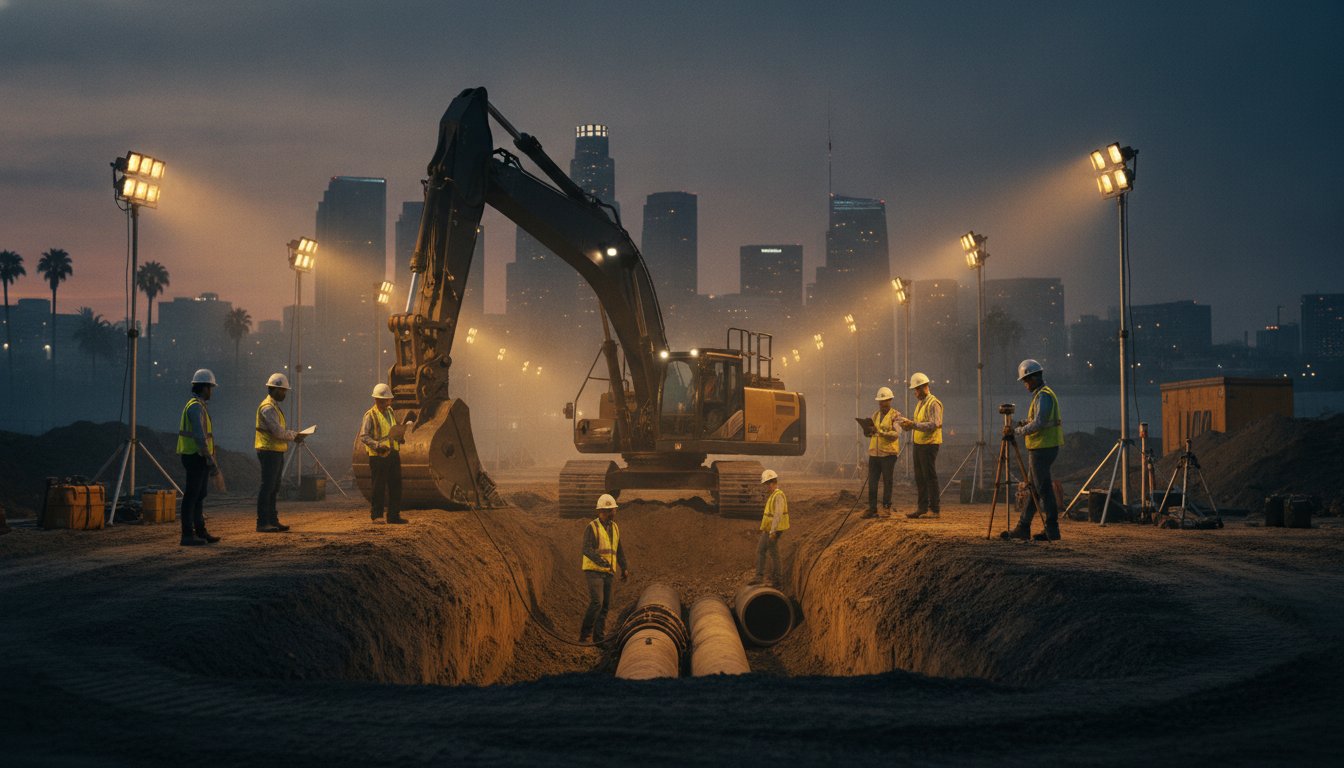
One wrong bucket depth can bankrupt a project. In Southern California, the margin for error is zero. The subterranean landscape of Los Angeles and San Diego is a complex grid of aging pipes and high-voltage lines. Professional underground utility contractors don’t just dig; they navigate a high-stakes environment where precision is the only protection against disaster.
It’s frustrating to face the constant threat of hitting unmarked lines or getting buried in regulatory paperwork. You want results, not excuses or delays. This guide helps you master the essentials of Southern California infrastructure, from critical water and sewer systems to the advanced engineering required for modern civil work. We provide the technical clarity needed to manage high-stakes projects with total confidence.
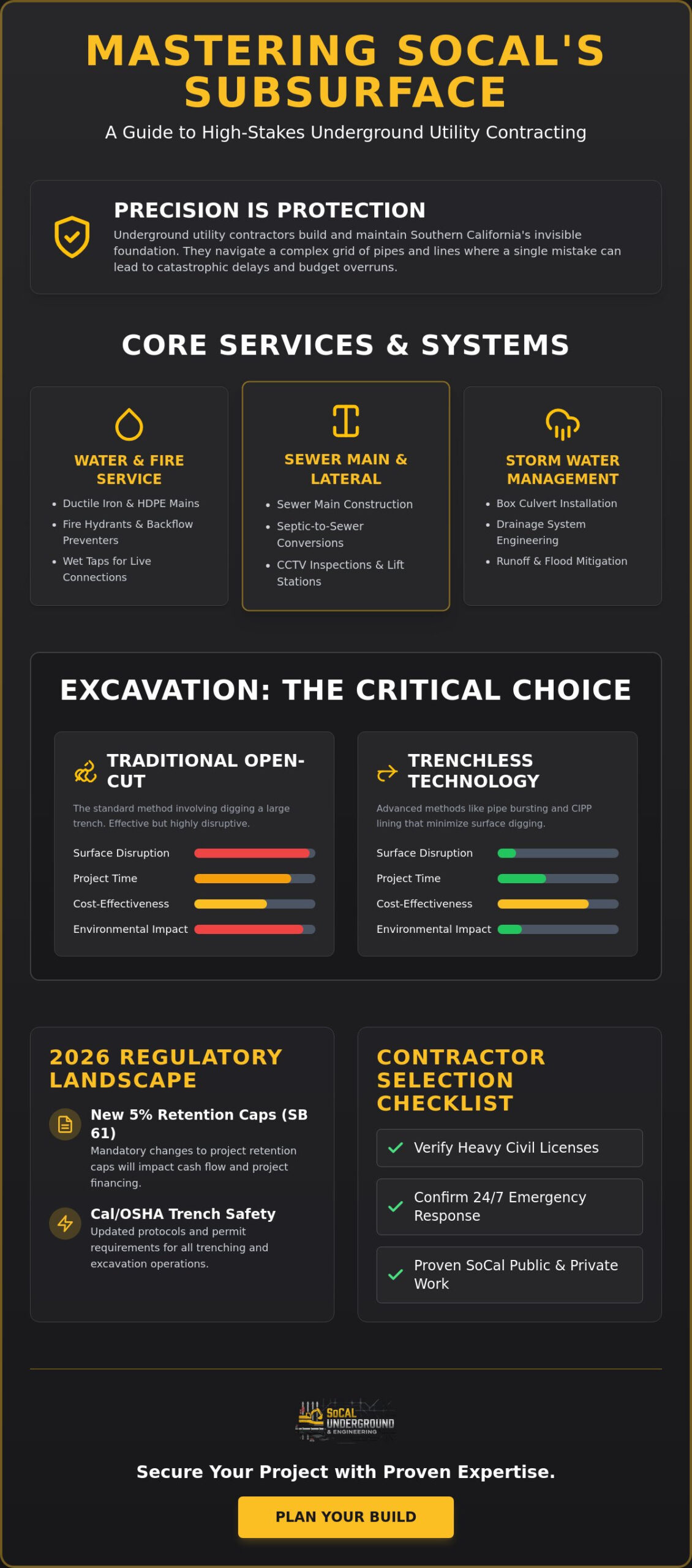
We will examine the cost-saving benefits of trenchless technology versus traditional open-cut methods. You will also get a clear breakdown of the 2026 regulatory changes, including the new 5% retention caps under SB 61 and Cal/OSHA’s latest trench safety protocols. Plan the work. Execute the build. Secure the site.
Key Takeaways
- Define the specialized scope of underground utility contractors in maintaining Southern California’s critical water, sewer, and storm drain infrastructure.
- Master the technical choice between traditional open-cut excavation and modern trenchless innovations like pipe bursting and CIPP lining.
- Navigate the 2026 regulatory landscape, including new Cal/OSHA trench safety permits and mandatory project retention caps.
- Secure reliable project outcomes by verifying heavy civil licenses and 24/7 emergency response capabilities for high-stakes civil work.
What is an Underground Utility Contractor?
Underground utility contractors are specialized civil engineering firms. They don’t just move dirt; they build and maintain the subsurface life-support systems that keep a city functional. This work involves the installation of water mains, sewer laterals, storm drains, and electrical conduits. It’s the invisible foundation of every site development project and municipal infrastructure improvement in Southern California. If these systems fail, the buildings above them become uninhabitable. It’s that simple.
This phase of construction is the most high-stakes part of any project. Once the concrete is poured and the asphalt is laid, the utility network is locked in place. Mistakes aren’t just expensive to fix; they’re catastrophic. A single miscalculation in pipe grade or a failure to properly shore a trench can lead to massive delays, safety violations, and budget overruns. Success requires a deep understanding of What is a Public Utility and how these complex systems must integrate with the existing local grid. Survey the site. Trench the earth. Lay the line. There’s no room for guesswork.
The Role of Civil Engineering in Utility Work
Utility work requires far more than just a backhoe and an operator. It demands precision engineering. Precision grading is the difference between a sewer system that flows by gravity and one that backs up into a basement. Every inch of slope matters. Professional underground utility contractors must also master utility coordination. This starts with the “811” Call Before You Dig system to locate existing gas, electric, and fiber optic lines. Striking an unmarked line isn’t an option. Beyond the trench, contractors must manage complex traffic control. Public works construction often happens in the middle of busy Los Angeles or San Diego thoroughfares. You have to keep the crew safe while keeping the city moving.
Public vs. Private Utility Infrastructure
Understanding the boundary between public and private infrastructure is critical for any developer or property owner. Municipal water mains and sewer trunks follow strict standards set by bodies like LA County Public Works or local water districts. These systems are the responsibility of the city, but the connection point is where the rules change. Private commercial laterals must meet specific codes but are maintained by the property owner. Professional contractors navigate these regulatory webs daily. They know where the city’s responsibility ends and yours begins. They ensure every connection, from a fire service line to a grease interceptor, meets the exact specifications required by the governing agency. Verify the code. Secure the permit. Execute the build.
Core Services: Water, Sewer, and Storm Drain Systems
Wet utilities are the lifeblood of any property. Underground utility contractors handle the heavy engineering required to move water, waste, and runoff through a site with total reliability. This isn’t just about moving pipes; it’s about managing pressure, gravity, and structural integrity. Whether it’s a new water main or complex sewer main construction, the work must be flawless. One leak can undermine a foundation. One backflow can shut down a city block. We build systems that last decades, not years.
Water and Fire Service Installation
Reliable water supply starts with the right material choice. We deploy ductile iron or HDPE systems depending on the soil conditions and pressure requirements of the project. For commercial developments, fire safety compliance is a non-negotiable priority. This involves installing dedicated fire lines, hydrants, and backflow preventers to protect the public supply from contamination. Specialty services like wet taps are essential in these environments. They allow us to connect new services to existing mains without shutting down water to the surrounding neighborhood. It’s surgical. It’s efficient. It keeps the project moving without community disruption. For a deeper look at the engineering standards and material specifications behind these systems, review our professional guide to water main installation contractor SoCal work, covering everything from ductile iron selection to live hot tap procedures.
Sewer Main and Lateral Expertise
Sewer work is high-stakes. We manage everything from large-scale sewer main construction to individual lateral installations and septic to sewer conversion Southern California projects that require heavy civil engineering, precision utility coordination, and full surface restoration. In areas with challenging topography, lift station piping is the only way to manage wastewater effectively. It requires precise pumps and gravity-defying engineering. To ensure longevity, we utilize CCTV sewer inspections as a standard practice. This technology identifies structural failures or root intrusions before they turn into a midnight emergency. If you are dealing with aging systems, professional sewer line replacement is the only way to prevent catastrophic surface damage and environmental hazards.
Storm Water Management and Box Culverts
Southern California rain events are infrequent but intense. Without proper drainage, your asphalt and concrete surfaces will fail rapidly. Box culvert installation is the heavy-duty answer for regional flood control. These massive concrete structures move high volumes of water away from critical infrastructure during storms. We also install catch basins and storm drains to manage localized runoff. All work must adhere to strict Underground Construction Safety Standards to protect the crew and the public during these deep excavations. Proper drainage preserves your site. It prevents erosion. It secures the build.
Specialty Engineering: Hydro Excavation
Traditional digging isn’t always the smartest answer. In dense utility corridors, hydro excavation is a technical necessity. We use high-pressure water and industrial vacuums to expose existing lines without the risk of mechanical strikes. It’s the safest way to pothole or excavate around sensitive fiber optics and high-voltage gas mains. Precision is the priority. Efficiency is the result. This “boots-on-the-ground” expertise ensures that even the most complex utility grids are navigated without incident.
Traditional Excavation vs. Trenchless Technology
Underground utility contractors face a critical choice on every job site: tear up the surface or work beneath it. Traditional open-cut excavation involves digging a continuous trench to install or repair lines. It’s the standard for new site development where the surface is already clear. However, in developed areas of Southern California, trenchless technology is now a primary solution. These methods can reduce project costs by 30% to 50% compared to traditional excavation by eliminating the need for massive surface restoration. Survey the ground. Select the tech. Get it done.
Innovation in this sector is moving fast. The global trenchless pipe rehabilitation market is expected to reach $5.38 billion in 2026. This growth is driven by the need to fix aging infrastructure without shutting down cities. Cured-In-Place Pipe (CIPP) lining is a leading “pipe within a pipe” solution. It uses resin-saturated felt tubes to create a new, seamless interior for existing lines. It’s the most efficient way to restore sewer systems under parking lots or sidewalks without disturbing the asphalt above.
When to Choose Trenchless Solutions
Trenchless isn’t a universal fix. If a pipe has collapsed entirely or has severe offsets, traditional excavation remains the only safe path. Open-cut is also preferred for shallow repairs where surface restoration is cheap and fast. However, pipe bursting is the preferred method for upsizing utility capacity. We pull a heavy-duty bursting head through the old line, shattering it while simultaneously pulling a new, larger HDPE pipe into the same path. It increases flow without the massive footprint of a deep trench. Analyze the site. Evaluate the soil. Deploy the right tech.
Precision Excavation and HydroVac
Safety in high-density utility corridors requires more than just a backhoe. Hydro excavation uses high-pressure water to liquefy soil, which is then removed by an industrial vacuum. This process, often called “potholing” or daylighting, allows us to visually confirm the location of existing utilities without the risk of a mechanical strike. It’s surgical and non-destructive.
For any trench deeper than five feet, strict adherence to OSHA’s Specific Excavation Requirements is mandatory. This includes utilizing engineered shoring or shielding systems to prevent cave-ins. In California, you must obtain a Cal/OSHA permit for any excavation five feet or deeper, which currently carries a $50.00 fee. We keep spoil piles at least two feet from the edge of the trench to maintain site stability. Don’t gamble with worker safety or project liability. Secure the trench. Protect the crew. Honor the commitment.
Critical Selection Criteria for SoCal Projects
Choosing the right partner for subterranean work is a decision that defines the project’s risk profile. In Southern California, the stakes are higher due to dense urban grids and strict environmental codes. You need underground utility contractors who bring more than just heavy machinery to the site. You need a firm that understands the specific seismic engineering requirements of the region. This means utilizing more steel and specialized concrete mixes to ensure infrastructure survives the next major shift. Verify the license. Inspect the gear. Confirm the bond. Don’t settle for a desk-bound firm when you need a site-present expert.
Accountability is the bedrock of civil work. Effective January 1, 2026, California’s SB 61 mandates a 5% cap on retention for most private construction contracts. Your contractor must be financially stable enough to operate within these new liquidity standards. Furthermore, as of July 1, 2026, CSLB fines for unlicensed activity start at $1,500. Hiring a cut-rate, unlicensed outfit isn’t just a safety risk; it’s a legal liability that can shut your project down instantly. Look for a team that offers 24/7 emergency response. If a water main breaks at 2:00 AM, you don’t need a voicemail. You need boots on the ground.
Regulatory and Safety Compliance
Street restoration is where many utility projects fail the final inspection. If you tear up a sidewalk to repair a sewer lateral, the replacement must meet current ADA standards. This often requires new ADA ramps and precise curb and gutter work to satisfy municipal inspectors in Los Angeles or San Diego. Safety is equally rigid. Cal/OSHA requires a $50.00 permit for any trench five feet or deeper. For high-stakes civil work, partner with a proven underground contractor who manages the entire lifecycle of the project, from the initial excavation to the final asphalt patch.
The “Straight-Shooter” Evaluation
Past performance on municipal infrastructure improvements is the best indicator of future success. You need a contractor who provides a “handshake” level of accountability. This means they own the results of the work, from the precision of the utility trenching to the quality of the slurry backfill. A single-source provider is always the superior choice. When one firm handles the underground installation and the subsequent asphalt paving, you eliminate the finger-pointing that happens between separate subcontractors. It streamlines the schedule. It reduces the overhead. It ensures the job is done right the first time. Beyond the underground work, surface durability is equally critical; working with an experienced concrete flatwork contractor in Southern California ensures your commercial slabs and site surfaces are engineered to withstand seismic demands and high-traffic loads. Plan the build. Execute the trench. Restore the surface.
Partnering with SoCal Underground and Engineering for Reliable Results
SoCal Underground and Engineering isn’t a desk-bound consultancy. We are active, present, and accountable on every job site. As specialized underground utility contractors, we bridge the gap between complex engineering blueprints and physical execution. We integrate heavy engineering with localized site development to ensure your infrastructure is built to last. Our team doesn’t just deliver a service; we deliver a commitment to structural soundness and professional ethics. We own the results. We honor the handshake. We get the job done right.
Comprehensive Utility and Civil Solutions
Our capabilities extend from the bottom of the trench to the final surface finish. We provide full-lifecycle solutions, including design-build services, utility relocations, and final asphalt striping. As seasoned underground utility contractors, we maintain a specialized fleet designed for peak performance in the high-stakes environment of LA, Orange, and San Diego Counties. We utilize HydroVac trucks for non-destructive excavation, CIPP equipment for trenchless pipe lining, and heavy excavators for deep civil work. This regional focus matters because we understand the specific soil conditions and municipal codes of the SoCal landscape. We know the local inspectors. We know the specific regulations. We know the ground. From ADA ramps to box culverts, we handle the entire scope of work under one roof. We manage the logistics. We execute the build. We restore the site.
Get Started with Your Infrastructure Project
Successful projects begin with accurate data, not guesses. We recommend an initial visual infrastructure audit or a CCTV sewer inspection to identify the exact state of your subsurface lines. This prevents costly surprises, mid-project delays, and budget overruns once the digging starts. We provide firm, transparent quotes for commercial, industrial, and municipal needs. You get the facts, the timeline, and the price without the fluff. Stop worrying about unmarked lines or regulatory delays. Put your project in the hands of seasoned experts who value integrity above all else and take pride in their output. Contact SoCal Underground and Engineering for your next utility project. Plan the build. Secure the site. Finalize the project.
Secure Your Subsurface Infrastructure
Subterranean work is the foundation of every successful build. You now understand the technical divide between open-cut excavation and trenchless innovation. You know that navigating local seismic codes and the shifting regulatory landscape requires more than just a shovel. Professional underground utility contractors provide the precision engineering needed to keep water flowing and waste moving without surface catastrophe. Mistakes underground are too expensive to ignore.
We bring a 24/7 emergency response team to every project. Our expertise covers the full spectrum of traditional and trenchless technologies. We provide complete civil engineering and surface improvement capabilities to ensure your site is restored to standard. Don’t leave your infrastructure to chance. Partner with a team that values a handshake and delivers results. Request a Consultation for Your Underground Utility Project. Build with confidence. Protect your investment. Let’s get to work.
Frequently Asked Questions
What is the difference between a plumber and an underground utility contractor?
Plumbers typically handle interior fixtures and small diameter lines within a building’s footprint. Underground utility contractors manage heavy civil infrastructure, municipal mains, and large-scale site development. We operate in the public right-of-way and handle deep excavations that require engineered shoring and heavy machinery. If the project involves a city main or a complex commercial lateral, you need a civil specialist. For those who need assistance with the building’s internal systems, you can discover Miami 305 Plumbing for 24/7 residential and commercial support. We own the street. Plumbers own the sink.
How long does a typical sewer line replacement take in Southern California?
Timeline depends entirely on the method and depth of the line. Trenchless pipe bursting or CIPP lining often finishes in one to two days with minimal surface disruption. Traditional open-cut excavation can take five to seven days depending on the complexity of the shoring and the extent of the surface restoration. Deep sewer mains in dense urban areas require more time for traffic control. We prioritize speed without sacrificing structural soundness. Survey. Excavate. Restore.
Do I need a permit for underground utility repair on my commercial property?
Commercial repairs almost always require a permit. Most Southern California cities demand encroachment or excavation permits for any work affecting public easements or right-of-ways. Additionally, Cal/OSHA requires a specific permit for any trench five feet or deeper. Professional underground utility contractors manage these filings to ensure the project remains compliant. Skipping the permit leads to work-stop orders and heavy civil penalties. Get the permit. Secure the site. Execute the build.
What is trenchless pipe bursting and is it cheaper than digging?
Trenchless pipe bursting breaks the existing pipe while pulling a new HDPE line into its place. It’s often the most cost-effective choice for commercial properties. While the specialized equipment has a higher daily rate, you save 30% to 50% on total project costs by avoiding massive asphalt and concrete restoration. You get a new, larger pipe without destroying your parking lot. It’s the smart move for aging infrastructure. Save the surface. Secure the line.
How can I prevent my new asphalt from being cut for utility repairs?
Utilize trenchless methods to keep your new surfaces intact. Cured-In-Place Pipe (CIPP) lining and pipe bursting allow us to rehabilitate or replace lines through existing access points like manholes or small entry pits. This eliminates the need for long, continuous trenches across your property. If you’ve recently invested in new paving, trenchless is the only way to protect that capital improvement while securing your utilities. Preserve the lot. Protect the build.
What happens during a 24/7 emergency utility repair call?
We dispatch a crew immediately to stabilize the failure and prevent further property damage. The process starts with site isolation and utility locating to ensure safety. We then utilize CCTV inspections or hydro excavation to identify the exact failure point. Once the break is found, we execute the repair, backfill the trench, and restore the surface. Our team is available at all hours. We don’t wait for morning. Dispatch. Stabilize. Repair.
Why is hydro excavation safer than traditional digging for utility potholing?
Hydro excavation uses high-pressure water and an industrial vacuum to remove soil. Traditional backhoes use metal buckets that can easily crush gas lines or fiber optics during the digging process. HydroVac is non-destructive and surgical. It’s the only safe way to pothole or daylight utilities in high-density areas where the margin for error is zero. Water doesn’t break pipes. Metal does. Secure the line. Protect the crew.
How does SoCal Underground and Engineering handle ADA compliance during street restoration?
ADA compliance is a mandatory part of our street restoration process. If a utility repair requires us to tear up a sidewalk or curb, we replace it according to current accessibility standards. This includes installing compliant ramps, cross gutters, and truncated domes. We handle the entire scope from the underground pipe to the final concrete finish. For commercial sites where surface durability is paramount, our expertise as a concrete flatwork contractor serving Southern California ensures every restored surface meets both ADA requirements and the structural demands of the local seismic environment. We ensure the work passes municipal inspection every time. Build it right. Finish it clean. Pass the audit.