A single trench failure in Southern California doesn’t just halt production. It can trigger CAL/OSHA penalties and legal liabilities that bury your project’s profitability before the first pipe is laid. You understand that the ground beneath your feet is unpredictable. One day you’re dealing with shifting coastal sand; the next, you’re fighting expansive clay that exerts massive lateral pressure on your excavation. It’s a high-stakes environment where compliance isn’t optional. Selecting an expert shoring systems contractor Southern California is the only way to lock in site safety and protect your bottom line.
We know you’re focused on hitting deadlines and managing tight margins, especially with new 2026 laws capping retention at 5% on private projects. This guide provides the technical and regulatory essentials you need to master shoring systems for your next underground utility project. You’ll learn how to navigate the latest CSLB enforcement standards, select the right protection for specific soil conditions, and ensure every utility installation is executed without the risk of a cave-in. Let’s get to work on securing your site.
Key Takeaways
- Identify the structural role of shoring in preventing soil movement and ensuring the total integrity of your underground work site.
- Evaluate the performance of soldier piles, trench boxes, and hydraulic bracing to select the right tool for your specific excavation depth.
- Master CAL/OSHA trenching standards and the legal requirements for excavations exceeding five feet to ensure full regulatory compliance.
- Learn how Southern California soil classifications and groundwater levels directly influence your choice of shoring systems contractor Southern California.
- Streamline your project lifecycle by integrating shoring and utility installation into a single, efficient workflow that prevents delays and cave-ins.
Understanding Shoring Systems in Southern California Infrastructure
Ground moves. It’s a fact of physics. Shoring is the specialized engineering practice of providing temporary or permanent structural support to an excavation. In the heavy civil sector, this isn’t just a safety checkbox. It’s a foundational requirement. As a leading shoring systems contractor Southern California, we know the stakes. A trench collapse isn’t just a line item delay. It’s a catastrophe. We prevent soil movement. We protect crews. We ensure structural integrity.
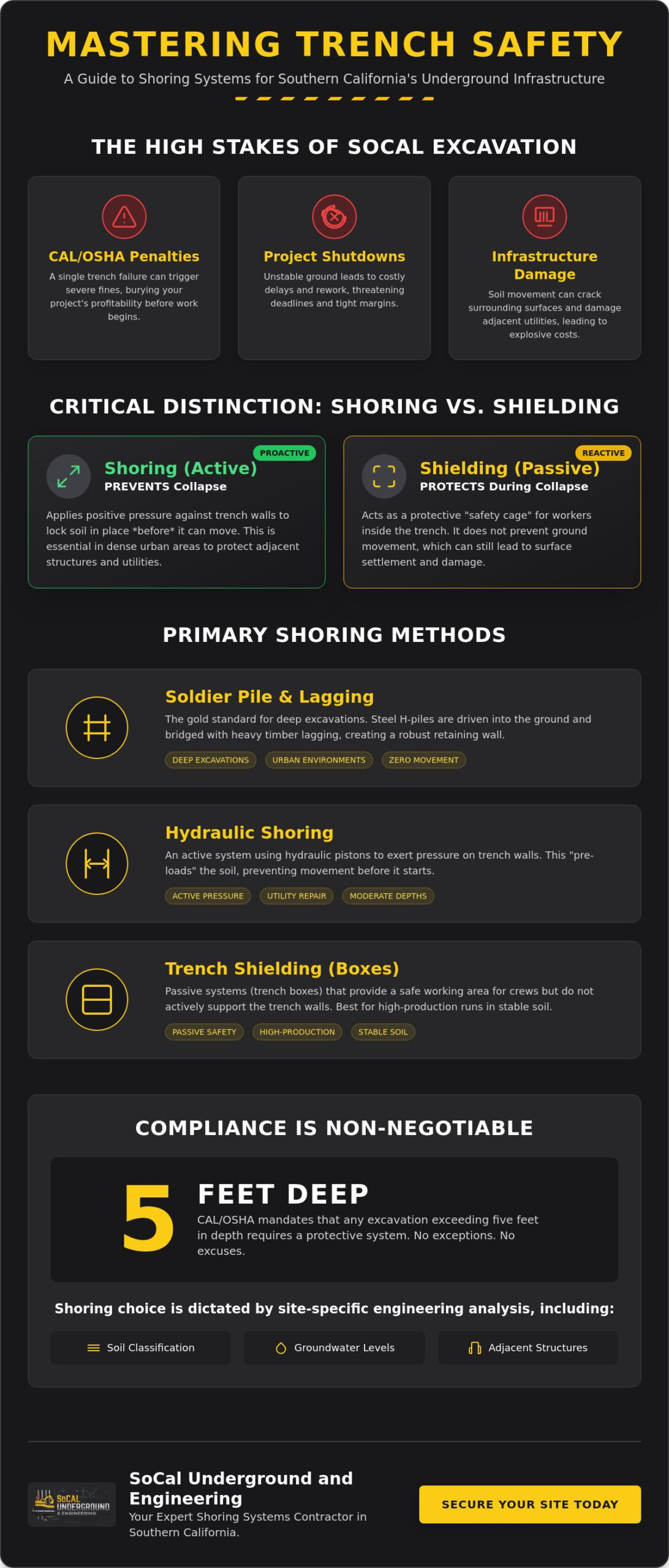
Urban density in markets like Los Angeles and San Diego changes the engineering math. You’re rarely digging in an open field. You’re working inches away from high-pressure gas lines, fiber-optic cables, and multi-story foundations. Active shoring systems apply positive pressure against the soil to keep it locked in place. This differs from shielding. Shielding provides a passive safety cage for workers but allows the ground to shift outside the box. If the ground shifts, the street sinks. If the street sinks, your project costs explode. No excuses. Just results.
The Purpose of Earth Retention Systems
Earth retention systems serve a singular goal: total site control. During deep sewer main construction or manhole installations, the lateral pressure from the surrounding earth is immense. We use heavy-duty systems to counteract this force. This protects workers from the weight of thousands of pounds of soil. It also shields existing underground infrastructure from damage. By maintaining the stability of the trench walls, we protect the surrounding asphalt and concrete surfaces from cracking or settling. Secure the ground. Protect the assets. Finish the job.
Temporary vs. Permanent Shoring Solutions
The choice between temporary and permanent systems depends on the project’s final objective. Temporary shoring is the workhorse of utility repair, pipe bursting, and sewer lateral installation. These systems provide immediate safety and are removed once the utility is secured and the slurry backfill is placed. Permanent shoring is required for massive infrastructure projects. Box culvert installations, lift stations, and deep foundations demand long-term stability. These systems are engineered to withstand soil loads for decades. They become part of the finished structure. We evaluate the soil classification, the depth of the cut, and the proximity of other structures to determine the right path. Every reputable shoring systems contractor Southern California must account for these variables before the first bucket hits the dirt.
Primary Shoring Methods: Soldier Piles, Trench Boxes, and Hydraulic Bracing
One size does not fit all in the dirt. You choose the system based on depth, soil classification, and site constraints. A professional shoring systems contractor Southern California uses a specific arsenal of equipment to keep the trench open and the crew safe. We don’t guess. We calculate. We execute. Whether you are installing a 48-inch sewer main or a standard water lateral, the method dictates the safety margin. Referencing the Caltrans Trenching and Shoring Manual ensures every calculation meets state-mandated safety thresholds for heavy civil projects.
Soldier Pile and Lagging Systems
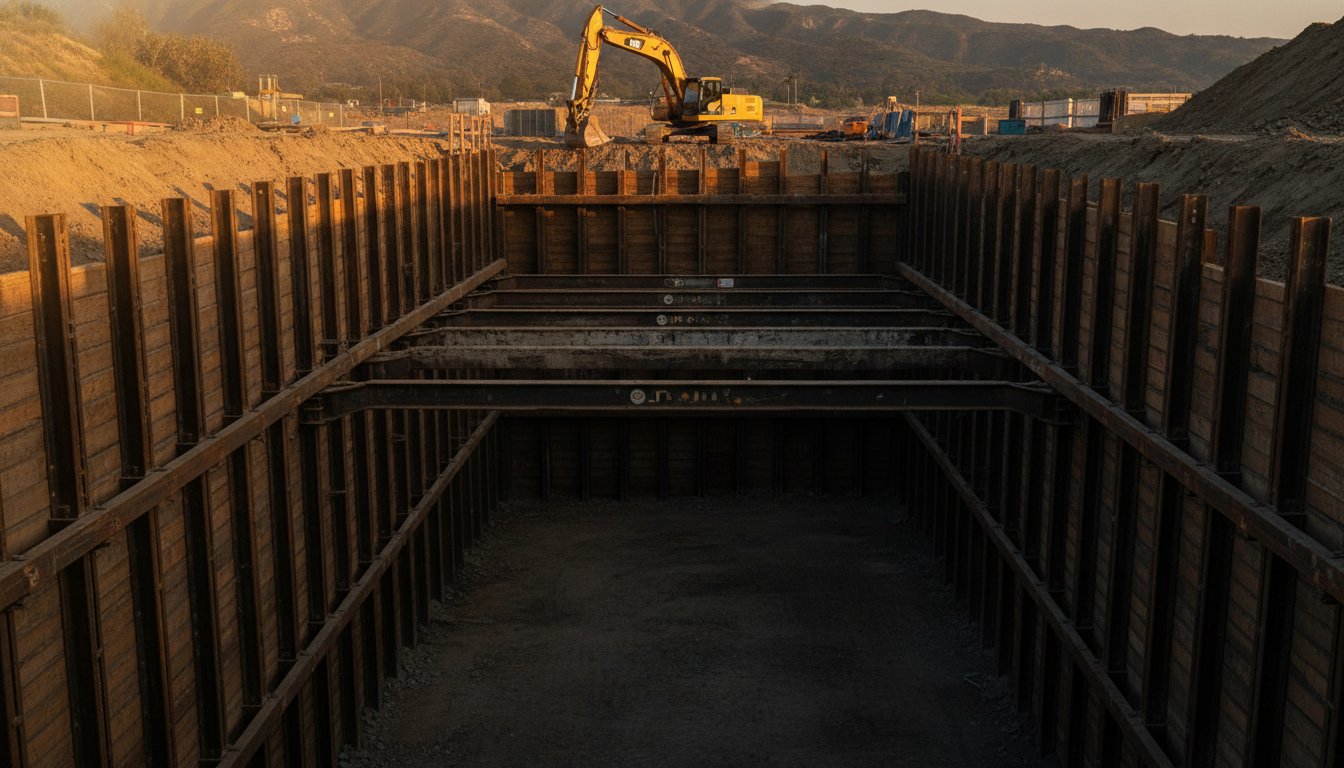
Soldier pile and lagging systems are the backbone of deep civil work. We drive steel H-piles into the ground at regular intervals. We bridge the gaps with heavy timber lagging. We secure the structure with tiebacks or internal rakers if the depth demands it. This is the heavy-duty choice for deep excavations where lateral movement must be zero. It is ideal for large-scale sewer main construction in LA County. This method requires precision caisson drilling and rigorous engineering. Drill. Set. Secure. It is the gold standard for high-stakes urban environments.
Trench Shielding and Hydraulic Bracing
Trench boxes provide rapid shielding for high-production utility runs. These are passive systems. They don’t stop the ground from moving; they protect workers if it does. For active protection, we use hydraulic shoring. Hydraulic pistons provide active pressure against the trench walls to prevent soil movement before it starts.
- Active Pressure: Hydraulic cylinders “pre-load” the soil to prevent cave-ins.
- Portability: Aluminum trench shields are lightweight and essential for emergency water repairs.
- Limitations: Shielding alone is often insufficient in Type C soil conditions, such as saturated coastal sand, where active support is mandatory.
Slide rail systems offer a modular alternative to traditional sheet piling. They eliminate the heavy vibrations that can damage neighboring foundations. This is the surgical approach to heavy excavation. If you’re planning a complex dig in a congested area, our heavy duty engineering services can help you select the most efficient method for your specific site. Every shoring systems contractor Southern California must know when to switch from a simple box to a complex engineered system. We make that call based on the data, not a hunch.
Compliance and Safety: Navigating CAL/OSHA Trenching Standards
Safety on a Southern California job site isn’t a suggestion. It’s a legal mandate. Every shoring systems contractor Southern California must answer to CAL/OSHA Title 8. While federal OSHA standards provide a baseline, California sets a higher bar. The most critical regulation is the five-foot rule. If your trench is five feet deep or more, a protective system is mandatory. No shortcuts. No “quick looks.” Secure the ground or face the consequences. This isn’t just about avoiding a fine; it’s about returning every crew member home at the end of the shift. For a comprehensive breakdown of how these regulations apply across every phase of excavation work, the professional guide to utility trenching in California covers 811 DigAlert protocols, CAL/OSHA shoring requirements, and precision site management in detail.
Site safety depends on the “Competent Person.” This individual isn’t just an observer. They possess the technical knowledge to identify soil hazards and the absolute authority to stop production. They perform daily inspections. They check for tension cracks. They verify the integrity of hydraulic braces. If conditions change, due to rain, vibration, or surcharging, the Competent Person re-evaluates the site. Inspect. Verify. Authorize. This cycle repeats before every shift to maintain a zero-incident environment.
CAL/OSHA Title 8 Requirements
Title 8 demands more than just equipment. It requires documentation. For any excavation deeper than five feet where employees enter, an annual or project-specific permit is required. California-specific codes often deviate from federal standards regarding sloping ratios and timber sizes. We cross-reference every design against the Caltrans Trenching and Shoring Manual to ensure full compliance. Following these protocols protects your project from work stoppages and keeps your site in the clear during surprise inspections.
The Role of Shoring Engineering
Standard trench boxes don’t always cut it. When you’re managing municipal infrastructure improvements or deep underground utility repair, a Registered Professional Engineer (RPE) must step in. If the excavation exceeds 20 feet or sits adjacent to existing structures, stamped shoring plans are required. These plans account for lateral earth pressure, hydrostatic loads, and equipment surcharges. An RPE ensures the structural integrity of the system before the first shovel hits the dirt. Engineering is the difference between a stable site and a legal nightmare.
Liability is non-negotiable. As of July 1, 2026, civil penalties for unlicensed activity and safety violations have increased, with fines starting at $1,500. Hiring a specialized contractor isn’t an expense; it’s insurance. We carry the professional liability and workers’ compensation coverage necessary to protect your interests. Don’t risk your license or your capital on unverified subcontractors. As a dedicated shoring systems contractor Southern California, we handle the compliance so you can focus on the build.
Engineering for Soil: How SoCal Geology Dictates Shoring Choice
The ground in Southern California is never static. It’s a complex mix of alluvial fans, coastal sands, and tectonic debris. You can’t use the same shoring design in the high-desert hardpan that you use in the saturated silts of the San Diego coastline. A professional shoring systems contractor Southern California must analyze the soil mechanics before the first bucket enters the earth. We look at cohesion. We measure moisture content. We assess lateral pressure. Getting the geology wrong leads to catastrophic failure. Getting it right ensures a stable, profitable site.
Soil Classifications and Trench Safety
Type A soil is the engineering dream: stable rock and stiff clay. It’s rare in our region. Most Southern California projects involve Type B or Type C soil. Type C is the most dangerous. It includes granular soils like gravel and sand. It also includes submerged soil. In coastal San Diego, groundwater levels turn stable ground into a liquid-like mess. Without active hydraulic shoring and a robust dewatering plan, your trench will boil. It’s not a matter of if, but when. We use utility potholing and vacuum excavation to verify soil types and identify existing lines without causing damage. We see the soil. We test the soil. We secure the soil.
Regional Geological Challenges
In the Inland Empire, expansive clays dominate the landscape. These soils swell when wet and contract when dry. This creates massive, unpredictable loads on earth retention systems. In Orange County, “running sand” is the primary enemy. It flows like water into any gap in your shoring. Managing these conditions requires more than just a box; it requires a comprehensive dewatering system and tight-fitting lagging. If you’re facing unpredictable ground conditions, you need an engineering partner who understands the local terrain. Partner with our underground and civil construction experts to secure your next project site.
Don’t ignore the seismic factor. Southern California is earthquake country. Shoring systems must be engineered to withstand not just static soil loads, but the potential for seismic vibration. We account for these surcharges in our heavy-duty engineering designs. Every bolt, every weld, and every timber is placed with the understanding that the ground might move. We also deal with bedrock and hardpan during utility trenching in the hills. This requires specialized caisson drilling and heavy-duty H-piles. Build for the worst. Expect the best. Deliver the result.
The SoCal Underground Approach: Integrated Shoring and Utility Solutions
Shoring is often treated as a separate trade. This is a mistake that breeds delay. When you hire a specialized shoring systems contractor Southern California who also handles the utility installation, you eliminate the finger-pointing. One team. One schedule. One result. We manage the structural support and the pipe work simultaneously. This keeps the project moving without waiting for a subcontractor to show up and drop a box. Efficiency isn’t a goal; it’s a requirement for profitability. Secure the site. Install the pipe. Restore the surface. We do it all.
Our approach combines shoring with advanced technical services like wet taps, pressure taps, and CIPP lining. We don’t just dig holes; we solve complex engineering problems. We coordinate the traffic control. We manage the slurry backfill. We handle the final asphalt and concrete restoration. You get a finished product that meets municipal standards and exceeds your expectations. No excuses. Just heavy civil excellence from a trusted shoring systems contractor Southern California. Project managers coordinating with agencies like SCE, LADWP, or SDG&E will find that working with an experienced utility trenching contractor in California who understands both the permitting landscape and the physical demands of the ground is essential to keeping operations on track.
Following the completion of underground utilities and surface restoration, many owners look to finalize their project with climate-appropriate landscaping. To see how to integrate sustainable, low-maintenance greenery into your property, you can discover Nu Scape Designs.
Full-Service Civil Engineering Integration
At SoCal Underground and Engineering, we manage shoring as a core component of our infrastructure contracts. We don’t rely on third-party rental schedules. We own the gear. We own the engineering. This is especially critical for complex septic-to-sewer conversions where tight residential footprints demand surgical precision. In-house design means we adapt to field conditions in real time. We identify the obstacle. We adjust the shoring plan. We keep the crew digging. It’s a linear process with zero wasted movement.
Emergency Shoring for Critical Failures
Emergency repairs don’t wait for business hours. When a water main fails or a sewer line collapses at midnight, you need immediate stabilization. We provide 24/7 emergency response for critical infrastructure failures across Southern California. Working with a dedicated 24/7 emergency utility repair contractor ensures that shoring systems are deployed under floodlights to protect crews during high-stakes hydro excavation. Every minute of delay is a minute of lost revenue and increased liability. We stabilize the ground. We fix the break. We restore the service. Our commitment to reliability is rooted in a “straight-shooting” professional ethics. If the ground is failing, we’re on the way.
Protecting existing utilities during an emergency is a high-stakes balancing act. We use vacuum excavation to locate sensitive lines while our shoring systems keep the surrounding earth from shifting. This integrated strategy prevents a single pipe break from becoming a multi-utility disaster. We handle the coordination with municipal agencies and utility providers so you don’t have to. Professional accountability. Rugged execution. Total site control. That is the SoCal Underground and Engineering standard.
Secure Your Site and Your Schedule
Shoring is the structural backbone of every successful underground project. You’ve navigated the complexities of SoCal geology and the strict mandates of CAL/OSHA. Whether you’re managing a deep sewer main installation or a rapid water repair, the engineering choice dictates your timeline. Selecting a specialized shoring systems contractor Southern California ensures that your excavation, utility installation, and site restoration move as one efficient operation. Don’t let fragmented trades stall your progress.
We don’t just provide equipment. We deliver total site control. Our team at SoCal Underground and Engineering brings deep expertise in CAL/OSHA compliance and a full-service civil engineering approach that covers everything from initial excavation to final asphalt restoration. If a main fails at midnight, our 24/7 Emergency Response Team is ready to stabilize the ground. Don’t leave your project’s integrity to chance. Stabilize. Secure. Succeed. We’re ready to stand behind the work.
Contact SoCal Underground and Engineering for Expert Shoring and Utility Solutions today. Let’s get your project moving with the professional accountability and rugged reliability you deserve.
Frequently Asked Questions
When is a shoring system required for a trench in California?
CAL/OSHA Title 8 mandates a protective system for any trench five feet deep or more. If a Competent Person identifies unstable soil, protection is required even at shallower depths. Failure to comply leads to immediate work stoppages and heavy civil penalties. We verify every excavation against these state standards to ensure total site safety and legal compliance. Don’t dig without a permit and a plan.
What is the difference between shoring and trench shielding?
Shoring is an active support system designed to prevent soil from moving in the first place. Shielding is a passive system, like a trench box, that protects workers from the impact of a cave-in. While shielding keeps crews safe, it doesn’t stop the ground from shifting. In dense urban areas, active shoring is often mandatory to protect neighboring foundations and existing utility lines from settlement.
How much does shoring affect the cost of an underground utility project?
Shoring is a strategic engineering asset that prevents the astronomical costs of a trench failure or CAL/OSHA fine. While it adds a line item to your budget, it eliminates the risk of project-killing delays and legal liabilities. Effective planning by an experienced shoring systems contractor Southern California ensures you use the most efficient system for your depth. This keeps your utility installation on schedule and your margins protected.
Can shoring be used in limited-access or residential areas?
Yes, specialized shoring systems are designed for tight footprints and residential septic-to-sewer conversions. Hydraulic shoring and slide rail systems offer high-strength protection without the need for massive machinery or wide excavation footprints. These modular solutions allow us to work inches away from existing structures or in narrow alleyways. We select the equipment based on the constraints of the site, not just the depth of the hole.
What are the most common shoring systems used in Southern California?
Southern California projects typically utilize trench boxes, hydraulic shoring, and soldier pile walls. Trench boxes provide speed for linear utility runs in stable ground. Hydraulic shoring offers versatile, active pressure for varying trench widths. For deep excavations or large-scale infrastructure, soldier piles and lagging provide the necessary structural weight. We deploy the system that matches your specific soil classification and project scale.
How do soil conditions in San Diego or LA affect shoring engineering?
Soil mechanics dictate the engineering design of every earth retention system. In San Diego, high groundwater and coastal sands require dewatering and active shoring to prevent soil from boiling at the bottom of the trench. Los Angeles projects often deal with dense clays or tectonic debris that exert massive lateral pressure. We analyze these regional variables to ensure the shoring system can handle the specific loads of the local landscape.
Who is responsible for inspecting shoring systems on a job site?
The designated Competent Person is legally responsible for inspecting all shoring systems before every shift. They must also inspect the site after rainstorms, vibrations, or any event that could increase the risk of a cave-in. This individual has the authority to halt work if they identify a hazard. Our team includes trained experts who perform these rigorous checks to maintain a zero-incident environment on every job site.
Does SoCal Underground provide shoring for emergency utility repairs?
Yes, we provide rapid shoring deployment as part of our 24/7 emergency response for water and sewer failures. When a main breaks at midnight, we stabilize the ground so repairs can begin immediately. Our integrated approach as a shoring systems contractor Southern California means we handle the shoring, the utility repair, and the street restoration. We move fast to protect your infrastructure and restore service to the community.