A crack in your asphalt is a breach in your property’s first line of defense. Most owners see a cosmetic problem, but a seasoned engineer sees a pathway for water to destroy underground utility mains and destabilize the subgrade. If you’re tired of recurring cracks after cheap repairs, you need the asphalt crack filling services Orange County relies on for heavy-duty infrastructure protection. Ignoring these gaps leads to potholes, liability claims, and compromised sewer lines.
We understand that you want the job done once and done right. You’ve likely dealt with contractors who skip the prep work and leave you with a failing surface in six months. This 2026 infrastructure maintenance checklist promises to change that. We’ll preview the latest Caltrans standards, explain the “pay now or pay more later” philosophy of proactive sealing, and provide a roadmap to keep your property compliant and structurally sound. Stop the water. Secure the subgrade. Protect your investment.
Key Takeaways
- Identify how surface cracks act as entry points for water that destroys subgrade stability and compromises underground utility mains.
- Recognize why professional asphalt crack filling services Orange County prioritize hot-pour rubberized sealant to create a durable, flexible bond.
- Verify contractor equipment standards by ensuring the use of oil-jacketed kettles and high-pressure heat lances for deep cleaning.
- Integrate crack sealing as the foundational step for seal coating to stop brittle failure and surface oxidation.
- Apply an engineering-grade approach to pavement maintenance to protect subgrade infrastructure and avoid total replacement costs.
Why Asphalt Cracks Threaten Orange County Infrastructure
A crack in the pavement is more than an eyesore. It’s a structural failure in progress. In Southern California, property managers often treat asphalt as a cosmetic layer. This is a massive mistake. Professional asphalt crack filling services Orange County identify these fractures as open conduits to the subgrade. When water penetrates the surface, it doesn’t just sit. It migrates. It erodes. It destroys.
To understand the stakes, you have to look at What is Asphalt Concrete? and how it functions as a flexible pavement. It relies entirely on the stability of the earth beneath it. Once moisture breaches the surface, the soil loses its load-bearing capacity. This leads to “pumping.” Heavy traffic forces water and silt back up through the cracks, hollowing out the foundation of your property from the bottom up. Cosmetic fixes fail because they don’t address this root cause. Applying a thin layer of cold filler is like putting a band-aid on a broken bone. It looks fine for a week, but the structural decay continues underneath.
The Danger of Water Intrusion to Underground Utilities
The soil surrounding your infrastructure must remain dry and compacted. Unsealed cracks allow runoff to seep into the bedding of your sewer and water lines. This moisture triggers soil shifts that snap pipes and cause joints to fail. As experienced underground utility contractors, we see the damage firsthand. Hairline fractures grow. Potholes form. Utilities fail. We provide asphalt crack filling services Orange County to save the systems you can’t see. True maintenance requires an engineering-grade approach that bonds the material to the existing pavement walls to create a watertight seal.
Orange County Climate Factors in 2026
The 2026 climate presents specific challenges for local infrastructure. High-intensity heat leads to rapid oxidation. This process strips the oils from the asphalt, making it brittle and prone to thermal expansion. When the pavement cannot flex, it breaks. Effective crack filling ensures your drainage systems function correctly. If cracks aren’t sealed, water bypasses your storm drains and heads straight for the subgrade. Industrial sites in Orange County are seeing heavier logistics loads than ever before. These weights crush weakened subgrades in weeks, not years. You don’t need a cosmetic patch. You need a structural defense that stands up to the heavy-duty demands of SoCal commerce.
Hot-Pour Crack Sealing vs. Cold-Pour Filling
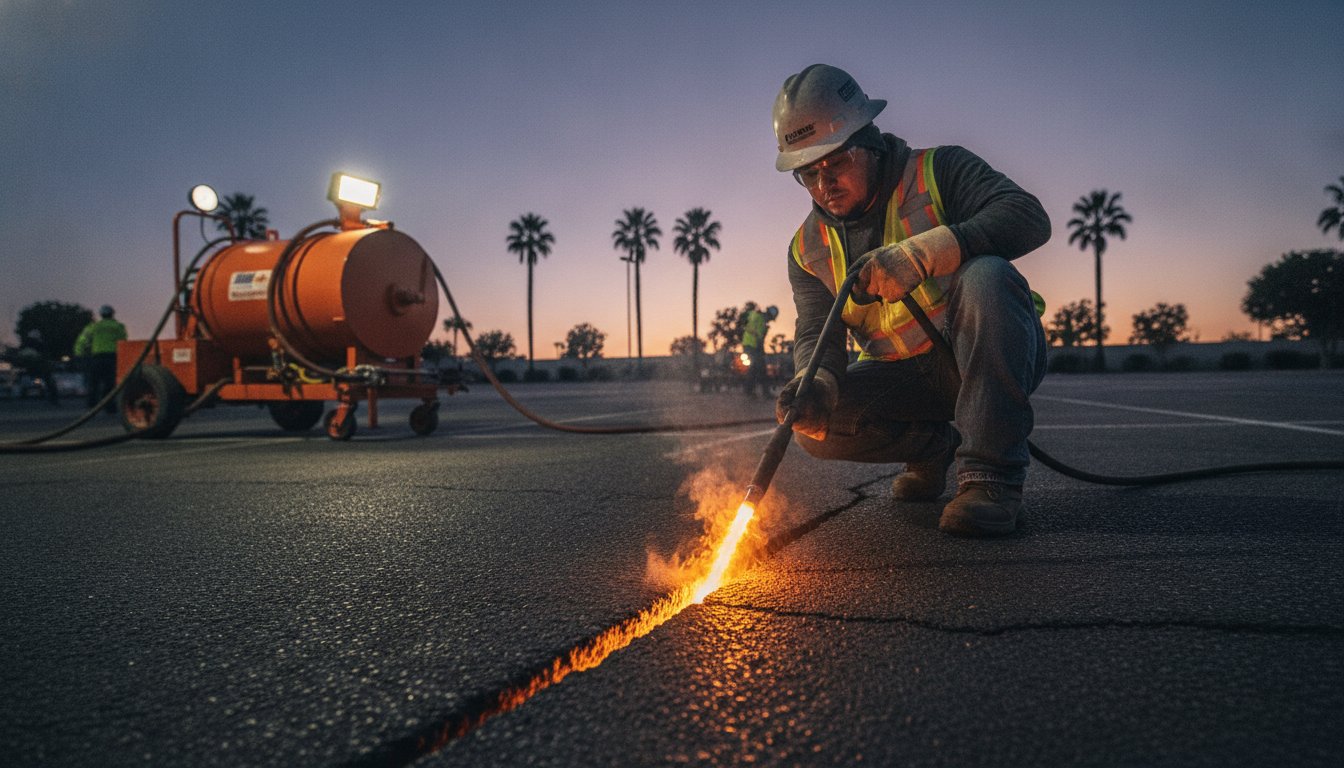
Cheap repairs cost more in the long run. Most property owners don’t realize that “filling” and “sealing” are entirely different processes. Cold-pour filler is a temporary liquid that hardens into a brittle plug. It doesn’t bond. It doesn’t flex. For high-traffic commercial environments, it’s a waste of budget. Professional asphalt crack filling services Orange County utilize hot-pour crack sealing. This process uses rubberized asphalt emulsion heated to 400 degrees. It creates a flexible, waterproof bridge that moves with the pavement. We don’t just plug the hole; we bridge the gap between asphalt sections to prevent water from reaching the subgrade.
The National Asphalt Pavement Association emphasizes that preventative maintenance is the only way to extend the lifecycle of your surface. When you choose a high-temperature application, the sealant penetrates the sidewalls of the crack. It creates a thermal bond that cold-pour products can’t match. If your current maintenance strategy involves a five-gallon bucket and a squeegee, you’re just delaying the inevitable. You need an industrial approach that accounts for the specific load-bearing requirements of your lot.
The Superiority of Rubberized Hot-Pour Sealants
Polymer-modified asphalt emulsions are engineered for resilience. These sealants contain synthetic rubber that allows the material to stretch during cold nights and compress during hot Orange County days. Without this elasticity, the sealant pulls away from the edges, reopening the path for water intrusion. ASTM D6690 is the industry standard for crack sealants, ensuring the material meets specific requirements for elasticity and bond strength. We rely on these standards to deliver a result that lasts through multiple seasons. If you’re ready to upgrade your maintenance plan, consider a professional civil engineering assessment for your property.
When Crack Sealing is No Longer Enough
Maintenance has its limits. If your parking lot looks like a spiderweb, you’re likely facing “alligator cracking.” This pattern indicates that the subgrade has already failed. At this stage, sealing is a lost cause. You must transition from maintenance to parking lot paving or full-depth reconstruction. Continuing to pour sealant into shattered asphalt is throwing money into a hole. We help you identify the tipping point where maintenance costs exceed the value of the repair. In some cases, replacing damaged sections with concrete flatwork or a new asphalt overlay is the only way to restore structural integrity and ensure ADA compliance.
The 2026 Commercial Crack Filling Selection Checklist
Selecting asphalt crack filling services Orange County shouldn’t be a guessing game. Most contractors show up with a direct-fire kettle and a squeegee. That isn’t professional maintenance; it’s a liability. You need a partner who follows Caltrans asphalt maintenance guidelines to ensure the work survives the 2026 infrastructure demands. High-quality work requires high-quality gear. If the crew doesn’t have the right equipment, the material won’t bond, and your budget will be wasted.
Equipment defines the outcome. Direct-fire kettles burn the rubber polymers in the sealant, turning a high-performance material into useless charred liquid. Demand oil-jacketed kettles. These units use a heat-transfer oil to maintain a consistent temperature, preserving the material’s integrity. If the contractor can’t explain their heating method, walk away. They’re likely cutting corners that will lead to premature failure and water intrusion.
Preparation is where most crews fail. A crack filled with dirt is a crack that will fail in six months. Professional standards require a specific workflow:
- Cleaning: Use high-pressure air or heat lances to remove all vegetation, moisture, and debris.
- Material: Demand rubberized asphalt specifically rated for Southern California thermal cycles.
- Safety: Verify a clear plan for traffic control and the preservation of ADA parking stalls.
Pre-Job Site Assessment Checklist
A professional doesn’t just look at the surface. They look at the grade. Before the first drop of sealant hits the lot, the team should identify high-stress zones like loading docks and dumpster pads. These areas require a thicker application to handle heavy axle loads. If a crack looks suspicious near a water main or sewer line, we may utilize hydro excavation to verify the subgrade utility’s condition without damaging the pipe. We document drainage patterns to ensure the sealant won’t trap water in low spots.
Execution and Quality Control Standards
Execution requires precision. We utilize the “over-band” technique, creating a three-inch wide cap that seals the crack and the immediate edges. This prevents edge-raveling and provides a secondary layer of protection against moisture. To get your lot back in service quickly, we use sand-dusting or de-tacking agents. This prevents tires from pulling the fresh material out of the crack. A perfect seal is flush, uniform, and bonded tightly to the sidewalls. No voids. No bubbles. Just a solid bridge.
Integrating Crack Repair with Parking Lot Rehabilitation
Rehabilitation is a calculated sequence. It is not a cosmetic cover-up. Professional asphalt crack filling services Orange County provide the essential foundation for any long-term surface restoration. If you apply a seal coat or an overlay without addressing existing fractures, you are inviting “reflective cracking.” The old cracks will simply telegraph through the new material, wasting your investment. We follow a strict phase-based approach to ensure structural soundness and compliance with the 2026 Caltrans Standards scheduled for implementation on October 19, 2026.
Identify. Seal. Protect. This is the lifecycle of a professional rehabilitation project. We start by securing the subgrade through high-performance crack sealing. Once the structure is watertight, we apply surface protection to block UV-induced oxidation. This process stops the asphalt from becoming brittle and prone to new failures. Orange County maintained roads currently hold a high Pavement Condition Index (PCI) of 81 because of this proactive “pay now or pay more later” philosophy. Commercial owners must adopt the same rigor to avoid total reconstruction.
The Synergy of Sealing and Seal Coating
Crack sealing and seal coating work together to lock out moisture and lock in the asphalt’s flexible oils. Sealing handles the structural gaps. Coating provides the wear layer. When executed correctly, this combination can extend the life of your pavement by 5 to 7 years. We schedule these services to minimize facility downtime, often working in sections to keep your business operational. If our surface assessment reveals deep voids or soil instability, we don’t ignore it. Surface repairs sometimes uncover deeper utility failures that require trenchless pipe bursting to restore the underlying infrastructure without destroying the entire lot.
ADA Compliance and Site Safety
Safety is a non-negotiable requirement. Large cracks are more than maintenance issues; they are trip hazards that create significant liability. Orange County municipal standards for commercial lots require level, accessible paths of travel. Our rehabilitation process includes restoring handicap stall painting and fire lane markings to ensure your property remains fully compliant. We ensure that crack repairs are flush with the surface to prevent pedestrian accidents. A well-maintained lot communicates professional accountability and protects you from legal exposure. If your pavement shows signs of structural distress, schedule a site evaluation today to protect your infrastructure.
SoCal Underground and Engineering: Engineering-Grade Asphalt Maintenance
We don’t just fill gaps. We protect infrastructure. Most paving crews look at the surface and see a job. We look at the subgrade and see a commitment. Our civil engineering background separates us from standard asphalt crack filling services Orange County provides. We understand the load-bearing requirements, the drainage flow, and the utility mains beneath the asphalt. We treat every crack as a structural breach. We seal it with the intent to preserve the entire site’s integrity. Our approach is rooted in professional accountability and industrial strength.
We handle the full lifecycle of your property. This starts with precision crack filling and extends to heavy engineering for complex civil projects. If a surface crack leads to a catastrophic subgrade failure, we don’t call a subcontractor. SoCal Underground and Engineering handles it directly. We offer a 24/7 emergency response team to address infrastructure failures before they paralyze your operations. We show up at any hour to stop a water main break that started as a neglected pavement fracture. We provide the asphalt crack filling services Orange County businesses use to mitigate long-term risk and secure their assets.
Boots-on-the-Ground Reliability
We are active on the job site. We don’t manage from behind a desk. Every project receives direct oversight to ensure compliance with municipal standards. We utilize CCTV inspections to verify the health of your underground lines before we seal the surface. This isn’t just about pouring rubber. It’s about data-driven maintenance. This transparency is our standard. You get honest assessments, firm handshakes, and results that stand up to industrial use. We deliver. We document. We move on to the next site. Our reputation is built on the finality and quality of our output.
Ready to Secure Your Infrastructure?
Don’t wait for a pothole to become a utility repair. We serve Orange County, Los Angeles, and San Diego with professional-grade maintenance plans. We show up with the right equipment. We do the work once. SoCal Underground and Engineering leaves your site secure. Our bidding process is transparent. No hidden fees. No fluff. Just a straightforward plan to keep your asphalt functional for the next decade. We lead you through a logical progression of capability and proof. Contact SoCal Underground and Engineering for a Quote to schedule a comprehensive site audit and secure your property’s future.
Secure Your Subgrade Before the Next Season
Neglecting a surface fracture is an invitation for structural decay. You’ve seen how water intrusion destroys the soil foundation and threatens the underground utility mains beneath your feet. Proactive maintenance is the only way to avoid the massive costs of full-depth reconstruction. By choosing high-performance asphalt crack filling services Orange County, you bridge the gap between simple paving and long-term civil engineering. We don’t just patch holes; we lock out moisture and stabilize your property’s infrastructure.
SoCal Underground and Engineering consists of licensed civil engineering specialists who understand the heavy-duty demands of Southern California commerce. Our team serves Orange County, LA, and San Diego with a 24/7 emergency response capability for infrastructure failures. We show up with the right equipment and a commitment to do the job once. Don’t wait for a liability claim or a utility failure to take action. Secure your site with a partner who values integrity and structural soundness above all else. Request an Engineering-Grade Asphalt Audit from SoCal Underground and Engineering to protect your investment today.
Frequently Asked Questions
Is asphalt crack filling the same as crack sealing?
No. Filling is a temporary fix using cold-pour materials that don’t bond to the pavement. Sealing is a structural repair using hot-pour rubberized asphalt that creates a flexible, watertight bridge. For commercial infrastructure, sealing is the only method that prevents water from reaching the subgrade and destroying utility bedding.
How long does asphalt crack filling last in Orange County?
A professional hot-pour seal typically lasts 3 to 5 years under standard traffic conditions. Environmental factors like high-intensity heat and oxidation can shorten this lifespan if the surface isn’t protected. Our asphalt crack filling services Orange County focus on high-performance materials that withstand the specific thermal cycles of the SoCal climate.
Can I drive on the parking lot immediately after crack filling?
You can typically resume traffic within 30 to 60 minutes of application. We utilize de-tacking agents or sand-dusting to prevent tires from pulling the fresh material out of the cracks. This ensures your facility remains operational while we secure the pavement. Every minute of downtime is a cost we work to minimize.
What happens if I ignore the cracks in my commercial parking lot?
You invite structural failure and massive liability. Water enters the fractures, hollowing out the subgrade and destabilizing the soil around your underground utilities. Minor cracks quickly evolve into deep potholes and collapsed sewer lines. Ignoring maintenance turns a simple sealing project into a total reconstruction requirement that costs significantly more.
How much does it cost to fill cracks in a parking lot?
Costs depend entirely on linear footage, crack density, and the level of preparation required. While we don’t provide flat rates, industry data shows that proactive maintenance is 88% cheaper than a standard asphalt overlay. We provide transparent bidding based on a physical site audit to ensure you only pay for the work your infrastructure needs.
Does crack filling prevent potholes from forming?
Yes. Potholes are the direct result of water weakening the soil foundation beneath the asphalt. By sealing the surface, you block the entry point for moisture and maintain subgrade compaction. This prevents the “pumping” effect where traffic forces silt out of the base, eventually causing the surface to cave in.
Will crack filling fix alligator cracking?
No. Alligator cracking is a sign of deep structural subgrade failure. Pouring sealant into these areas is a waste of budget and material. If your lot shows this pattern, you need a professional assessment to determine if a grind-and-overlay or full-depth reconstruction is necessary to restore the load-bearing capacity of the site.
What is the best time of year to perform crack sealing in Southern California?
Spring and fall are ideal because moderate temperatures allow cracks to be at a “neutral” width. However, the stable Orange County climate allows for year-round application as long as the pavement is dry. We monitor local humidity and surface temperatures to ensure the thermal bond meets our engineering-grade standards every time.