

Most parking lot failures happen before the first ton of asphalt hits the ground. You’ve seen the results of cut corners: premature cracking, pooling water, and crumbling edges that turn into major liabilities. Hiring a parking lot paving contractor Southern California isn’t just about laying blacktop. It’s about civil engineering. You need a surface that stands up to heavy traffic and brutal heat without failing in the first few years. A cheap bid today often leads to a massive repair bill tomorrow.
We believe a parking lot is a long-term asset that requires a high-stakes specialist. This article teaches you how to evaluate contractors and build infrastructure that lasts. We’ll cover the strict California Building Code requirements that make parking stalls responsible for 15.96 percent of all physical-access violation claims. You’ll learn how to navigate new CARB reporting standards and why sub-base integrity is the only way to prevent drainage failures during flash floods. We provide the technical knowledge you need to demand quality, ensure compliance, and secure your investment.
Key Takeaways
- Learn why sub-grade compaction is the non-negotiable foundation for withstanding Southern California’s intense heat and UV exposure.
- Use the Pavement Condition Index (PCI) to identify the “Point of No Return” where maintenance becomes a waste of capital.
- Master strict California ADA and environmental standards to ensure full site compliance and avoid high-stakes litigation.
- Evaluate a parking lot paving contractor Southern California based on civil engineering expertise rather than surface-level aesthetics.
- Integrate surface paving with underground utility and storm drain infrastructure to deliver a complete, heavy-duty result.
The SoCal Factor: Why Parking Lot Paving in Southern California is Unique
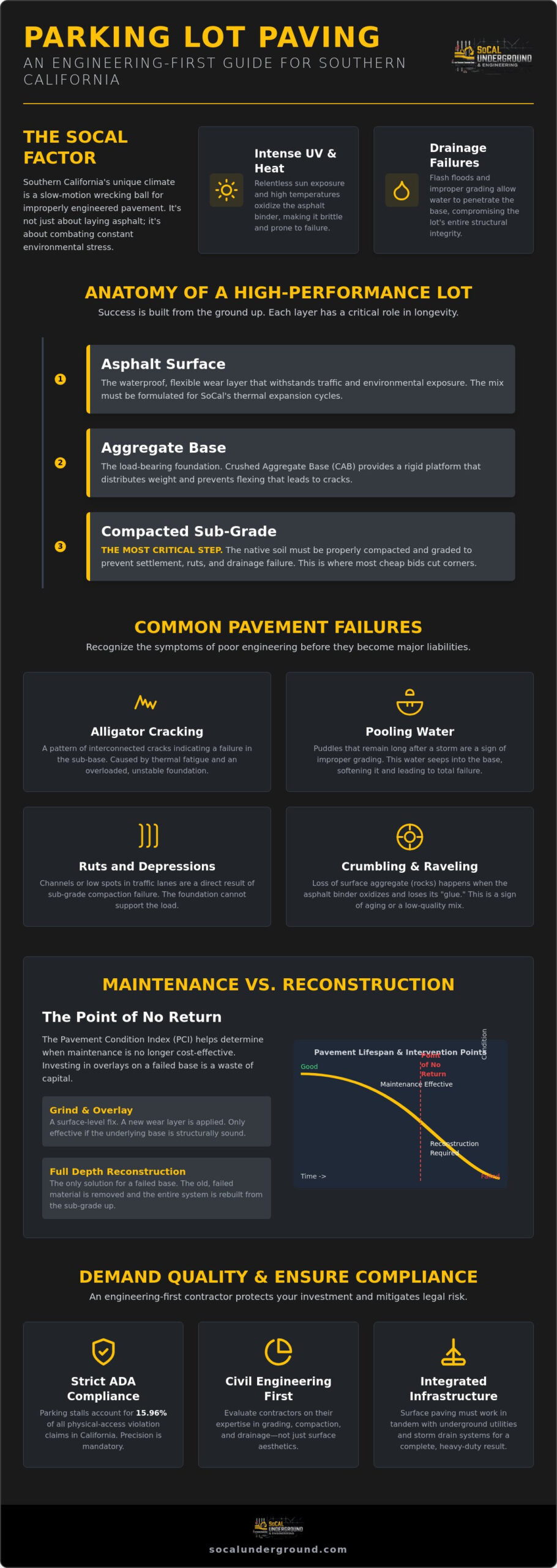
Southern California pavement exists in a state of constant environmental stress. While other regions worry about freeze-thaw cycles, we deal with relentless UV radiation and sustained high temperatures. This creates a specific SoCal Pavement Lifecycle. It’s a progression from deep black to oxidized gray, followed by structural failure if the initial engineering was flawed. A professional parking lot paving contractor Southern California knows the local climate acts as a slow-motion wrecking ball. We plan, grade, and pave for maximum longevity.
The Heat Island Effect accelerates this process. Large expanses of Asphalt concrete absorb solar energy, raising surface temperatures far above the ambient air. This heat triggers rapid oxidation of the asphalt binder. When the binder dries out, the aggregate loses its glue. The surface becomes brittle, loses its waterproofing, and begins to ravel. Commercial lots face higher stakes than residential driveways. A driveway supports a few cars; a commercial lot supports heavy delivery trucks, garbage haulers, and thousands of vehicle rotations. The engineering must match the load. If you treat a commercial project like a residential one, the surface will fail within three years.
Thermal Expansion and Asphalt Durability
Asphalt is flexible by design, but Southern California pushes that flexibility to its limit. 100-degree days followed by cooler coastal nights cause the material to expand and contract significantly. This movement leads to alligator cracking, a pattern of interconnected cracks that look like reptile skin. We use high-quality binders specifically formulated for the Southwest to resist this movement. Thermal fatigue is the primary cause of SoCal surface failure. Without the right chemical composition, the pavement simply gives up under the pressure of constant expansion.
Drainage: The Silent Killer of SoCal Lots
Standing water destroys more parking lots than heavy traffic ever will. In LA and Orange County, localized flash flooding can overwhelm poorly designed surfaces in minutes. If water sits on the surface, it seeps into the cracks. Once it reaches the base rock, the structural integrity of the entire lot is compromised. This is why we work closely with underground utility contractors to ensure the storm drain system is integrated perfectly with the surface grade. Sub-surface moisture softens the foundation. If the base fails, the asphalt on top will crumble regardless of its thickness. Proper drainage isn’t an add-on. It’s the foundation of a durable surface.
The Anatomy of a High-Performance Parking Lot
A parking lot is an engineered system, not a coat of paint. You build from the bottom up. A professional parking lot paving contractor Southern California understands that surface failure is usually a foundation failure. We look at three essential layers: the sub-grade, the base rock, and the asphalt surface. Each performs a specific structural role. If one layer fails, the entire lot follows. We don’t just lay asphalt; we manage the earth beneath it.
Sub-grade compaction is the most critical step in the entire project. This is the native soil. If it’s loose or saturated, the weight of a vehicle will push the asphalt down, creating ruts and cracks. Precision grading follows compaction. We use laser-guided equipment to ensure water moves toward storm drains with mathematical accuracy. Standing water is a death sentence for pavement. If the grade is off by even a fraction of a percent, you get ponding. Ponding leads to saturation, and saturation leads to total base failure.
Property managers often ask about a “Grind and Overlay” versus “Full Depth Reconstruction.” An overlay is a cosmetic fix that adds a new wear layer. It works if the base is sound. If the base rock has turned to mud, an overlay is a waste of capital. Full depth reconstruction involves digging out the failure and starting over. It’s the only way to fix a lot that has reached its structural limit. To see how we handle these complex site requirements, you can review our site development services for commercial properties.
Sub-Base Preparation and Soil Stabilization
We use proof-rolling to identify “soft spots” before a single rock is dropped. We drive heavy, loaded trucks over the prepared sub-grade. If the soil pumps or deflects, we fix it. Southern California is known for expansive clay soils that swell when wet and shrink when dry. This movement destroys pavement. We often use Crushed Aggregate Base (CAB) to provide a rigid, load-bearing platform that bridges these soil movements. It’s about stability and predictability.
Asphalt Mix Selection for Commercial Use
Mix design is where heavy engineering meets chemical science. In California, we typically choose between Type A and Type B asphalt mixes. Type A is a high-performance municipal grade used for heavy traffic and high-capacity infrastructure. Aggregate size also plays a role. Larger aggregates provide better structural support for heavy trucks, while smaller aggregates offer a smoother finish for pedestrian areas. The anatomy of your lot must also accommodate Federal ADA standards for parking, which require specific slopes that must be baked into the base rock layer before the asphalt is ever poured.
Maintenance vs. Reconstruction: When to Invest
Professional evaluation requires more than a visual scan. We use the Pavement Condition Index (PCI) to grade your lot on a scale from 0 to 100. A score above 70 indicates that maintenance is the priority. When that score drops below 40, you’ve hit the Point of No Return. At this stage, pouring money into surface repairs is throwing capital away. A reputable parking lot paving contractor Southern California will tell you when a lot is past saving. We don’t believe in band-aid fixes for terminal problems.
Ignoring structural failures creates immediate liability. Potholes and crumbling edges are more than just eyesores; they are trip hazards. In California, accessible parking accounts for 15.96 percent of all physical-access violation claims. If your lot is deteriorating, you aren’t just losing curb appeal. You’re inviting lawsuits and high-stakes litigation. Maintain the surface. Secure the perimeter. Protect your bottom line.
The ROI of Seal Coating and Crack Filling
Seal coating acts as a heavy-duty sunscreen for your asphalt. It blocks the UV rays that oxidize the binder and turn pavement brittle. Crack filling is the most cost-effective way to stop water from reaching the base rock. If you wait until you see deep alligator cracks, you’ve already lost the battle. For high-traffic San Diego and LA facilities, we recommend seal coating every two to three years. Stay ahead of the damage. Protect the investment. Extend the lifecycle. A comprehensive parking lot seal coating Southern California maintenance plan is the most cost-effective strategy for halting oxidation and extending pavement lifespan before structural repairs become unavoidable.
Identifying Structural Failure
Surface patches won’t fix a foundation problem. If you see “rutting,” which are deep depressions in the wheel paths, or “shoving,” which looks like ripples in the asphalt, your base rock is failing. These issues indicate that the sub-grade cannot support the load. Sometimes you need more than an asphalt patching contractor Riverside facility managers rely on to slap on a temporary fix. Severe degradation requires full-depth reclamation. We grind the existing asphalt and base rock together, stabilize the mixture, and create a new foundation. It’s a rugged solution for heavy-duty infrastructure.
Navigating California Compliance: ADA and Environmental Standards
California has the strictest accessibility laws in the nation. A parking lot paving contractor Southern California must look beyond federal guidelines to meet California Building Code Chapter 11B. If your slopes are off by half a percent, you’re open to predatory litigation. Accessible parking accounts for 15.96 percent of all physical-access violation claims in the state. Compliance isn’t a suggestion; it’s your primary defense. It protects your property from lawsuits that often range from $10,000 to $100,000 even for minor infractions.
Title 24 and ADA Striping Requirements
Stall dimensions are non-negotiable under Title 24. A standard accessible stall must be 108 inches wide. Van-accessible stalls require 144 inches of width. Access aisles need to be 60 inches for standard stalls and 96 inches for van-accessible spaces. California also mandates a vertical clearance of 98 inches for all accessible spaces. This is significantly stricter than federal ADA standards. Your signage must include the International Symbol of Accessibility and specific “Minimum Fine $250” language. Use the California Parking Lot Striping Checklist to verify your layout before the paint dries.
Concrete Integration: Curbs, Gutters, and Ramps
Asphalt and concrete must work as a unified system. We integrate concrete flatwork to handle high-stress areas that asphalt can’t manage alone. Dumpster pads must be reinforced concrete to prevent the heavy bins from sinking into the surface during 100-degree days. ADA ramps require truncated domes to alert visually impaired pedestrians. Slope is the most scrutinized element of an inspection. Both the parking stall and the access aisle must maintain a maximum slope of 2.08 percent in any direction. We use precision grading to hit these marks every time.
Environmental regulations are also tightening. The Buy Clean California Act now requires Environmental Product Declarations (EPDs) for asphalt and concrete to track global warming potential. Starting in 2026, reporting data to the California Air Resources Board becomes a standard requirement for major projects. We manage these filings so you don’t have to. Compliance is a heavy lift, but it’s the only way to secure your asset. Schedule an ADA compliance audit with SoCal Underground and Engineering to identify your risks before they become legal liabilities.
Choosing a Paving Partner: The Engineering-First Approach
Don’t hire a contractor who only looks at the surface. Most pavers are simply operators with a truck and a roller. You need an engineering firm that understands the earth beneath the asphalt. A professional parking lot paving contractor Southern California should be able to explain the load-bearing capacity of your soil before they ever mention the thickness of the asphalt. We view a parking lot as a critical piece of infrastructure. It requires the same level of precision as a municipal roadway or a high-capacity utility line. If your contractor doesn’t understand civil engineering, your pavement will fail early.
Reliability is built on accountability and presence. You need a partner who is active on the job site, not one who sits behind a desk. We prioritize a handshake style of communication. It’s honest. It’s firm. It’s rooted in professional ethics. When high-capacity infrastructure fails, time is the enemy. We provide a 24/7 emergency response team to handle storm drain collapses or utility failures that threaten your surface. We show up, solve the problem, and secure the site. That is the standard of a high-stakes specialist.
Questions to Ask Your Paving Contractor
Vetting a contractor requires technical questions. Surface-level promises don’t hold weight on a job site. Use these criteria to evaluate your next partner:
- What is your compaction testing process? If they don’t mention proof-rolling or sub-grade stabilization, they are cutting corners.
- How do you protect existing utilities? When paving over high-density areas, ask if they use hydro excavation for precision digging to avoid damaging underground lines.
- Are you bonded for public works? Large-scale municipal and commercial projects require specific licensing and high-limit bonding. Verify these credentials before signing a contract.
The SoCal Underground and Engineering Commitment
SoCal Underground and Engineering bridges the gap between heavy civil construction and finished surface paving. We understand how a sewer lateral replacement or a water main installation impacts the integrity of the asphalt above it. Our approach is direct and no-nonsense. We don’t over-explain or use flowery language to prove our worth. We rely on results. We plan the project, grade the site, and pave the surface with a focus on finality and quality. Every project is a commitment we honor. Contact SoCal Underground and Engineering for a comprehensive lot evaluation to get a straight-shooting assessment of your property.
Secure Your Infrastructure and Minimize Liability
A parking lot is a high-stakes asset that demands more than a surface-level fix. You’ve learned that durability starts with sub-grade compaction and ends with strict adherence to California’s unique environmental and ADA standards. Ignoring the civil engineering behind your pavement leads to premature failure and costly litigation. Whether you’re managing a high-capacity facility in LA, Orange County, or San Diego, you need a partner who prioritizes structural integrity over cosmetic speed. Proper drainage, soil stabilization, and precise grading are the only ways to withstand the relentless Southern California climate.
Hiring a professional parking lot paving contractor Southern California ensures your project is backed by boots-on-the-ground expertise. SoCal Underground and Engineering brings civil engineering expertise to every job site. We provide a 24/7 emergency response team to handle storm drain collapses or utility failures that threaten your surface. We don’t believe in band-aid fixes; we believe in building surfaces that stand the test of time. Take control of your property’s longevity and safety. Get a Professional Paving Evaluation from SoCal Underground and Engineering and let’s get to work.
Frequently Asked Questions
How long should a commercial parking lot last in Southern California?
A well-engineered commercial parking lot should last 20 to 30 years with proper maintenance. Intense UV exposure and heavy traffic loads will shorten this window if you skip preventative care. Regular seal coating and crack filling are non-negotiable actions for maximizing the lifecycle of your pavement. Without them, the asphalt binder oxidizes and the surface becomes brittle within a decade.
What is the difference between an asphalt overlay and a total reconstruction?
An asphalt overlay is a new surface layer applied over existing pavement to fix cosmetic wear. Total reconstruction involves removing the asphalt and base rock to address deep-seated structural failures. Use an overlay if the foundation is sound. Choose reconstruction if you see rutting, base saturation, or widespread instability. It’s the difference between a cap and a complete rebuild.
How much does ADA compliance affect the cost of a paving project?
ADA compliance is a significant cost factor because it requires precision grading and specific stall dimensions. California mandates slopes no steeper than 2.08 percent in any direction for accessible stalls and aisles. Achieving this accuracy often requires more extensive base work and concrete integration. It’s an essential investment to avoid litigation that often costs tens of thousands of dollars.
Why does my asphalt look like “alligator skin” and can it be fixed?
Alligator cracking indicates a structural failure in the base rock or advanced thermal fatigue. It cannot be fixed with a simple patch or a layer of sealer. A parking lot paving contractor Southern California must remove the failed section, stabilize the sub-grade, and replace the material. If you don’t fix the foundation, the cracks will reappear through the new surface.
How soon can traffic return to a newly paved or seal-coated lot?
You can typically allow foot traffic after 24 hours and vehicle traffic after 48 hours. High temperatures in the Inland Empire or San Diego can extend this window because the asphalt needs more time to cool. The material must reach a specific hardness to prevent power steering scuffs and tire marks. We coordinate the schedule to minimize your facility’s downtime.
What is the best time of year for parking lot paving in LA or San Diego?
The best time for paving is between April and November when the weather is consistently dry and warm. Heat helps the asphalt binder set correctly and ensures a stronger bond between layers. Avoid the winter months when flash floods can saturate the sub-grade during the grading process. Dry soil is a requirement for proper compaction and structural integrity.
Do I need a permit for parking lot resurfacing in Southern California?
Most Southern California municipalities require permits for work that alters drainage patterns or ADA paths of travel. Resurfacing projects often trigger mandatory upgrades to current accessibility standards. We handle the coordination with local building departments to ensure your project is fully permitted and compliant. Don’t risk a stop-work order by skipping the paperwork.
How does proper drainage extend the life of my asphalt?
Proper drainage prevents water from seeping into the base rock and softening the foundation of the lot. We integrate surface paving with underground storm drains to move water off the site immediately. If the base rock stays dry, the asphalt remains stable under heavy loads. Standing water is the primary cause of potholes and total pavement collapse.