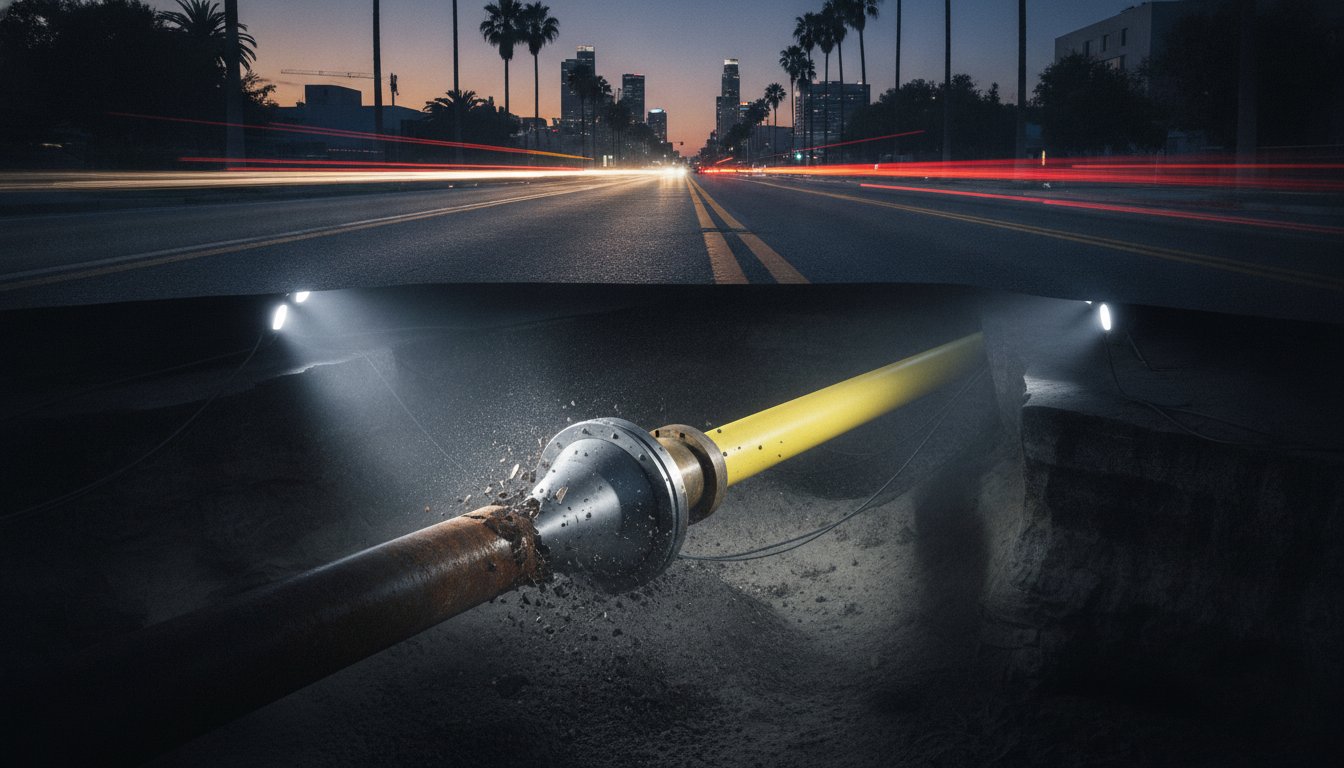
The most expensive part of a utility failure isn’t the pipe itself. It’s the thousands of dollars in asphalt, concrete, and lost time you waste tearing up a street just to reach it. For municipal managers and commercial developers in high-density hubs like Los Angeles or San Diego, traditional excavation is a liability you can no longer afford. As a leading trenchless pipe bursting contractor California, we know that infrastructure needs to grow without shutting down the city. Pipe bursting doesn’t just repair a line; it replaces it with a brand-new, high-durability pipe while keeping your surface assets intact.
You know that aging infrastructure is a ticking clock. The risk of damaging adjacent utilities in crowded corridors is a constant concern. This article shows you how to secure long-term structural integrity and upsize existing lines without a single trench. We will break down the impact of the 2026 California Building Standards Code on your next project. We also explain how new laws like SB 61 change the financial landscape of private contracts. From high-capacity municipal mains to complex commercial laterals, discover the no-dig solution built for California’s 2026 infrastructure demands.
Key Takeaways
- Replace, don’t patch. Learn how a conical bursting head fragments old pipe to install brand-new, structurally independent infrastructure without the trench.
- Increase your capacity. Understand why pipe bursting is the only trenchless method that allows for upsizing line diameters using durable HDPE materials.
- Protect your surface assets. Partnering with a trenchless pipe bursting contractor California eliminates the massive overhead of asphalt and concrete restoration.
- Audit before you act. See how CCTV inspections and precision mapping prevent structural failures and ensure project accuracy from the first pull.
- Demand professional accountability. Learn why a General A Engineering license and a specialized heavy-duty equipment inventory are essential for municipal-grade utility work.
Understanding Trenchless Pipe Bursting for California Infrastructure
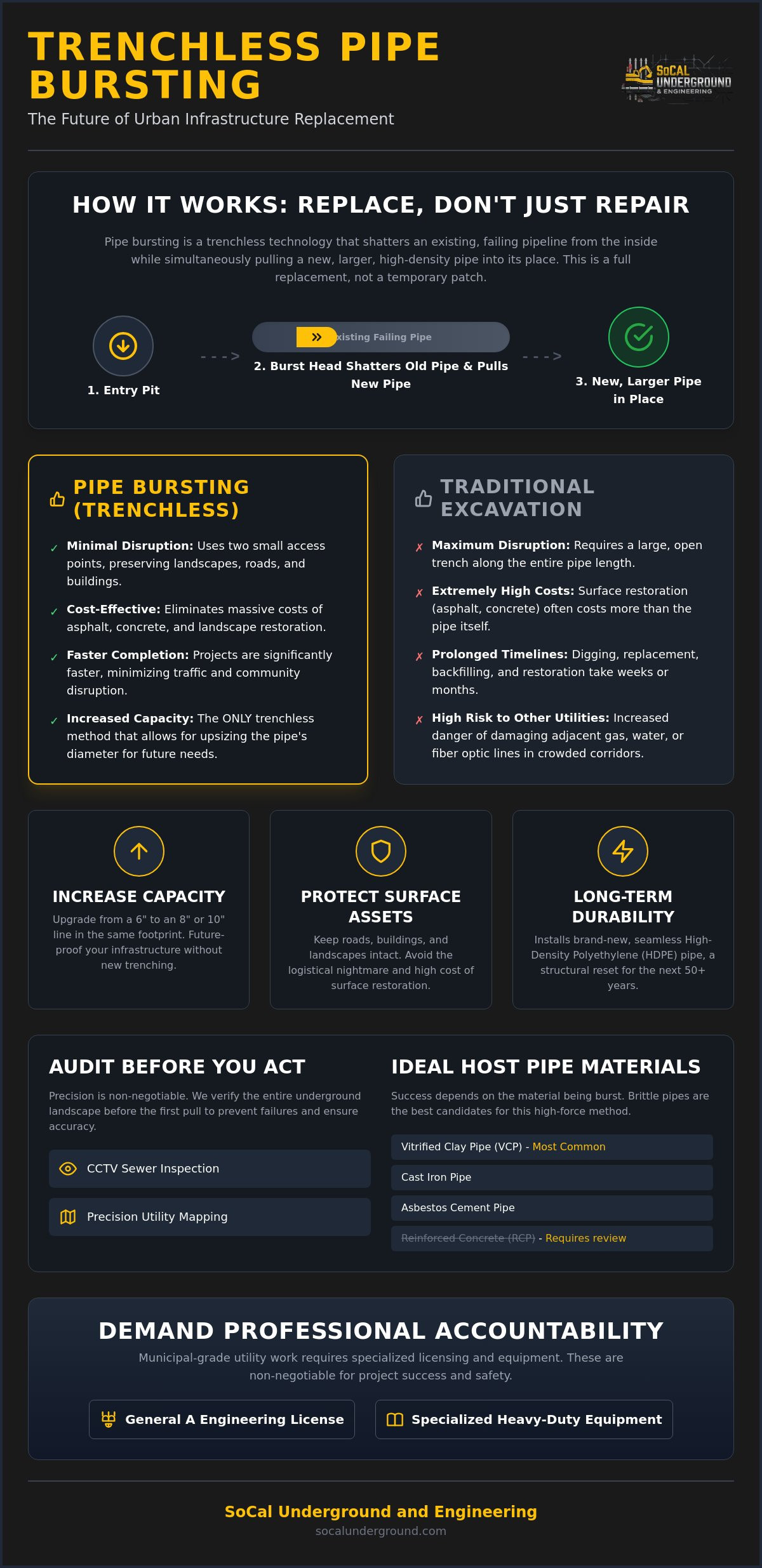
Infrastructure management in California is a battle against time and density. Most contractors offer a quick patch; we offer a total replacement. Pipe bursting is a civil engineering solution that destroys the failing host pipe while simultaneously pulling a new, high-capacity line into its place. As a specialized trenchless pipe bursting contractor California, we focus on permanent results. This method isn’t a “repair” in the traditional sense. It’s the complete installation of a brand-new system without the logistical nightmare of open-cut trenches. Whether it’s a municipal sewer main or a commercial water service, this technology provides a structural reset for the next fifty years.
The “no-dig” advantage is critical in Southern California’s high-density corridors. In cities like Los Angeles or San Diego, the cost of traffic control and surface restoration often exceeds the cost of the pipe itself. Pipe bursting bypasses these overheads. By utilizing two small access points, we can replace hundreds of feet of utility line under existing buildings, highways, and parking lots. This approach is the industry standard for Understanding Trenchless Pipe Bursting and its role in modernizing aging urban grids. We apply this heavy-duty technique to sewer, water, and gas lines, ensuring the surface remains undisturbed while the underground capacity grows.
The Core Process: How the Bursting Head Works
The process relies on raw mechanical force and precision engineering. A high-tensile steel cable pulls a conical bursting head through the host pipe. This expander head performs three distinct actions in a single pass. First, it shatters the old pipe from the inside out. Second, it forces the fragments into the surrounding soil. Third, it pulls a new High-Density Polyethylene (HDPE) pipe directly behind it. Break. Expand. Install. This tripartite sequence ensures the new line is protected and perfectly seated. There’s no room for error. The force required can reach hundreds of tons, making specialized equipment and expert operators a non-negotiable requirement for project success.
Ideal Host Pipe Materials in Southern California
Success depends on the material being burst. Vitrified Clay Pipe (VCP) is the most common candidate in older SoCal districts. It is brittle and fragments easily under the pressure of the bursting head. Cast iron and asbestos cement also respond well to this method, though they require specific head configurations to ensure a clean break. Before any force is applied, a CCTV sewer inspection Southern California is mandatory. We use these scans to identify collapses or reinforced concrete pipe (RCP) sections that might require a more aggressive approach. We don’t guess; we verify the underground landscape before the first pull begins.
The Mechanics of Pipe Bursting: Why Upsizing Matters
Capacity is the bottleneck of California’s infrastructure. Most trenchless methods, like CIPP lining, solve for leaks but fail to address volume. Pipe bursting is different. It is the only trenchless replacement method that allows for significant diameter expansion. As a trenchless pipe bursting contractor California, we use this advantage to help municipalities and commercial developers future-proof their utility grids. If the current flow demands exceed the original pipe’s limits, we don’t just replace the line; we upgrade it.
The choice between static and pneumatic bursting depends on the job site. Static bursting uses high-tonnage hydraulic jacks to pull the head through the host pipe. It’s clean, quiet, and minimizes vibration, making it ideal for dense urban environments like San Diego or Orange County. Pneumatic bursting uses an air-powered hammer to drive the head forward. Both methods rely on the technical frameworks established by the North American Society for Trenchless Technology to ensure structural integrity. Maintaining flow capacity is non-negotiable for growing California cities where utility loads are projected to increase through 2026 and beyond.
Upsizing Capacity Without New Trenches
Growing cities require bigger pipes. Traditional thinking says you must dig a new trench to install a larger main. Pipe bursting proves otherwise. We can upgrade a 6-inch sewer lateral to an 8-inch or 10-inch line within the same footprint. The expander head is the key. It is wider than the original pipe, creating the necessary annular space by compressing the surrounding soil. This allows for immediate capacity increases for multi-family housing projects and large-scale commercial developments. You get the volume you need without the cost of a full-scale excavation.
HDPE: The Standard for Modern Trenchless Replacement
The material we pull in is as important as the method we use. High-Density Polyethylene (HDPE) is the industry standard for a reason. It is flexible enough to navigate slight offsets and durable enough to withstand California’s seismic shifts. Unlike clay or iron, HDPE does not corrode. It resists chemicals and prevents root intrusion. The fusion process creates a monolithic pipe system where the joints are as strong as the pipe wall itself. This results in a leak-proof, high-performance utility line with a service life exceeding 50 years. If you’re managing a high-stakes infrastructure project, consulting with an engineering specialist is the first step toward a permanent solution.
Pipe Bursting vs. Open-Cut Excavation: Protecting Surface Assets
Open-cut excavation is a brute-force approach that treats your property like a demolition site. It requires a massive footprint of heavy machinery, shoring, and backfill. For a trenchless pipe bursting contractor California, the mission is surgical, not destructive. When you choose bursting, you protect the surface assets that keep your business or municipality functional. Traditional digging is a logistical nightmare. It involves weeks of road closures, complex traffic control, and high-risk exposure to adjacent utilities. Bursting keeps the street open. It limits your liability. It simplifies the job site.
The technical best practices detailed by NASTT’s Pipe Bursting Center of Excellence emphasize that trenchless solutions are about more than just convenience. They are about engineering efficiency. Trenchless saves significant time, but it demands higher technical skill and specialized equipment. We don’t just dig and drop. We engineer a path. We monitor the pull. We deliver a result that preserves the integrity of the surrounding soil and infrastructure. It’s a straight-shooting reality: the less you disturb the ground, the fewer problems you create for the future.
The ROI of Surface Preservation
The math is simple. Compare the cost of two small access pits against a 300-foot continuous trench. Open-cut forces you to pay for the pipe, the digging, the backfill, and the total restoration of the surface. As a concrete flatwork contractor Southern California, we know that restoring a parking lot or a public sidewalk to its original state is a massive expense. Bursting avoids this. By leaving the asphalt and concrete intact, you maintain ADA compliance without the risk of botched ramp or sidewalk reconstructions. You save your budget for the infrastructure itself, not the patch job on top.
Environmental and Social Impact in SoCal
Southern California is too dense for old-school excavation. In LA and Orange County, a single blocked lane can cripple a commercial center’s revenue. Bursting reduces business downtime by keeping access points clear. It also slashes your project’s carbon footprint. Fewer heavy haul trucks are needed because there’s less dirt to remove and less backfill to import. Noise is another factor. We avoid weeks of jackhammering and heavy engine idling. The work is fast, quiet, and purposeful. We get in, replace the line, and get out before the neighborhood even knows we were there.
Pre-Construction Engineering: Inspections and Precision Mapping
Engineering comes before the equipment. You don’t launch a multi-ton bursting head without a clear map of the underground landscape. For a trenchless pipe bursting contractor California, the pre-construction phase is where we eliminate risk. We audit. We map. We verify. A successful project relies on precision data to prevent ground heave and utility strikes. Without a comprehensive physical audit, you aren’t engineering; you’re guessing. Our process identifies every obstacle before the first cable is tensioned.
The first step is a high-definition CCTV sewer inspection Southern California that delivers the NASSCO-compliant visual audit data required for defensible capital planning. We need to see the internal state of the host pipe. We look for heavy scale, root masses, and structural offsets. More importantly, we identify total collapses. If the pipe is pancaked, the bursting head has no path to follow. Soil analysis is equally critical. We evaluate the soil’s expandability to ensure it can absorb the displaced fragments of the old line. If the ground is too consolidated or contains solid rock, the expansion force can cause surface heave, damaging the very asphalt we intend to protect. As a seasoned trenchless pipe bursting contractor California, we know that ground conditions dictate the equipment choice.
Precision Utility Mapping
Safety requires daylighting. We use our capabilities as a hydro excavation contractor California to expose crossing lines. High-pressure water and vacuum suction allow us to see what’s in the path without the risk of a backhoe strike. This precision digging identifies “hard points” like old concrete encasements or abandoned thrust blocks. These obstacles can stop a burst mid-pull, leading to an emergency excavation you didn’t budget for. We map the exact depth and pitch of the existing line. Gravity flow integrity is the goal. We ensure the new line maintains the necessary slope for long-term performance.
Assessing Structural Readiness
Not every pipe is a candidate for bursting. If the host pipe has lost its shape entirely, the path is gone. We use hydro jetting sewer line California to clear debris and prepare the environment. This high-velocity cleaning removes obstructions that could snag the new HDPE line during the pull. A total structural collapse that prevents the passage of a lead cable is the point of no return for trenchless rehabilitation. If the path is clear, we move forward. If not, we pivot to a surgical spot repair before the burst begins. If you need a technical assessment of your high-capacity infrastructure, contact our engineering team for a site-specific audit.
Selecting a Trenchless Pipe Bursting Contractor in California
Choosing a partner for high-capacity utility work isn’t about finding the lowest bidder. It’s about finding the firm that can handle the load. A General A Engineering license is the non-negotiable standard for large-scale bursting projects. Many residential firms offer trenchless “repair,” but they lack the heavy-duty equipment required for municipal mains or industrial laterals. As a professional trenchless pipe bursting contractor California, we view this work as a civil engineering challenge. It requires specialized training, a robust equipment inventory, and a history of performance in public works environments. If the firm doesn’t own their bursting rigs or their restoration teams, you’re adding layers of risk to your project.
High-priority utility failures don’t wait for business hours. When a sewer main collapses or a fire line fails, you need a contractor with 24/7 emergency response capability. Accountability is the foundation of a successful project. You should verify past performance in municipal environments where standards are high and the margin for error is zero. We don’t just provide a service; we honor a commitment to the local landscape. We show up. We work hard. We finish the job. Professional accountability means standing behind the finality and quality of the output, every time.
The SoCal Underground Standard
We operate on handshake integrity. If our pre-construction audit shows that pipe bursting isn’t the right fit for your specific soil or pipe condition, we tell you. Our expertise covers the full lifecycle of underground utility construction. We don’t just pull the pipe. We manage the site. We restore the asphalt. We stripe the lot. This comprehensive approach ensures one point of contact for the entire scope. You get boots-on-the-ground expertise and active site management that keeps the project on schedule and within the technical requirements of the 2026 California Plumbing Code. When the underground work is complete, our team coordinates directly with a qualified parking lot paving contractor Southern California to ensure the finished surface meets long-term durability and drainage standards.
Critical Questions for Your Contractor
Before you sign a contract, ask the hard questions to separate the specialists from the amateurs. A high-stakes infrastructure project has no room for guesswork. Use this checklist to vet your team:
- Material Experience: Do they have documented experience bursting Vitrified Clay Pipe (VCP) versus ductile iron or asbestos cement?
- Contingency Planning: What is their specific protocol when an unmapped utility conflict appears mid-pull?
- Safety Protocols: Can they provide documentation for deep pit shoring and OSHA-compliant traffic control?
- Equipment Ownership: Do they own the static or pneumatic bursting rigs, or are they relying on third-party rentals?
A straight-shooting contractor will provide clear, direct answers. You need a team that views every project as a commitment to be honored. If you’re ready to modernize your infrastructure with a no-dig solution, contact our engineering team for a transparent assessment and a heavy-duty result.
Future-Proof Your Underground Grid
Aging infrastructure doesn’t fix itself. Pipe bursting provides the only trenchless path to increased capacity and a total structural reset. By partnering with an expert trenchless pipe bursting contractor California, you bypass the massive overhead of surface restoration and the logistical chaos of open-cut excavation. We provide the precision mapping, heavy-duty equipment, and engineering expertise required for high-stakes municipal and commercial projects. Our process ensures your surface assets remain undisturbed while your underground utilities meet the growth demands of 2026.
SoCal Underground backs every project with a General A Engineering License and a focus on professional accountability. We serve Los Angeles, Orange, and San Diego Counties with 24/7 emergency response for critical failures. We assess the site. We engineer the solution. We honor the commitment. Don’t let a failing line compromise your budget or your timeline.
Secure Your Infrastructure with SoCal Underground and deliver the durable, high-capacity results your project demands. We’re ready to deploy to your site today.
Frequently Asked Questions
What is the difference between pipe bursting and CIPP lining?
Pipe bursting is a total replacement method; CIPP is a rehabilitation liner. As a trenchless pipe bursting contractor California, we use bursting to provide a brand-new, structurally independent line. CIPP places a resin-soaked felt inside the host pipe, which slightly reduces the internal diameter. Bursting is the only trenchless option when you need a capacity increase or a complete structural reset.
Can pipe bursting be used for water main replacement in California?
Yes, it’s a standard solution for water main replacement. It’s particularly effective for replacing brittle materials like cast iron or asbestos cement. The process installs a new HDPE water service that’s flexible and seismic-resistant. It’s a permanent fix for aging municipal water grids that meets the 2026 California Plumbing Code standards for potable water delivery.
How much can you upsize a pipe using the trenchless bursting method?
You can typically upsize a pipe by one or two standard diameters. We frequently upgrade 6-inch sewer lines to 8-inch or 10-inch mains using this method. The limit depends on the depth of the pipe and the expandability of the surrounding soil. This allows for immediate capacity growth for commercial developments without the cost of digging new trenches.
Will pipe bursting damage other utilities near the host pipe?
No, not when the project is engineered correctly. We use hydro excavation to daylight crossing lines and verify the underground landscape before the pull begins. Soil analysis ensures the expansion force won’t cause surface heave or damage adjacent utilities. Precision mapping and experienced operators keep the bursting head on its intended path throughout the entire process.
How long does a typical commercial pipe bursting project take?
Most commercial pulls take one working shift to complete. A 300 to 500-foot run is typically finished in a single day once the access pits are ready. The total project timeline, including pre-inspections and final surface restoration, is significantly shorter than open-cut excavation. It’s built for speed and efficiency to minimize business downtime in high-traffic areas.
Is pipe bursting permitted for public works projects in San Diego and LA County?
Yes, municipalities in San Diego and LA County regularly approve pipe bursting for public works infrastructure. As a specialized trenchless pipe bursting contractor California, we handle the permitting and compliance required by local agencies. The method is preferred by public works directors for its minimal impact on traffic, public assets, and the local environment.
What happens to the old pipe fragments after they are burst?
Old fragments are permanently displaced into the surrounding soil. The conical bursting head forces the shattered pieces of clay, concrete, or iron into the trench walls. This creates a clear annular space for the new HDPE pipe to occupy. The process is clean, contained, and requires no hauling of old debris, which reduces the project’s carbon footprint.
Is HDPE pipe safe for potable water service in California?
Yes, HDPE is fully certified and safe for potable water service across California. It meets all NSF-61 requirements for drinking water safety and chemical resistance. The material is preferred for water main installation because it doesn’t corrode and utilizes fused joints that eliminate leak points. It provides a reliable, monolithic system that withstands the state’s unique seismic challenges.