
In Southern California’s high-stakes utility landscape, what you can’t see isn’t just a mystery; it’s a liability waiting to become a sinkhole. You understand that relying on outdated maps or “best guesses” for municipal infrastructure is a recipe for project delays and heavy regulatory fines. Professional CCTV sewer inspection Southern California provides the high-resolution engineering audit required to shift from reactive repairs to precision asset management. Inspect the line, identify the defect, and secure the system.
This article delivers the technical standards and diagnostic capabilities you need to secure defensible data for your 2026 capital planning. We’ll break down NASSCO Version 8 protocols, GIS-ready reporting, and the integration of visual audits with trenchless technology. You’ll learn how to locate defects, map assets, and maintain compliance with the State Water Board’s latest spill reporting orders. It’s time to replace uncertainty with visual proof. Get the facts. Minimize the footprint. Protect the infrastructure.
Key Takeaways
- Master NASSCO Version 8 standards to ensure all pipeline defect grading remains compliant with municipal reporting requirements.
- Deploy high-resolution robotic crawlers to audit critical infrastructure from small-diameter laterals to massive box culverts.
- Utilize CCTV sewer inspection Southern California as a precise diagnostic tool to determine if CIPP lining or pipe bursting is the correct rehabilitation path.
- Secure GIS-ready data for accurate utility mapping, defensible capital planning, and long-term seismic resilience.
- Integrate visual audits into pre-construction due diligence to eliminate utility strikes, project delays, and unseen structural failures.
What is CCTV Sewer Inspection & Why SoCal Infrastructure Needs It
What is CCTV Sewer Inspection? It’s the intelligence phase of heavy-duty engineering. We use high-resolution robotic cameras to perform remote visual assessments inside the pipe. This isn’t just looking for a clog; it’s an audit of structural integrity. In the industrial and municipal sectors, CCTV sewer inspection Southern California acts as the first line of defense against catastrophic system failure. You can’t manage what you can’t see. We bring the unseen into focus. Survey the damage. Grade the defect. Plan the repair.
Southern California presents unique challenges. Expansive clay soils and frequent seismic shifts put constant stress on pipe joints. Over time, these joints pull apart or shear. This leads to the “Blind Spot” problem. Water escapes, erodes the surrounding soil, and creates massive underground voids. With approximately 100,000 miles of sewer lines across California, these voids are the primary cause of sudden sinkholes that swallow asphalt and halt commerce. High-capacity visual audits identify these failures before the ground gives way. We move from reactive emergency repairs to proactive asset management through defensible visual data.
The Cost of Underground Uncertainty
Undetected leaks do more than waste water. They destabilize the very ground your projects stand on. A small fracture in a storm drain can wash out the sub-base of a new parking lot in months. The financial risk is clear. A targeted inspection today prevents a six-figure emergency excavation tomorrow. Beyond the money, there’s the law. The California State Water Resources Control Board’s General Order (No. 2022-0103-DWQ) requires strict spill reporting for all sanitary sewer overflows. Defensible data keeps you compliant. It keeps you out of court. It keeps the project moving.
Beyond the Residential Plumber
Commercial infrastructure demands more than a handheld snake camera. Residential-grade equipment lacks the reach and resolution for 1,000-foot mains or massive industrial box culverts. We use self-propelled robotic crawlers designed for the heavy-duty environment. This technology integrates directly with Underground Utility Construction to provide a complete picture of the site. Whether you’re verifying a new installation or auditing a 50-year-old concrete main, the data must be precise. We deliver the resolution required for engineering decisions. No guesswork. Just hard data.
NASSCO Standards: PACP, MACP, and LACP Certified Coding
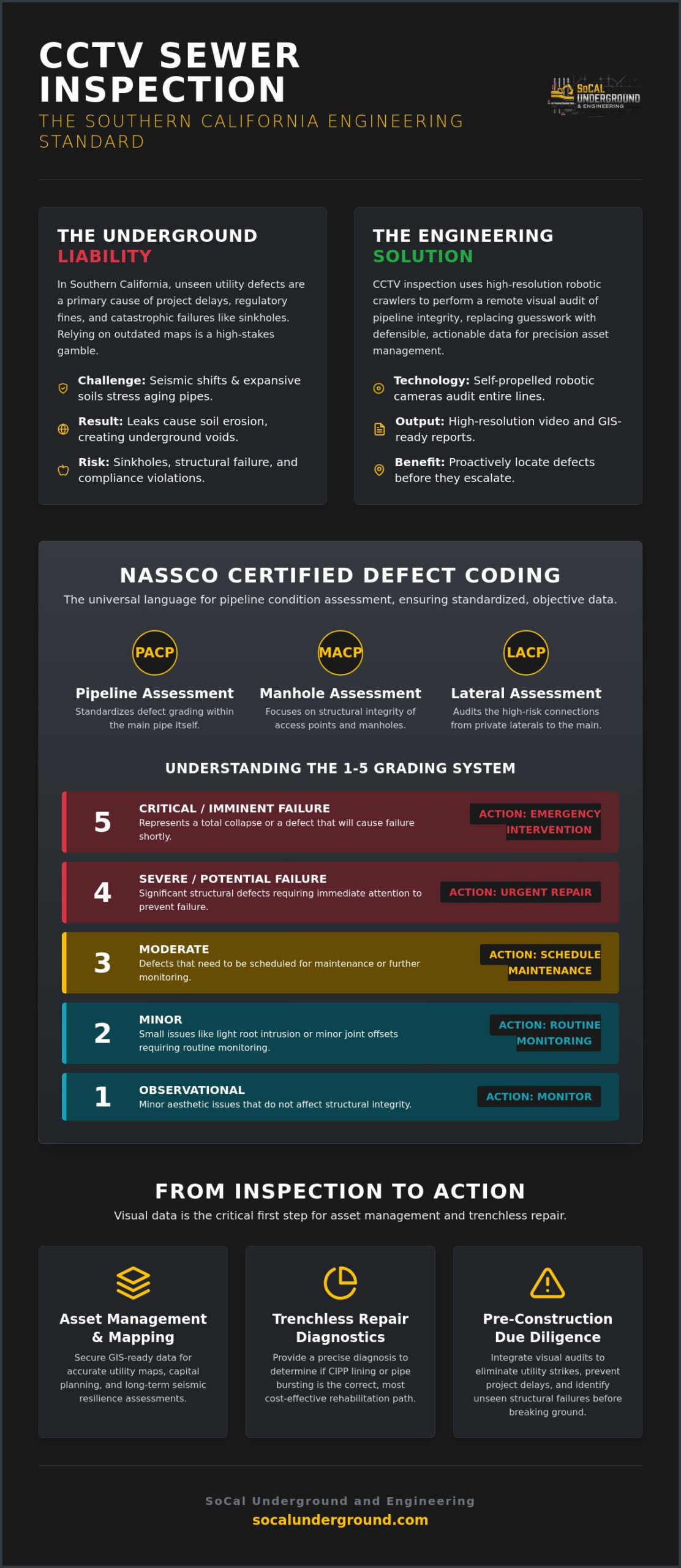
Visual evidence is only as good as the interpretation behind it. In the field, a grainy video of a crack doesn’t help an engineer decide whether to dig or line. We utilize the NASSCO Standards: PACP, MACP, and LACP to ensure every defect is coded with surgical precision. This is the universal language of pipeline health. By using NASSCO Version 8 protocols, we provide a standardized, objective assessment that removes the “guesswork” from CCTV sewer inspection Southern California. Identify the crack. Code the severity. Plan the fix.
The system is divided into three critical certifications. PACP (Pipeline Assessment Certification Program) standardizes the grading of defects within the pipe itself. MACP (Manhole Assessment Certification Program) focuses on the structural integrity of access points, identifying chimney leaks or bench failures before they collapse. Finally, LACP (Lateral Assessment Certification Program) audits the high-risk junction where private sewer laterals connect to the municipal main. This tripartite approach ensures no part of the system is left unexamined. It’s about professional accountability and total system visibility.
Understanding the Grading System
NASSCO codes every defect on a scale of 1 to 5. Grades 1 and 2 represent minor issues like light root intrusion or small joint offsets that require routine monitoring. Grade 3 indicates a moderate defect that needs to be scheduled for maintenance. Grades 4 and 5 are the red zones. These represent imminent structural failure or total collapse. If your report shows a Grade 5 defect under a major thoroughfare, you aren’t looking at a maintenance task; you’re looking at an emergency intervention. Standardized coding allows project managers to prioritize budgets based on actual risk rather than intuition.
Defensible Data for Municipal Projects
Southern California agencies don’t just want video; they want defensible data. Most public works closeouts now require NASSCO-certified reports to verify that new installations meet design specifications. We use WinCan diagnostic software to generate GIS-ready data that plugs directly into municipal asset management systems. This ensures your utility mapping is accurate and your capital planning is backed by hard evidence. If you’re managing a large-scale facility or municipal grid, you need a partner who understands the weight of a certified report. You can trust our team for reliable CCTV inspections that stand up to regulatory scrutiny. We provide the proof you need to sign off on the job with confidence.
High-Resolution Diagnostic Technology for Southern California Soils
Southern California’s geology demands hardware that can handle more than just water. Between seismic shifts and expansive clay soils, pipes don’t just crack; they shift, settle, and shear. Standard CCTV sewer inspection Southern California requires a tiered technology approach to capture every detail. We utilize self-propelled robotic crawlers capable of surveying mains up to 1,000 feet in a single run. For tight-access laterals and smaller diameter lines, high-resolution push cameras provide the flexibility needed to navigate complex bends. These tools don’t just see. They measure. They map. They verify.
Total visibility requires a 360-degree perspective. Our Pan-and-Tilt Zoom (PTZ) cameras allow technicians to inspect joint offsets and lateral connections with surgical clarity. When a defect is identified, Sonde locating technology uses radio-frequency tracking to pinpoint the exact GPS coordinates and depth of the issue. This isn’t a “general area” estimate. It’s a precise coordinate that allows for surgical repairs. This level of accuracy is why NASSCO’s PACP, LACP, and MACP certifications are non-negotiable for our field teams. We provide the data required for engineering-grade decisions.
Navigating Complex Infrastructure
Storm drains and box culverts in the region face unique stressors. Santa Ana winds drive heavy debris, silt, and organic matter into the systems, creating blockages that standard cameras can’t bypass. We deploy specialized camera sleds and bypass pumping to maintain visibility in high-flow environments. This technology is critical for identifying “pipe bellies,” which are sagging sections of pipe caused by local soil settlement. These bellies collect sediment and lead to recurring clogs. Identify the sag. Quantify the slope. Correct the grade. We ensure the infrastructure performs as designed.
The Role of Clean Lines
A visual audit is only effective if the pipe wall is visible. This is why Hydro Jetting Sewer Lines is a mandatory prerequisite for any professional inspection. We use industrial-grade pressure to strip away calcified scale, grease, and invasive root mats that hide structural cracks. Without this cleaning, a camera only sees the debris, not the defect. In cases where visual data needs physical confirmation, we use potholing. This is the process of vacuum-excavating a small, non-destructive test hole to verify the exact depth and material of the utility. Clean the line. Inspect the wall. Verify the depth. This is how you eliminate underground uncertainty.
When to Schedule a Visual Audit: Commercial and Municipal Triggers
Timing isn’t just about convenience; it’s about risk mitigation. In the industrial sector, waiting for a backup to occur is a failed strategy. Professional CCTV sewer inspection Southern California should be integrated into the project lifecycle at specific, high-stakes intervals. Whether you’re breaking ground on a new development or managing an aging municipal grid, the visual audit provides the intelligence needed to proceed. Map the line. Verify the work. Protect the asset.
There are four primary triggers for a professional audit in the SoCal region:
- Pre-Construction Due Diligence: Before heavy excavation or grading begins, you must map existing utilities. Relying on 40-year-old blueprints is a liability. CCTV identifies exact depths and locations to prevent utility strikes and project shutdowns.
- Post-Construction Verification: Never backfill a new installation without a visual sign-off. We verify that the new sewer line meets engineer specifications, ensuring no joints were compromised during the lay.
- Seismic Event Response: Southern California is earthquake country. Even minor tremors can shear clay pipe joints or cause offsets in concrete mains. Post-seismic audits identify these structural shifts before they lead to soil erosion and sinkholes.
- Point-of-Sale Requirements: An increasing number of SoCal municipalities now mandate sewer lateral inspections during property transfers. We provide the certified video evidence required to meet local building codes and close the deal.
Identifying Structural Red Flags
Landscaping in Southern California commercial lots often features aggressive root systems that thrive on sewer moisture. Root intrusion is the leading cause of pipe failure in the region. CCTV allows us to see exactly where roots have breached the pipe wall. We also look for fractures in older cast iron or vitrified clay pipes that indicate the material has reached the end of its design life. Joint offsets are another critical red flag. These minor shifts allow groundwater infiltration (I&I), which overburdens treatment plants and destabilizes the surrounding soil. Catch the offset early. Prevent the collapse.
Strategic Maintenance Planning
Data from a visual audit allows you to justify your capital improvement budget. Instead of guessing which lines need replacement, you can use high-resolution footage to prove the need for CIPP Pipe Lining. We help industrial parks and municipal districts develop multi-year inspection cycles that prioritize “Grade 4” and “Grade 5” defects. This proactive approach slashes 24/7 emergency repair costs by addressing structural weaknesses before they become total system failures. If you need a reliable partner for your next project, contact us for professional CCTV inspections today. We deliver the proof you need for a secure infrastructure.
From Inspection to Action: Integrating Visual Data with Trenchless Repair
Visual data is the foundation of every successful repair. In the industrial sector, an inspection report that sits on a desk is useless. You need a partner who translates video into a project plan. At SoCal Underground and Engineering, we view CCTV sewer inspection Southern California as the intelligence phase of the construction cycle. We don’t just find the problem; we execute the solution. Survey the wreckage. Choose the weapon. Execute the fix.
The transition from diagnostic to delivery follows a strict four-step protocol:
- Step 1: Surface Preparation. We use high-pressure hydro jetting to clear scale and debris. This reveals the pipe wall for a clear audit.
- Step 2: Diagnostic Audit. We deploy the robotic crawler to grade the defect. This determines if the pipe is a candidate for lining or requires a full burst.
- Step 3: Precision Measurement. We capture the exact internal diameter and run length. This ensures material orders for liners or HDPE pipe are accurate to the millimeter.
- Step 4: Quality Verification. After the repair, we perform a final CCTV inspection. This provides documented proof of structural integrity and restored flow capacity.
The Trenchless Advantage
High-resolution data allows us to deploy “no-dig” solutions that protect your surface assets. If the pipe is structurally sound but leaking, we use the visual data to guide CIPP Lining directly into place. This seals the system without breaking a single square foot of asphalt. However, if the camera reveals a total structural collapse or a “Grade 5” failure, we pivot. In these cases, we utilize Trenchless Pipe Bursting to pull a new line through the old one. We use the camera to identify the exact limits of the failure, minimizing the excavation footprint and reducing downtime for your facility.
Choosing a Full-Service Engineering Partner
There’s a significant danger in hiring a “camera-only” company. These firms provide a video but lack the heavy equipment and engineering license to fix what they find. When you’re facing a utility emergency, you don’t have time to manage two different contractors. Our 24/7 emergency response team relies on immediate visual diagnostics to start repairs within hours, not days. We own the equipment. We know the soil. We honor the commitment. Don’t settle for a grainy video and a “good luck” handshake. Contact SoCal Underground and Engineering for a comprehensive CCTV sewer inspection today. We provide the visual proof and the industrial force to secure your infrastructure for the long haul.
Secure Your Infrastructure with Defensible Visual Data
Underground uncertainty is a liability you can’t afford. Professional CCTV sewer inspection Southern California provides the NASSCO-certified proof required for capital planning and seismic resilience. We’ve established how robotic diagnostics eliminate guesswork, standardize defect grading, and pave the way for precise trenchless rehabilitation. It’s about moving from reactive emergencies to proactive asset management. Map the system. Identify the risk. Execute the solution.
Our NASSCO PACP, MACP, and LACP certified operators deliver GIS-ready data that stands up to municipal scrutiny. We aren’t just camera technicians; we’re a full-service civil engineering and utility repair force. Whether you’re verifying a new installation or auditing an aging main, we provide the industrial strength needed to get the job done right. Our 24/7 emergency response team is ready to deploy when the stakes are highest. Don’t leave your infrastructure to chance.
Schedule a NASSCO-Certified CCTV Inspection for Your Infrastructure. Protect your project. Secure the line. Build with confidence.
Frequently Asked Questions
How much does a CCTV sewer inspection cost in Southern California?
Industry rates for inspections across Los Angeles and Orange County vary based on pipe diameter and the detail required for the final report. A basic diagnostic scan typically costs less than a full municipal survey that utilizes NASSCO-certified coding. Final project costs are determined by the total footage, site access challenges, and whether hydro jetting is needed to clear the line before the audit.
How long does a commercial sewer camera inspection take?
Most commercial inspections are completed within 2 to 4 hours per segment. Total time depends on the length of the pipe run and the amount of debris present. If the line requires industrial cleaning to allow camera passage, the process can extend to a full shift. We focus on rapid deployment and efficient data capture to minimize interference with your daily operations.
What is a NASSCO certified pipe inspection?
This is an assessment performed by an operator who has completed NASSCO’s Pipeline Assessment Certification Program (PACP). The certification ensures that every crack, root, and joint offset is coded using a standardized, objective system. It provides engineers and municipal agencies with defensible data that can be used for structural grading and long-term capital planning.
Can CCTV cameras find leaks in pressurized water mains?
No, standard CCTV technology is designed for gravity-fed systems like sewer mains and storm drains. Pressurized water lines require different diagnostic tools, such as acoustic sensors or tethered leak detection systems. CCTV sewer inspection Southern California is used to audit the internal walls of non-pressurized pipes to identify structural failures and invasive root growth.
Do I need to clean my sewer line before a camera inspection?
Yes, hydro jetting is a mandatory prerequisite for a high-quality visual audit. Debris, grease, and silt hide structural defects from the camera lens. Cleaning the pipe wall ensures the robotic crawler can navigate the entire run and provide the high-resolution footage needed for an accurate NASSCO-certified report.
What kind of report will I receive after the inspection?
You’ll receive a comprehensive digital package that includes high-definition video files and still photos of every identified defect. For municipal and industrial projects, we provide a NASSCO-certified log and GIS-ready data. These reports act as a structural roadmap, allowing your team to prioritize repairs based on the actual severity of the pipe’s condition.
Can CCTV cameras inspect storm drains and box culverts?
Yes, robotic crawlers are capable of auditing infrastructure ranging from small laterals to massive box culverts. We use specialized camera sleds and high-intensity lighting to navigate large-scale municipal storm systems. This identifies silt accumulation, joint separation, and structural failures that could lead to catastrophic surface sinkholes if left unaddressed.
Is a sewer camera inspection required for commercial property sales in LA County?
Mandates vary by specific city within Los Angeles County, but a growing number of municipalities now require a lateral inspection and certification before a property title can be transferred. Even without a legal mandate, smart investors use a professional inspection to identify hidden utility liabilities. Always verify current local ordinances with the specific city’s public works department before closing a deal.