What if you could fully restore a failing industrial sewer line without breaking a single square foot of your parking lot? You know the reality of aging infrastructure. A root-clogged clay pipe or a cracked main usually means excavating, weeks of downtime, and a massive bill for asphalt restoration. It’s a logistical headache that halts operations and drains your budget. CIPP pipe lining Riverside County offers a way to bypass the mess and the cost of surface repair while delivering industrial-grade durability.
We understand that reliability is non-negotiable. This guide explains how Cured-In-Place Pipe technology creates a structural, seamless pipe-within-a-pipe that meets the 2025 California Plumbing Code. You’ll discover how this trenchless rehabilitation provides a 50-year service life with zero digging. We’ll break down the installation process, the strength of NSF-listed resins, and how to ensure compliance with the latest Riverside County building standards. Get the facts, fix the pipe, and get back to work.
Key Takeaways
- Eliminate excavation costs by using CIPP technology to create a seamless “pipe-within-a-pipe” that restores structural integrity without breaking ground.
- Evaluate the total ROI of trenchless repairs by calculating the savings on asphalt restoration, traffic control, and avoided business downtime.
- Ensure your project meets 2026 standards for CIPP pipe lining Riverside County while gaining superior resilience against seismic movement and corrosive soils.
- Follow a professional engineering lifecycle of Inspect, Clean, and Cure to guarantee a high-strength finish rated for a 50-year service life.
- Scale your infrastructure repairs effectively by deploying industrial-grade solutions designed for complex commercial and municipal sewer systems.
What is CIPP Pipe Lining in Riverside County?
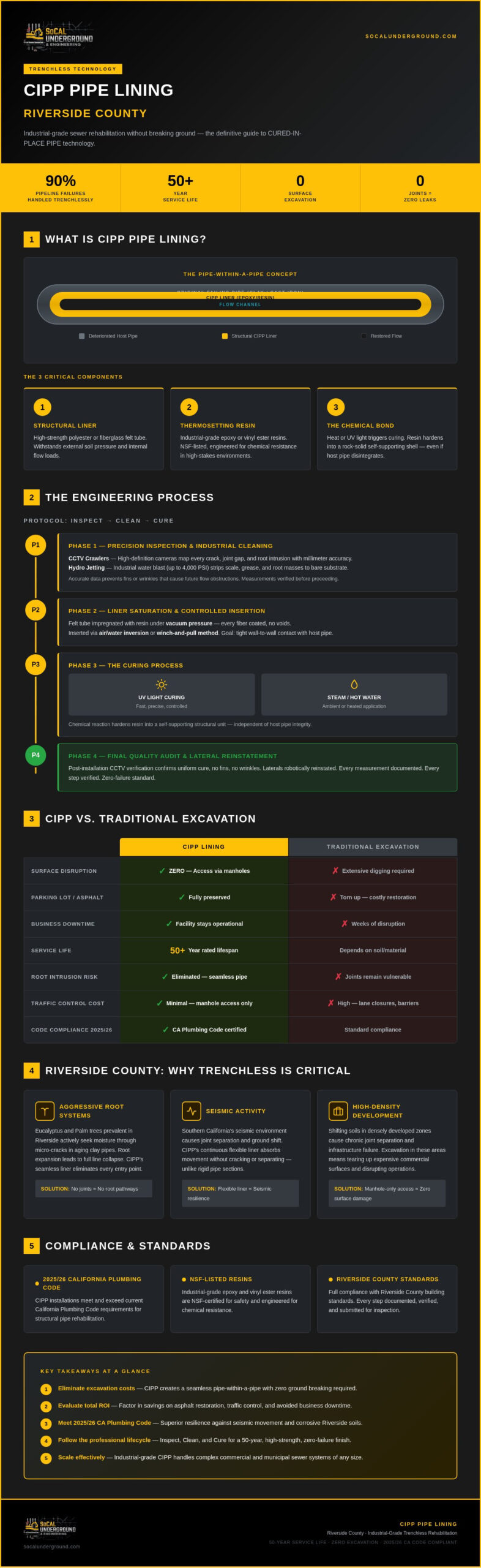
Infrastructure fails. It’s a reality for every property manager and municipal engineer in the Inland Empire. Traditional repairs usually involve heavy machinery, deep trenches, and weeks of site disruption. Cured-in-place pipe (CIPP) changes that equation. It’s a trenchless rehabilitation method that builds a new, structural pipe inside the old one. We don’t dig. We cure. This technology handles approximately 90% of pipeline failures without disturbing the surface. For aging commercial sewer lines and municipal mains, it’s the heavy-duty standard for structural restoration.
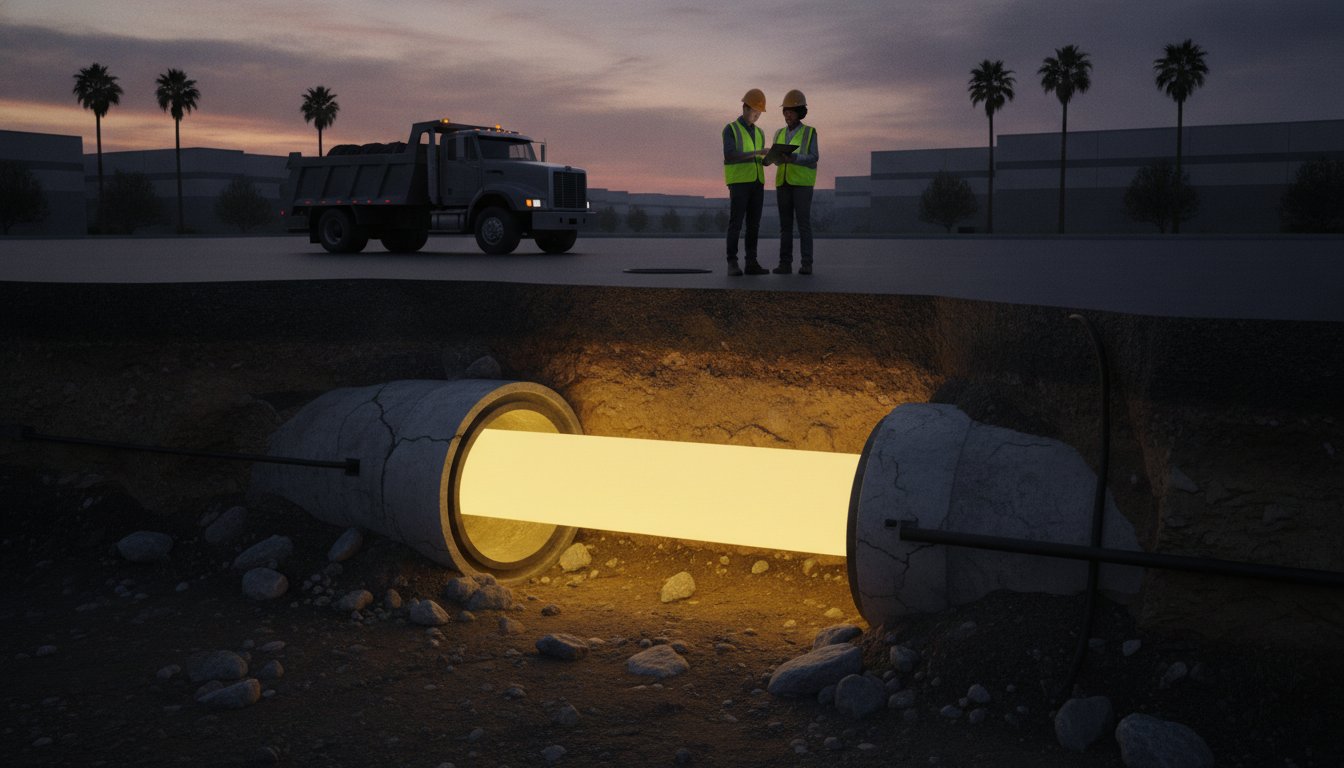
The process is straightforward but requires precision. We saturate a felt tube with resin, pull it into the failing line, and harden it. It’s a “pipe-within-a-pipe” that eliminates joints. No joints mean no leaks. No leaks mean no root intrusion. It’s a permanent fix for a temporary problem. We focus on results that last 50 years or more, ensuring your facility stays operational throughout the entire process.
The Components of a CIPP System
A successful CIPP installation relies on three critical elements. First, the structural liner. This is a flexible, high-strength polyester or fiberglass felt tube. It’s built to withstand the external pressures of the soil and the internal flow of the system. Second, the thermosetting resin. We use industrial-grade epoxy or vinyl ester resins tailored for specific chemical resistance. These aren’t off-the-shelf glues; they’re engineered polymers designed for high-stakes environments. Third, the bond. Once the liner is in place, heat or UV light triggers a chemical reaction. The resin hardens into a rock-solid shell. It doesn’t just patch a hole. It creates a standalone structural unit that supports itself even if the original pipe completely disintegrates.
Why Riverside Infrastructure Needs Trenchless Solutions
Riverside’s landscape presents specific challenges. Local vegetation like Eucalyptus and Palms have aggressive root systems. These roots seek moisture. They find the smallest cracks in aging clay pipes and expand until the line collapses. Shifting soils in high-density developments also cause joint separation and structural failure. Traditional excavation means tearing up expensive asphalt parking lots or cutting through concrete foundations. CIPP pipe lining Riverside County eliminates that destruction. We access the line through existing manholes or cleanouts. You keep your parking lot. You keep your facility open. You get a pipe that resists root intrusion and ground movement for decades. It’s about maintaining operations while securing the future of your underground assets.
The Engineering Process: How We Restore Your Pipeline
Engineering a structural solution requires a disciplined workflow. We don’t just pull a liner and hope for the best. We follow a strict protocol: Inspect. Clean. Cure. This isn’t a residential plumbing patch. It’s a civil engineering deployment designed for CIPP pipe lining Riverside County projects that demand zero failure. Every step is documented. Every measurement is verified. We focus on four distinct phases to ensure the final product stands up to industrial use:
- Phase 1: Precision CCTV inspection and industrial-grade cleaning.
- Phase 2: Liner saturation and controlled insertion.
- Phase 3: The Curing Process (Ambient vs. Steam/Hot Water).
- Phase 4: Final quality audit and lateral reinstatement.
Preparation: Cleaning and Inspection
Before a liner enters the pipe, the host line must be stripped to its original substrate. We use industrial hydro jetting sewer line California to blast away scale, grease, and root masses. Once cleaned, we deploy high-definition CCTV crawlers. This phase serves two purposes. First, it confirms the pipe’s structural readiness. Second, it allows us to measure the internal diameter and length with millimeter precision. Accurate data prevents “fins” or “wrinkles” that can cause future flow obstructions. If the measurements are off, the engineering fails. We get it right the first time. For projects requiring defensible documentation and GIS-ready reporting, our CCTV sewer inspection Southern California services provide the high-resolution visual audit required to shift from reactive repairs to precision asset management.
Phase two involves liner saturation. We impregnate the felt tube with a calculated volume of resin under vacuum pressure. This ensures every fiber is coated. Once saturated, we insert the liner using air or water inversion, or a winch-and-pull method. The goal is a tight fit against the host pipe walls. This process is backed by rigorous testing, including an EPA demonstration of CIPP technology that highlights the method’s effectiveness in municipal environments.
Curing and Structural Finalization
The final transformation occurs during curing. We introduce heat via steam or hot water to trigger the exothermic chemical reaction. For specific industrial applications, we may use UV light for a faster, more controlled cure. This process hardens the resin into a structural unit that meets ASTM F1216 standards. Even though the new pipe is slightly smaller in diameter, its smooth surface improves the “C-Factor.” This means your flow capacity often increases because of reduced friction. This ensures your CIPP pipe lining Riverside County installation provides the maximum possible ROI for your infrastructure.
After curing, we perform a final CCTV audit. We verify the bond and the structural integrity. If the line has laterals or service connections, we use robotic cutters to reinstate them from the inside. No digging. No downtime for adjacent lines. The result is a seamless, high-performance asset ready for immediate service. If your facility needs a technical assessment, request an industrial site inspection to start the process.
CIPP vs. Traditional Excavation: A ROI Comparison
Traditional digging is a logistical war zone. It requires backhoes, dump trucks, and a crew to manage the debris. When you invest in CIPP pipe lining Riverside County, you’re paying for engineering, not dirt moving. The direct cost of the liner might seem comparable to raw pipe on paper, but that’s where the similarities end. Traditional replacement forces you to pay for the destruction of your own property before the repair even begins. We eliminate that waste.
Restoration is usually the largest hidden expense in any utility project. Ripping up a parking lot means paying for asphalt removal, new aggregate, and fresh paving. Cured-in-place pipe (CIPP) technology bypasses these costs entirely. You avoid the heavy machinery and the subsequent need for massive concrete pours. An engineered liner doesn’t just patch the problem. It creates a jointless, root-proof system that often outlasts the original clay or cast iron pipe it inhabits. It’s a structural upgrade that delivers a 50-year service life without the 10-day disruption of a trench.
The “Hidden” Savings of Trenchless Tech
Business downtime is a silent killer of project budgets. We don’t need a fleet of underground utility contractors to reroute your customers or manage complex traffic patterns for weeks. We set up, we line, and we leave. This efficiency minimizes soil displacement and reduces the environmental footprint of the project. CIPP provides a superior lifecycle return by delivering a 50-year structural solution while maintaining 100% facility uptime.
When Excavation is Still Necessary
We shoot straight: trenchless isn’t magic. If a pipe has fully collapsed or lost its basic structural shape, a liner cannot be inserted. CIPP follows the path of the host pipe; it cannot fix a “belly” or a severe grade mismatch. In these cases, we deploy targeted excavation or trenchless pipe bursting contractor California solutions. We use our initial CCTV audit to identify these deal-breakers early. If a full liner isn’t the right fit, we might recommend strategic spot repairs to address specific failure points without over-engineering the entire line. We provide the solution that makes sense for your specific infrastructure, not just the one that’s easiest to sell.
Riverside County Environmental and Seismic Factors
Riverside infrastructure faces two silent enemies: shifting earth and aggressive soil chemistry. You can’t install a rigid pipe in a seismically active zone and expect it to survive indefinitely. Ground movement near the San Jacinto Fault puts immense stress on underground assets. Traditional clay and cast iron pipes are brittle. They crack. They separate at the joints. CIPP pipe lining Riverside County offers a structural solution that moves with the earth rather than fighting it. We don’t just install liners. We engineer for the specific geological reality of the Inland Empire.
The soil itself is often the primary cause of failure in 20th-century Riverside construction. Corrosive alkaline soils common in our region eat through concrete and metal over time. This leads to pinhole leaks, structural thinning, and eventual collapse. CIPP resins are chemically inert. They don’t react to soil pH or groundwater minerals. By creating a seamless barrier, we stop the corrosion cycle and protect the system from the outside in.
Seismic Considerations for SoCal Infrastructure
Earthquakes don’t just break pipes; they exploit their weakest points. In 90% of failures, the joints are the first to go. When the ground moves, rigid pipe segments shift independently, causing immediate separation. CIPP technology utilizes the elasticity of high-grade epoxy resins. This material can absorb minor ground vibrations and shifts without fracturing. Because the finished product is a single, continuous unit from manhole to manhole, there are no joints to fail. This makes it the superior choice for high-risk zones near major fault lines where infrastructure must remain resilient during and after a seismic event.
Adhering to Riverside Municipal Standards
Compliance isn’t optional. Every project we handle must align with the “Greenbook” Standard Specifications for Public Works Construction. We also navigate the specific requirements of the Riverside County Flood Control and Water Conservation District. This includes managing discharge permits for curing water. If we use a hot-water cure, that water must be treated and disposed of according to local environmental laws to prevent chemical runoff. We maintain strict documentation for every cure cycle, ensuring your project passes municipal infrastructure audits without delays. We handle the red tape so you can focus on your facility operations. If you need to ensure your system meets the latest 2026 compliance standards, schedule a seismic infrastructure audit today.
SoCal Underground: Heavy-Duty CIPP Solutions
We don’t just patch pipes. We deliver structural certainty. For CIPP pipe lining Riverside County, you need a partner with the industrial capacity to handle high-stakes infrastructure failures. SoCal Underground and Engineering operates with a single, clear directive: Inspect. Clean. Cure. We manage the full lifecycle of your underground assets. From the initial inquiry to the final structural audit, we maintain professional accountability. We aren’t residential plumbers; we are civil engineering specialists who focus on the heavy lifting.
Our team scales to meet the demands of municipal mains and large-scale commercial facilities. We integrate our lining solutions with a comprehensive suite of civil engineering and utility services. To understand the standards we uphold on every job site, review our guide for choosing a CIPP lining contractor Southern California. We don’t hide behind desk-bound project managers. We are active on the site, ensuring every linear foot of resin meets our internal compass for quality and structural soundness.
Infrastructure doesn’t wait for business hours. When a sewer main fails at 2 AM, your operations stop. We respond. Our 24/7 emergency response isn’t a marketing claim; it’s a commitment to the local landscape. SoCal Underground and Engineering provides the heavy-duty engineering required to keep Riverside moving. We take pride in the finality of our output. When we leave a site, the pipe is fixed for the next 50 years.
Our Heavy-Duty Equipment and Expertise
We utilize industrial-grade inversion tanks and high-output steam generators. These aren’t hobbyist tools. They are precision instruments designed for rapid, controlled curing in large-diameter lines. We maintain total project control by using in-house CCTV and hydro-excavation teams. We don’t outsource our integrity. By keeping every phase of the project under our direct supervision, we guarantee the structural soundness of the finished product. It’s a straight-shooting approach to ethics and engineering.
Next Steps for Your Riverside Project
Getting started requires data, not guesswork. Schedule a diagnostic CCTV inspection to identify the exact state of your underground lines. We provide technical bids for commercial and municipal rehabilitation that account for every engineering variable, from soil chemistry to seismic risk. If your site development is complex, consult with our civil engineering team. We deliver the facts, the plan, and the result. Contact us to secure your infrastructure today.
Secure Your Underground Assets for the Future
Infrastructure is a commitment. CIPP pipe lining Riverside County provides the structural finality required to protect that commitment against seismic shifts and corrosive soils. You bypass the destruction of excavation. You secure a 50-year service life for your sewer mains. This isn’t a temporary patch. It’s a professional-grade restoration that keeps your facility operational. We build it to last.
SoCal Underground and Engineering is a Licensed Civil Engineering Firm specialized in municipal and industrial assets. Our 24/7 Emergency Response Team is active and present. We deliver the solution when your infrastructure fails. We Inspect. We Clean. We Cure. No excuses. No unnecessary downtime. We rely on firm professional ethics to ensure your project meets the highest standards of structural integrity.
Request a Heavy-Duty CIPP Quote for Your Riverside Infrastructure
Your project demands integrity and structural soundness. Let’s get it done.
Frequently Asked Questions
How long does CIPP lining last in Riverside soil conditions?
CIPP liners have a documented service life of 50 years or more, matching the longevity of traditional materials like ABS or PVC. The resin is chemically inert, so it won’t react to the aggressive alkaline soils common in the Inland Empire. This durability ensures that your CIPP pipe lining Riverside County project provides a permanent structural solution rather than a temporary patch.
Can CIPP be used for large-diameter commercial storm drains?
Yes, we scale this technology for large-diameter municipal and commercial storm drains. Our heavy-duty inversion tanks and steam generators are built to handle high-capacity infrastructure. We manage the full lifecycle for industrial-scale storm drain rehabilitation, providing a seamless internal structure that handles heavy flow without the need for trenching.
What is the typical cure time for a CIPP liner in Southern California?
A typical project is completed in a single day. The actual curing time depends on the method used; steam or UV curing is significantly faster than ambient temperature curing. This efficiency allows us to restore your line and exit the site in a fraction of the time required for traditional excavation, which often lasts 2 to 10 days.
Is CIPP lining safe for potable water lines in Riverside County?
CIPP is safe for potable water applications when we use specialized, NSF-listed resins. These materials are engineered for safety and structural soundness in pressurized environments. We verify all material standards before installation to ensure your water service replacement meets every local health and safety regulation.
Does CIPP lining require a building permit in Riverside?
Yes, all CIPP pipe lining Riverside County projects require a plumbing permit. As of January 1, 2026, all permit applications must comply with the 2025 California Plumbing Code. In areas under county jurisdiction, building department fees for these permits are estimated to range between $50 and $500 depending on the project’s scope.
How much flow capacity will I lose by lining my existing pipe?
Internal diameter decreases slightly, but your total flow capacity often improves. The new liner creates a jointless, smooth surface with a superior “C-Factor” compared to aged clay or cast iron. This reduction in friction allows fluids to move more efficiently, often compensating for the minor loss in pipe diameter.
Can a CIPP liner be installed if the pipe has significant root intrusion?
Yes, we install liners in pipes with heavy root intrusion from local vegetation like Palms and Eucalyptus. We use industrial-grade hydro jetting to strip all roots and debris from the host pipe substrate first. Once the line is clean and verified by CCTV, the liner creates a permanent, seamless barrier that prevents future roots from entering the system.
What happens if the host pipe is partially collapsed?
CIPP is not a solution for fully collapsed pipes or lines with severe grade issues. The liner follows the path of the host pipe; it cannot bridge a collapse or fix a “belly” in the line. If our initial CCTV inspection reveals a collapse, we recommend trenchless pipe bursting contractor California services or a targeted spot repair to restore the pipe’s shape before lining.