California accounts for roughly 40% of all ADA accessibility lawsuits in the country. In a city where a single non-compliant ramp can lead to $4,000 in statutory damages plus legal fees, hiring the wrong ADA ramp repair contractor Los Angeles is a gamble you can’t afford. You know the pressure of “drive-by” lawsuits and the headache of navigating the gap between federal mandates and California Title 24. Most contractors aim for “close enough.” In Los Angeles, close enough is a failing grade that leaves your business vulnerable.
You need precision, not guesswork. We understand the frustration of conflicting codes and the fear of a failed inspection. This checklist secures your property and eliminates liability by giving you a professional roadmap for compliant repairs. We will cover the 2026 City of Los Angeles Building Code updates, specific slope requirements, and the documentation needed to verify your site is 100% legal. It’s time to build it right, document the work, and move on.
Key Takeaways
- Master the 2026 Los Angeles Building Code updates to ensure every ramp slope, width, and landing meets strict Title 24 standards.
- Learn how to vet a qualified ADA ramp repair contractor Los Angeles by verifying Class A or C-8 licensing and specific local inspection experience.
- Identify when to utilize precision concrete grinding for minor shifts and when full removal and replacement is the only way to eliminate legal liability.
- Understand how Southern California seismic activity and local street trees impact ramp integrity and long-term structural compliance.
- Access a professional remediation checklist designed to secure your property and provide clear documentation against serial lawsuits.
Understanding ADA Ramp Compliance in Los Angeles
Compliance isn’t about general accessibility; it’s about millimeters. In Southern California, the legal foundation starts with the Americans with Disabilities Act of 1990, but it doesn’t end there. Los Angeles property owners face a dual layer of enforcement. You have federal standards and the more stringent California Title 24 requirements. A qualified ADA ramp repair contractor Los Angeles knows that passing a federal check doesn’t mean you’ll pass a local inspection. LA inspectors prioritize the entire “path of travel.” They look for a seamless, unobstructed route from the public right-of-way to your front door. If one section of concrete is off by a fraction of an inch, the entire path fails.
Hiring a Certified Access Specialist (CASp) is a strategic move before starting repairs. They identify the specific violations. We execute the heavy-duty remediation. This partnership provides a “qualified respondent” status in court. It proves you’re proactive, not negligent. It’s the difference between a handshake deal and a legally defensible infrastructure project. Hiring an experienced ADA ramp repair contractor Los Angeles is the only way to ensure your facility meets both sets of codes without costly rework.
The 1:12 Slope Rule and Beyond
The standard ratio is 1:12. For every inch of vertical rise, you need 12 inches of horizontal ramp. This translates to an 8.33% grade. Don’t aim for the absolute limit. Soil in the Los Angeles basin shifts. Concrete settles. We build at 1:13 or 1:14 whenever the site allows. This extra margin ensures that minor environmental changes don’t push your ramp into non-compliance. Cross-slopes are just as vital. You cannot exceed a 2% (1:48) grade. If a wheelchair veers or water pools on the surface, the ramp is a liability. We use precision grading to keep surfaces flat and functional.
Landing and Clearance Requirements
Every ramp run needs level landings at the top and bottom. These must be at least 60 inches long and at least as wide as the ramp itself. The minimum clear width for any ramp is 36 inches between handrails. If your ramp features a turn, that landing must be a minimum of 60-by-60 inches to allow for a full wheelchair rotation. Door maneuvering is another common failure point. A door swinging into a landing cannot cut into the required clear space. We also focus on edge protection. Curbs or barriers must prevent crutches or wheels from slipping off the side. Handrails are mandatory if the rise exceeds 6 inches. They must be mounted between 34 and 38 inches high with smooth, continuous gripping surfaces. No shortcuts. No “close enough.” Just compliant engineering.
Common Causes of ADA Ramp Failure in SoCal
Concrete doesn’t lie. It reflects every environmental stressor and every shortcut taken during installation. In the Los Angeles basin, the ground is never truly still. Seismic activity and the high clay content of local soils create a cycle of expansion and contraction. This movement leads to “heaving,” where sections of a ramp lift out of alignment. Once a ramp shifts even a fraction of an inch, it often violates the U.S. Access Board’s Guide to ADA Standards. When this happens, you don’t just have a maintenance issue; you have a legal liability. A specialized ADA ramp repair contractor Los Angeles must account for these geological realities before pouring a single yard of concrete.
Tree root intrusion is another relentless enemy. Common LA street trees, particularly Ficus and Liquidambar, have aggressive root systems that can easily crack four-inch concrete slabs. These roots seek moisture and will lift entire landings, destroying the 1:12 slope you worked hard to achieve. Beyond biology, poor drainage is a silent killer. If water ponds at the base of a ramp or seeps into the subgrade, it erodes the supporting soil. This leads to “pumping” and eventual collapse under load. Many property owners also make the mistake of allowing heavy equipment, like delivery trucks or forklifts, onto ramps designed strictly for pedestrian traffic. This overloads the structural capacity, causing deep fractures that no simple patch can fix.
Structural vs. Surface Damage
You need to know the difference between cosmetic issues and terminal failure. Spalling, which is the flaking or peeling of the top concrete layer, is often a surface problem caused by poor finishing or weather. It’s unsightly but sometimes repairable with specialized overlays. Deep structural cracking is different. If a crack runs through the entire thickness of the slab, it usually points to subgrade failure. In these cases, a “skin patch” is a waste of money. You need full-depth reconstruction to stabilize the ground and ensure the new ramp stays level. If your asphalt parking lot is subsiding where it meets the concrete ramp, that transition will quickly become a trip hazard. If you’re seeing these signs, it’s time for a professional site evaluation to determine the best engineering call.
The Hazard of Non-Compliant Transitions
Most ADA lawsuits are triggered by the “1/4 inch rule.” Any vertical lip or change in level greater than a quarter-inch is a violation. These lips often appear at the joints between the ramp and the sidewalk or parking lot. Southern California summers make this worse. Intense heat causes concrete to expand. Without proper expansion joints, the slabs push against each other and “tent” or buckle. Listen for a “hollow” sound when walking on the ramp. This indicates a void has formed underneath, usually from erosion or shifting. These voids are precursors to total failure. An expert ADA ramp repair contractor Los Angeles will use ground-penetrating tools or simple percussion tests to find these weak spots before they become $150,000 federal fines.
Repair vs. Replacement: Making the Engineering Call
Property owners often want the cheapest path to compliance. We understand that. But a quick patch on a failing structure is just an expensive way to delay the inevitable. When you hire an ADA ramp repair contractor Los Angeles, the first task is an engineering assessment. Analyze the site. Assess the damage. Make the call. We don’t just look at the crack; we look at the cause. If the underlying slope is non-compliant, no amount of surface work will save you from a CASp failure. You must decide between a surgical repair or a total teardown.
A major risk involves “patching” a ramp where the slope is already at the legal limit. Adding even a thin layer of material can easily push an 8.33% grade into illegal territory. For projects requiring long-term structural integrity, you need a concrete flatwork contractor Southern California who understands load-bearing requirements and soil stabilization. The new ramp must also integrate perfectly with your existing parking lot paving. If the transition between asphalt and concrete creates a lip, you’re back to square one. Consult California’s Access Compliance Reference Manual to see how these transitions are strictly governed by state law.
When Grinding is an Option
Concrete grinding is a precision tool for minor corrections. If you have a vertical displacement of less than 1/2 inch, grinding can often bring the joint back into compliance. It’s fast. It’s cost-effective. It minimizes downtime. However, grinding has limits. You cannot grind away a structural defect. Removing too much material thins the slab, leading to rapid cracking under heavy traffic. For commercial storefronts, grinding also leaves a scarred finish. We typically follow grinding with a professional seal or finish to maintain the aesthetic of your property while ensuring safety.
The Case for Full Reconstruction
Full removal is the only solution for “built-in” errors. If the original pour was too steep or the landings are too small, grinding is useless. Reconstruction allows us to fix the foundation. We excavate. We stabilize the subgrade. We pour back to exact specifications. This is also the time to upgrade to modern truncated domes. These detectable warnings are mandatory for safety and compliance at curb transitions. A full rebuild also lets us solve drainage issues. We can redirect water flow away from the ramp, preventing the erosion that likely caused the original failure. Build it once. Build it right. Secure the site.

The ADA Ramp Repair Contractor Checklist
Hiring an ADA ramp repair contractor Los Angeles isn’t like hiring a typical concrete finisher. You’re hiring a partner to mitigate legal risk. If the contractor doesn’t understand that a 0.1% slope error can trigger a lawsuit, they shouldn’t be on your job site. Start with the basics: verify a California Class A (General Engineering) or C-8 (Concrete) license. Insurance isn’t optional. You need a firm that carries substantial general liability and workers’ compensation. This protects your property from the moment the first jackhammer hits the ground.
Demand a detailed site survey before any work begins. A “visual estimate” is a red flag. Professional contractors provide digital slope measurements and a clear plan for Title 24 compliance. You also need a firm with “Design-Build” capabilities. In Los Angeles, ramp repairs often uncover old underground utilities or drainage issues that weren’t on the original blueprints. A high-stakes specialist handles these surprises in-house without stopping the project. Review their references, specifically municipal or high-traffic commercial projects. If they haven’t passed a Los Angeles Department of Building and Safety (LADBS) inspection recently, they aren’t ready for your project.
Pre-Construction Verification
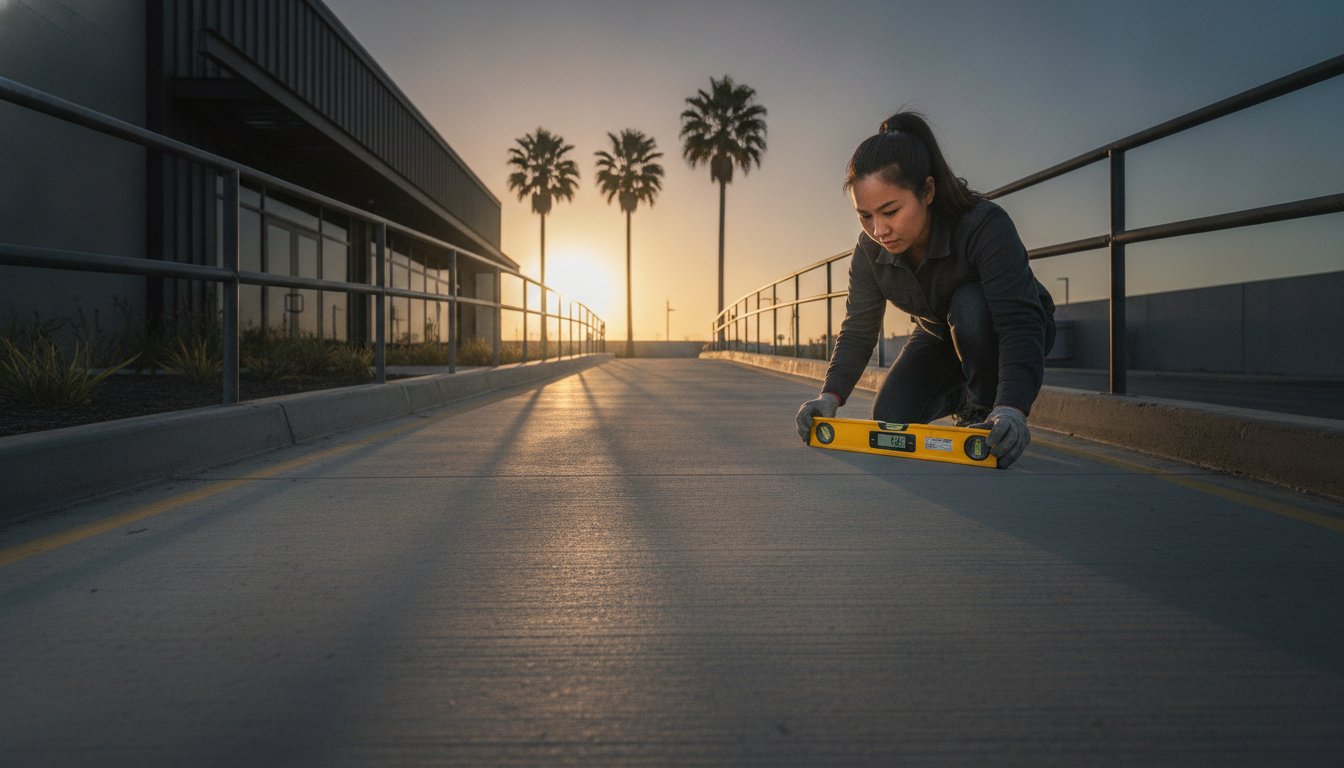
Precision requires the right tools. Ask if the crew uses digital inclinometers or just old-school bubble levels. Digital tools are the only way to guarantee the 2% cross-slope limits mentioned earlier. You must also confirm who is pulling the permits. Navigating the Los Angeles Bureau of Engineering (BOE) is a specialized skill. Don’t handle this yourself. Finally, ask for a traffic control plan. If you’re repairing a ramp at a busy storefront, you need a strategy to keep pedestrians safe and your business accessible during construction.
Quality and Compliance Guarantees
The job isn’t finished when the concrete dries. It’s finished when you have proof of compliance. Demand a compliance certificate post-repair. This document acts as your first line of defense against serial plaintiffs. We don’t use standard residential mixes. We utilize high-strength 4000 PSI concrete to ensure the repair withstands heavy commercial traffic and Southern California heat. Ask about the warranty. A firm that stands behind its work will offer a clear guarantee on both the concrete bond and the structural integrity of the ramp. If you’re ready to secure your property with a firm that values accountability, contact SoCal Underground to schedule your site assessment.
Why SoCal Underground and Engineering is the Choice for ADA Remediation
We don’t do “close enough.” We do heavy-duty engineering. When you hire an ADA ramp repair contractor Los Angeles, you need a partner who understands the high stakes of civil infrastructure. SoCal Underground and Engineering brings a direct, no-nonsense approach to every job site. We specialize in precision concrete removal and replacement across LA County and Orange County. Our team doesn’t just skim the surface. We dig deep. We find the root cause of failure. Whether it’s shifting soil or aggressive tree roots, we stabilize the foundation before we pour the finish. This is rugged work that requires professional accountability and boots-on-the-ground experience.
Safety hazards don’t wait for business hours. We provide 24/7 emergency response for critical repairs that threaten public safety or property access. Because we have specialized expertise in underground utility construction, we navigate complex sites without damaging existing lines. We protect your assets. We minimize your downtime. We eliminate your liability. Every project is a commitment to structural soundness and professional ethics. We are active and present on the job site. We lead with action, not flowery language. We deliver results that pass inspection the first time.
From Demolition to Final Striping
We manage the full lifecycle of your ADA upgrade. We handle the heavy lifting. Our crews manage the demolition, the excavation, and the final finish. This includes integrating your new ramp with broader site improvements and professional ADA stall painting. For complex municipal ramps that require heavy engineering, SoCal Underground and Engineering provides the technical depth to pass the most rigorous Los Angeles inspections. We build for durability. We build for compliance. We build to withstand heavy traffic. We deliver order and efficiency to every project we touch.
The Handshake Commitment
Our reputation is built on honesty. We provide straight-shooting assessments. If a ramp can be saved with precision grinding, we tell you. If it needs full replacement to meet strict Title 24 standards, we show you the data. Project management is transparent from the first permit to the final pour. We value integrity. We honor every handshake. We take pride in the finality and quality of our work. This is localized expertise for high-stakes specialists who need the job done right. Contact SoCal Underground and Engineering today for a precision ADA compliance audit and secure your property for 2026.
Secure Your Property Against 2026 Liability
Compliance in the Los Angeles basin is a game of millimeters where the margin for error is non-existent. Throughout this guide, we’ve outlined the technical thresholds and environmental stressors, from shifting clay soils to aggressive root systems, that threaten your site’s accessibility. Hiring a specialized ADA ramp repair contractor Los Angeles is the final step in closing the gap between a vulnerable property and a legally secure one. We’ve detailed the 2026 code shifts and the critical difference between Federal and Title 24 standards; now it’s time to execute.
SoCal Underground and Engineering provides the heavy-duty civil capabilities needed to handle everything from municipal-grade demolition to precision finishing. Our 24/7 emergency response and deep expertise in LA Title 24 compliance mean your repairs are handled with professional accountability. We don’t just pour concrete; we deliver structural integrity that stands up to the most rigorous inspections. Secure your infrastructure and protect your bottom line with a partner who values the handshake. Get a Precision ADA Audit from SoCal Underground and Engineering and ensure your facility is ready for the years ahead. We’re ready to get to work.
Frequently Asked Questions
How much does it cost to repair an ADA ramp in Los Angeles?
Repair costs are determined by the extent of structural failure and site accessibility. The City of Los Angeles currently estimates the cost of a single curb ramp at approximately $50,000, while nearby Beverly Hills projects average $10,000. These figures illustrate the complexity of municipal-grade concrete work. Your specific project requires a site audit to determine if you need a surface fix or a full engineering overhaul.
What is the maximum slope allowed for an ADA ramp in California?
The maximum allowable slope for a ramp in California is 1:12, which is an 8.33% grade. Any incline steeper than this is a violation of both federal and state law. You must also maintain a cross-slope of no more than 2% to ensure stability for wheelchair users. We build with a slight margin of safety to account for natural soil settling that occurs in the Los Angeles basin.
Do I need a permit for ADA ramp repair in Los Angeles County?
Permits are mandatory for most structural ADA repairs in Los Angeles County. You’ll typically need clearance from the Los Angeles Department of Building and Safety or the Bureau of Engineering. A professional ADA ramp repair contractor Los Angeles handles this administrative burden by pulling the necessary permits and scheduling city inspections. Don’t risk unpermitted work, as it leaves you vulnerable to legal challenges and future code enforcement actions.
Can I just grind down a trip hazard on my ramp to be compliant?
Grinding is only an option for correcting minor vertical displacements of less than 1/2 inch. It’s a fast way to remove small trip hazards at joints. If the shift is larger, grinding will thin the concrete slab too much and compromise its structural integrity. We evaluate the subgrade to see if the concrete is “pumping” or hollow, which usually signals that a full replacement is required.
How long does a typical ADA ramp reconstruction take?
A typical ADA ramp reconstruction takes between three and five business days to complete. This timeline includes the demolition of the existing slab, subgrade stabilization, and the final concrete pour. While the concrete cures quickly, the ramp must remain closed to traffic to ensure the finish and slope aren’t compromised. We coordinate the schedule to minimize downtime for your tenants or customers while maintaining a safe job site.
What are truncated domes and are they required in Los Angeles?
Truncated domes are tactile warning tiles required at the bottom of ramps that enter a hazardous vehicular area. In Los Angeles, these must provide a high visual contrast, typically safety yellow, and meet specific dome spacing requirements. They’re a critical component of Title 24 compliance. We install high-durability tiles that are cast into the wet concrete to ensure they don’t peel or lift under heavy commercial use.
Will an ADA repair protect me from lawsuits immediately?
Remediation provides an immediate defense by removing the physical violation that triggers a claim. Under California law, a single non-compliant feature can result in $4,000 in statutory damages plus attorney fees. By fixing your ramp, you stop the accumulation of these damages and demonstrate a commitment to accessibility. We provide a compliance certificate post-repair to document that your facility meets current 2026 standards and local building codes.
What is the difference between ADA and Title 24?
ADA is the federal civil rights law, while Title 24 is the California Building Standards Code. In Los Angeles, you’re required to follow the stricter of the two. Title 24 often has more rigorous specs for ramp width and handrail extensions than federal guidelines. A qualified ADA ramp repair contractor Los Angeles builds to these higher state standards to ensure your property passes both local inspections and federal accessibility audits.