In Southern California, a water main failure isn’t just a repair job; it’s a massive liability that can paralyze a city block in minutes. You know the pressure of managing mainline infrastructure under the strict eye of local water districts while contending with seismic soil shifts and regulatory hurdles. Hiring a professional water main installation contractor SoCal is about finding a partner who prioritizes structural integrity over speed. Excavate. Connect. Backfill. We understand that every joint and valve is a long-term commitment to the local landscape.
You need a system that stays leak-free and compliant with the 2025 California Building Standards Code. This guide provides the professional blueprint for mastering the complexities of Southern California mainline work. We will cover the specific durability of ductile iron versus HDPE, the July 2026 backflow certification requirements, and the surgical precision required for hot taps on live utilities. From the first permit application to the final pressure test, we lay out the path to a reliable, AWWA-standard water system that minimizes service disruptions.
Key Takeaways
- Master AWWA standards and regional regulations. Ensure your infrastructure meets every compliance benchmark.
- Use hydro excavation and utility potholing. Verify existing lines to prevent costly utility strikes and service interruptions.
- Compare Ductile Iron and HDPE. Select the right material for Southern California soil chemistry and seismic stability.
- Execute Hot Taps on live mains. Maintain water service to the community while completing critical system tie-ins.
- Hire a water main installation contractor SoCal with a Class A license. Demand a partner with owned equipment and proven field accountability.
Understanding Water Main Infrastructure in Southern California
A water distribution system is the structural lifeline of any commercial or municipal development. The mainline acts as the heavy-duty backbone for both potable water and fire-service infrastructure. In the SoCal region, these systems must endure extreme environmental stressors. Expansive soils and high-density utility corridors leave zero room for error. This is high-stakes civil work. It requires a Class A licensed water main installation contractor SoCal to ensure the project meets rigorous AWWA standards. We plan, permit, and perform every installation with surgical precision.
Compliance is the only path forward. Every foot of mainline must adhere to American Water Works Association (AWWA) specifications to guarantee longevity and public safety. Failure to follow these standards leads to catastrophic leaks, regulatory fines, and system-wide shutdowns. Hiring an experienced water main installation contractor SoCal ensures your project avoids these pitfalls. We prioritize structural integrity from the first trench to the final pressure test.
The Role of Mainline Systems in Commercial Development
Commercial projects demand a clear distinction between domestic water services and dedicated fire protection mains. Domestic lines focus on consistent, safe delivery for daily use. Fire mains are built for volume. They must provide the massive hydraulic flow required for life-safety systems during an emergency. Local water districts, including LADWP and MWD, enforce strict regulations on pipe diameter and material selection. System pressure requirements dictate the build. A professional contractor calculates these loads, selects the right materials, and executes the installation without compromise. It’s about matching the infrastructure to the demand of the site.
Seismic Considerations for SoCal Utility Lines
Southern California’s geography is unforgiving. Rigid pipe systems are a liability in high-risk fault zones. When the ground moves, a rigid system shears and fails. We utilize flexible expansion joints and specialized fittings to absorb energy. These components allow the infrastructure to move with the earth rather than against it. Expansive soils further complicate the landscape. These soils swell and shrink, applying constant external pressure on the pipe walls. Seismic joints are specialized mechanical couplings designed to accommodate axial, lateral, and angular pipe displacement during a seismic event. We build for the next big shift, ensuring the water stays in the pipe and the pressure stays in the system.
Steps to Planning a High-Capacity Water Main Installation
Mainline construction begins long before the first excavator arrives on site. Planning starts with a rigorous review of civil engineering plans and the procurement of district encroachment permits. A professional water main installation contractor SoCal ensures every detail aligns with the California Waterworks Standards (Title 22). This includes meeting mandatory separation distances from existing sewer and reclaimed water lines. We don’t guess. We verify. Every step is documented to satisfy the inspector’s requirements and the project’s long-term viability.
Site Assessment and Utility Mapping
Utility mapping is the first line of defense against catastrophic strikes. We combine Ground Penetrating Radar (GPR) with active DigAlert (811) coordination to visualize the underground landscape. Electronic markings are only estimates. We utilize hydro excavation for utility potholing to physically locate existing conduits. This non-destructive method exposes fiber, gas, and power lines without the risk of mechanical damage. Identifying potential conflicts with storm drains or sewer laterals early prevents mid-project redesigns and costly delays. It’s about seeing the obstacles before they become emergencies.
Trenching Safety in Dense Urban Corridors
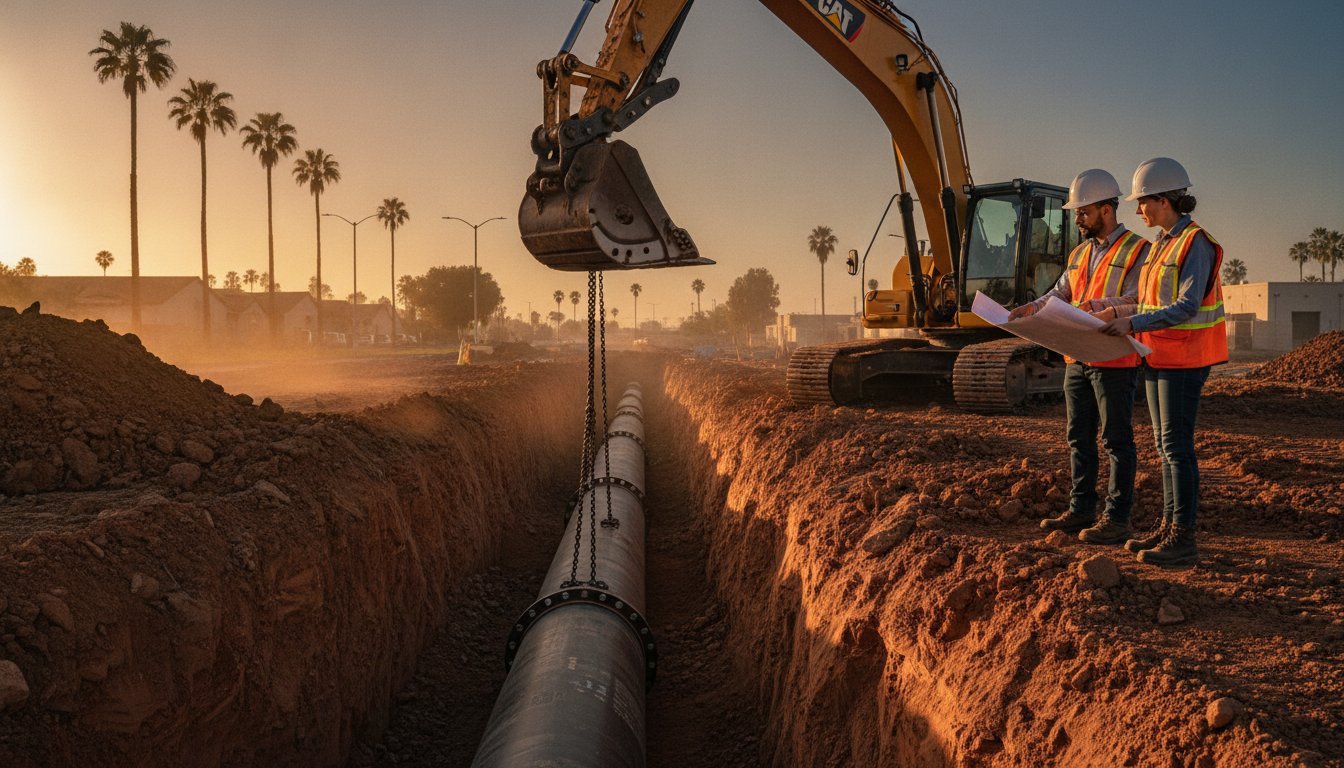
Deep burial requires uncompromising safety systems. Southern California presents a mix of stable clay and unstable sandy soils. In Los Angeles and San Diego, we deploy OSHA-mandated shoring systems tailored to the specific soil classification. Trench boxes and hydraulic shoring protect our crews and the surrounding infrastructure. Traffic control is equally critical in high-density areas. Managing high-volume SoCal traffic requires engineered bypass plans and professional flagging. Once the pipe is set, we use slurry backfill to meet strict street restoration requirements. This ensures the road surface remains stable under heavy traffic loads and prevents future sinking.
Precision placement of pipe sections is the core of the build. Each segment is placed with laser-guided accuracy to maintain the specified grade and alignment. Mechanical joints are torqued to manufacturer specifications to prevent future movement. After the line is joined, the system undergoes rigorous pressure testing. We hold the line at 150% of operating pressure for a set duration. No drops. No leaks. Disinfection involves a high-concentration chlorine flush followed by a clean water purge. We pull samples for laboratory analysis to ensure the system is bacterially safe. Relying on a seasoned water main installation contractor SoCal ensures these testing protocols are executed with total transparency and moral accountability.
Material Selection: Ductile Iron vs. HDPE for SoCal Soil
Material selection isn’t a matter of preference; it’s a calculated engineering decision based on soil chemistry and seismic risk. Southern California soil is often corrosive, expansive, and unstable. A professional water main installation contractor SoCal must analyze these site conditions before spec’ing the pipe. Ductile Iron offers unmatched structural rigidity for high-pressure environments. HDPE provides the flexibility needed to survive ground movement in fault zones. We evaluate the load, the soil, and the required lifespan. We choose the material that ensures the system stays in the ground and out of the repair queue.
Ductile Iron: The Municipal Standard
Ductile Iron Pipe (DIP) remains the heavy-duty standard for high-pressure urban corridors and LA County public works projects. It’s built for extreme durability. With a lifespan exceeding 100 years, DIP handles high traffic loads and internal pressure surges without flinching. However, bare metal is vulnerable. SoCal soil chemistry can be aggressive. We implement polyethylene encasement, commonly known as polywrap, to shield the pipe from corrosive elements. This barrier is essential for maintaining structural integrity over the long haul. For a comprehensive technical breakdown of AWWA C151 standards, seismic design requirements, and V-Bio polyethylene encasement in aggressive soils, our ductile iron water main contractor guide to high-pressure infrastructure covers the full engineering blueprint. Analyze the environment. Protect the asset. Ensure longevity.
HDPE and Trenchless Options
High-Density Polyethylene (HDPE) excels where flexibility is the priority. Unlike traditional pipes, HDPE joints are heat-fused to create a monolithic, leak-proof system. This makes it the ideal choice for seismic fault zones where ground displacement is a certainty. HDPE also facilitates trenchless pipe bursting. This method allows us to replace failing mains by pulling a new line through the old one, significantly reducing surface disruption. For a deeper look at these civil engineering strategies, reference our guide on Underground Utility Construction: The Complete Guide. It provides the broader context for modern SoCal infrastructure.
Installation speed and lifecycle costs must be weighed against upfront material prices. For 8-inch diameter pipe, HDPE material typically costs between $25 and $40 per linear foot. Ductile Iron for the same diameter ranges from $45 to $65 per foot. While HDPE has a lower entry price, the 50-year lifecycle analysis often favors Ductile Iron. Some industry studies indicate that DIP can result in up to 30% lower total system costs when factoring in maintenance and its 100-year service life. We don’t just look at the invoice for the pipe. We look at the cost of the system over the next five decades. Hiring an expert water main installation contractor SoCal ensures your material choice is backed by data and professional ethics.

Executing the Tie-In: Hot Taps and Wet Taps
The tie-in is the final, high-stakes phase of mainline infrastructure. A “Hot Tap” (or Wet Tap) allows a new connection to be made to a live water main without interrupting the existing flow. This is precision engineering at its peak. Contrast this with “Dry Tie-ins.” Dry connections require a total system shutdown, draining the line, and notifying every affected resident. It’s slow, disruptive, and often unnecessary for modern developments. A professional water main installation contractor SoCal prioritizes the Hot Tap method to keep the community online and the project on schedule.
Clean the pipe. Secure the sleeve. Torque the bolts. The process begins by installing a heavy-duty tapping sleeve around the existing main. We then attach a permanent gate valve to the sleeve. A specialized drilling machine is mounted to the valve face. This machine uses a shell cutter to core into the live pipe through the open valve. Once the cut is complete, the cutter retracts, the valve closes, and the “coupon”—the circular piece of the pipe wall—is removed. This is surgical work on an industrial scale.
Why Hot Tapping is Preferred in Southern California
Logistics drive the decision. In high-density areas like Los Angeles or Orange County, notifying thousands of residents of a water shutoff is a massive administrative burden. Beyond the paperwork, a live main maintains critical fire-flow protection for adjacent properties. We don’t compromise safety for convenience. The wet tap mechanism utilizes a specialized shell cutter and pilot drill housed within a pressure-rated chamber to penetrate the pipe wall while maintaining a watertight seal against the system’s internal PSI. This ensures zero pressure loss during the entire procedure.
Testing and Final Chlorination
The new infrastructure must be proven before it goes into service. We pressure test every new segment to 150% of the maximum operating pressure. The line must hold this pressure without a single drop for the duration of the test. Once the structural integrity is verified, we move to “Super-Chlorination.” This involves injecting a high-concentration chlorine solution into the new line to eliminate any biological contaminants. After the required contact time, we flush the system. We use neutralizing agents to dechlorinate the water before it enters the municipal storm drain or sewer system. This protects the local environment while ensuring potable water safety.
If you need a team that handles high-pressure connections with stoic confidence, hire a water main installation contractor SoCal who owns their gear and knows the ground.
Selecting a Water Main Installation Contractor in SoCal
Mainline infrastructure demands a specialist with high-stakes field experience. When you vet a water main installation contractor SoCal, a Class A General Engineering license is the non-negotiable standard. This credential validates the technical mastery required to manage deep excavations, heavy-duty shoring, and complex hydraulic loads. It’s about professional accountability. We don’t just read civil plans; we interpret the ground conditions and anticipate the risks before they impact the schedule.
Equipment ownership separates the doers from the brokers. A top-tier contractor owns their hydro-excavation trucks, shoring systems, and tapping gear. This ensures the right tools are on-site without the delays or surcharges of third-party rentals. It also reflects a permanent commitment to the local landscape. Inspect. Deploy. Install. We maintain our own fleet to ensure every project moves with industrial weight and total reliability.
The “Full-Service” factor is your primary defense against project fragmentation. Underground work is only half the lifecycle. You need a partner who handles the entire scope, including street restoration, asphalt paving, and concrete curb replacement. Managing multiple subcontractors for surface work leads to liability hand-offs and communication failures. A single-source contractor provides “handshake” accountability from the first trench to the final striping. Properties transitioning off aging private systems may also benefit from understanding the full scope of a septic to sewer conversion Southern California municipalities increasingly require, as this work often intersects with mainline tie-in planning and municipal sewer capacity coordination.
The SoCal Underground and Engineering Advantage
We provide a formidable industry presence on every project site. SoCal Underground and Engineering offers 24/7 emergency response for water main failures, understanding that infrastructure doesn’t break on a schedule. We integrate civil construction with surgical precision. From utility potholing to final asphalt overlay, we maintain control of the entire process. This vertical integration gives municipal and commercial developers a direct, localized partner who values integrity above all else.
Ready to Break Ground?
Successful builds start with a transparent, detailed bid that eliminates hidden costs. We manage the friction of utility coordination and district permits so your team can focus on the development. Our internal compass is rooted in moral character and structural soundness. We view every mainline installation as a commitment to the community’s future. When you’re ready for a specialist who takes pride in the finality and quality of their work, we’re ready to break ground. Contact SoCal Underground and Engineering for a Water Main Consultation and let’s secure your project’s foundation.
Secure Your Mainline Infrastructure
Reliable water distribution requires more than just digging a trench. It demands a surgical approach to material selection, seismic joint integration, and live-system tie-ins. You now understand the critical role of AWWA compliance and why hydro excavation is the only way to protect existing utilities. These standards ensure your system survives Southern California’s expansive soils and high-density corridors for the next fifty years. Don’t leave your project’s success to chance or unproven subcontractors.
SoCal Underground and Engineering brings stoic confidence to every job site. We are Class A General Engineering Licensed and specialize in high-stakes wet taps and hydro excavation. When infrastructure fails, our 24/7 emergency utility response team is ready to move. We handle the full lifecycle of your project, from civil planning to final street restoration. Integrity is our compass; we deliver results you can trust. Choosing the right water main installation contractor SoCal means choosing a partner who values structural soundness above all else. Request an Infrastructure Project Estimate from SoCal Underground and Engineering today. Let’s build a system that stands the test of time.
Frequently Asked Questions
What is the difference between a water main and a water service line?
A water main is the high-capacity municipal pipeline that acts as the backbone of the distribution system. It transports potable water throughout a community or development. A water service line is the smaller diameter pipe that branches off the main to deliver water to a specific property or meter. While the main serves the public infrastructure, the service line is dedicated to an individual building.
How much does a new water main installation cost in Southern California?
Total project costs depend on pipe diameter, material selection, and the complexity of the site conditions. Factors such as soil stability, existing utility density, and traffic control requirements in urban centers like Los Angeles significantly influence the final bid. A professional water main installation contractor SoCal provides a detailed, transparent estimate that accounts for these regional variables and street restoration needs.
How long does a typical water main installation project take to complete?
Timeline varies based on the length of the run and the complexity of the tie-ins. A standard commercial mainline installation can take anywhere from a few weeks to several months. This schedule includes pre-construction planning, permitting, excavation, pressure testing, and final asphalt restoration. Owning the necessary equipment and maintaining utility coordination are the primary drivers of a fast-paced, efficient schedule.
What is a wet tap and why is it used for water main connections?
A wet tap, also known as a hot tap, is a method of connecting a new line to an existing main while it remains under full pressure. We use a specialized tapping machine to core through the pipe wall without shutting off the water supply. This prevents service disruptions to the surrounding community. It’s the preferred method for high-stakes infrastructure where a system shutdown is logistically impossible.
Do I need a special permit for water main work in Los Angeles or San Diego?
Yes, all mainline work in the public right-of-way requires specific encroachment and excavation permits from the local municipality. In Los Angeles, you’ll coordinate with the Bureau of Engineering and LADWP; in San Diego, approvals go through the Development Services Department. Hiring a water main installation contractor SoCal ensures this paperwork is filed correctly and the project remains compliant with AWWA standards.
What is the lifespan of a ductile iron water main in SoCal soil?
Ductile iron pipe typically has a service life exceeding 100 years when installed correctly. In Southern California, the corrosive nature of many soil types makes polyethylene encasement, or polywrap, essential to achieving this longevity. This protective barrier shields the metal from aggressive soil chemistry. We build for the long term, ensuring the infrastructure outlasts the current development.
Can you replace a water main without digging up the whole street?
Yes, pipe bursting is a proven trenchless method for replacing aging mains with minimal surface disruption. We pull a new high-density polyethylene (HDPE) pipe through the existing line, breaking the old pipe outward as the new one is installed. This avoids the need to excavate the entire street, which is especially valuable in dense urban corridors. It’s an efficient solution that saves time on restoration.
What happens if a water main breaks during construction?
Immediate response is the only priority during a failure. We maintain 24/7 emergency response capabilities to handle utility strikes or structural breaks on the job site. Our crews utilize bypass pumping and rapid shoring to stabilize the area while performing the repair. We take full professional accountability for the site, fixing the problem before it escalates into a larger liability.