In the 1989 Loma Prieta earthquake, ductile iron pipe made up 20% of the infrastructure in the impact zone and recorded zero failures. While other materials shattered under the stress, ductile iron held its ground. You understand the stakes in Southern California. Corrosive soils and active fault lines turn weak pipelines into massive liabilities. Choosing an expert ductile iron water main contractor is about more than just digging a trench. It’s about securing a 100-year infrastructure lifespan through superior engineering and material strength.
We agree that high lifecycle costs and frequent repairs are unacceptable for modern municipal and industrial projects. This guide provides the technical blueprint you need to master high-pressure water distribution. You’ll learn the engineering advantages of AWWA C151 standards, the necessity of ISO 16134 seismic design, and how to combat aggressive soils with V-Bio polyethylene encasement. We cover everything from material comparisons to specific California regulatory requirements to ensure your next project is built to last. Expect a deep dive into the installation requirements that keep high-pressure systems reliable for a century.
Key Takeaways
- Understand why nodular graphite provides the flexibility and impact resistance necessary for high-pressure water systems.
- Evaluate the structural advantages of ductile iron over HDPE and PVC when managing seismic ground shifts and heavy external loads.
- Master the specific corrosion protection strategies required to survive Southern California’s aggressive alkaline soil environments.
- Learn how to vet a ductile iron water main contractor for Class A licensing and specialized hot tap capabilities.
- Discover the engineering standards and installation techniques that secure a 100-year infrastructure lifespan.
What is a Ductile Iron Water Main?
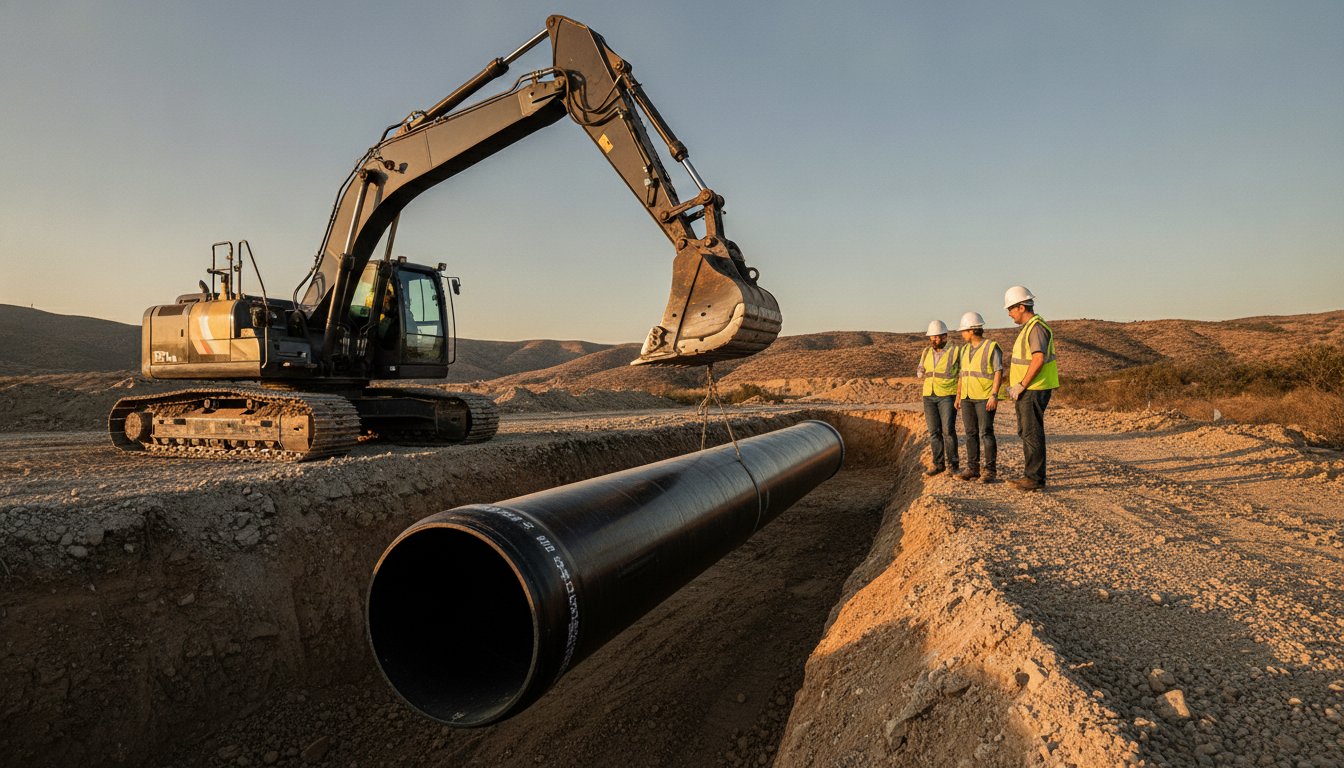
Modern water infrastructure demands more than just a hollow tube. It requires a resilient, high-strength alloy designed to withstand extreme internal pressures and external loads. Ductile Iron Pipe represents the peak of this engineering. It’s an evolution of the traditional gray cast iron used in the early 20th century. Unlike its brittle predecessor, ductile iron is manufactured through a centrifugal casting process. This ensures uniform wall thickness and structural integrity across every linear foot. As a specialized ductile iron water main contractor, we rely on this material for its predictable performance in the field. It provides the heavy-duty backbone for municipal fire lines and potable water transmission systems.
The Evolution from Cast Iron to Ductile Iron
The primary difference between old cast iron and modern ductile iron lies in the shape of the graphite. In traditional cast iron, graphite exists as flakes. These flakes create internal stress points, making the pipe brittle and prone to cracking under impact. Modern manufacturing introduces magnesium into the molten iron. This transforms the graphite into nodules or spheres. This nodular structure allows the metal to bend without breaking. It provides the toughness required to handle heavy surface loads from Southern California traffic. Modern infrastructure has phased out gray iron entirely. We now focus on materials that offer impact strength, high tensile strength, and long-term reliability.
Anatomy of a Ductile Iron Pipe
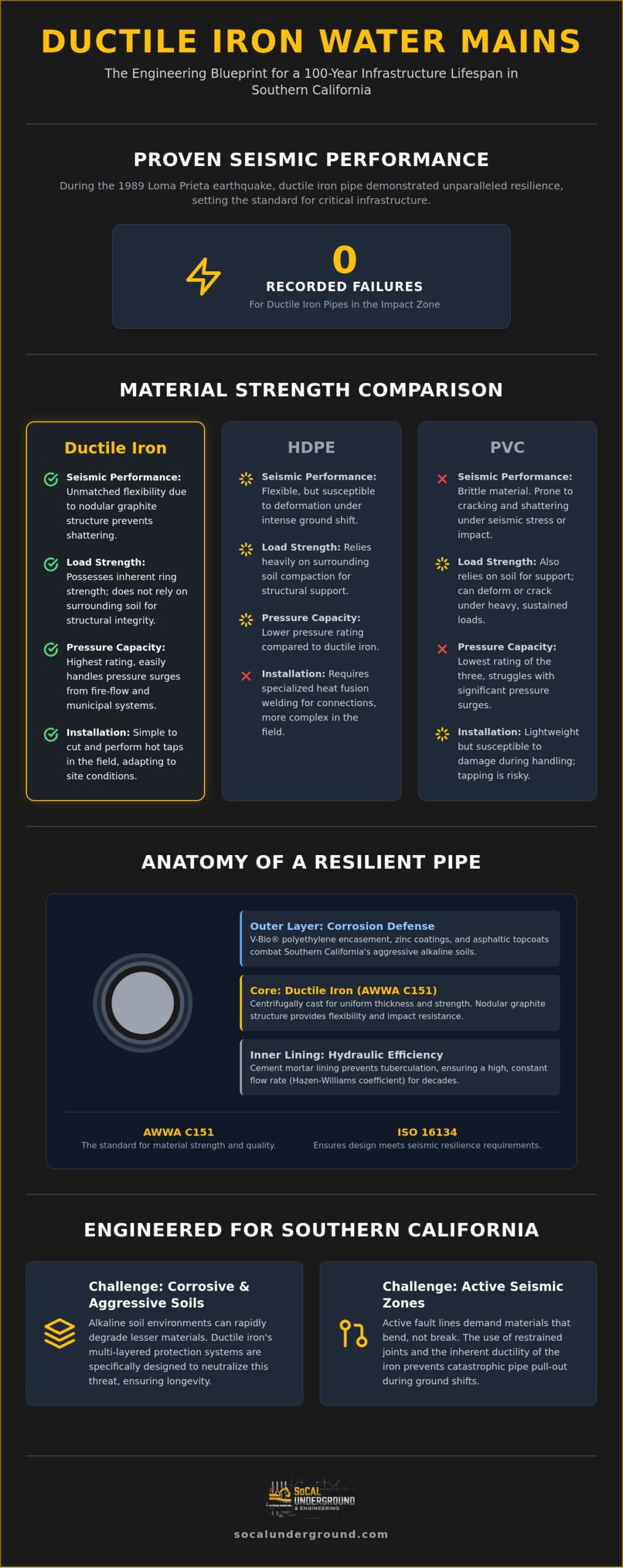
A ductile iron water main is a multi-layered system built for hydraulic efficiency and environmental resistance. Every component serves a specific purpose in the lifecycle of the pipeline. Most pipes feature an internal cement mortar lining. This lining prevents tuberculation, keeping the interior smooth and maintaining high flow rates for decades. The external protection is equally critical. To survive aggressive soil conditions, pipes are often treated with zinc coatings, asphaltic topcoats, or encased in polyethylene sleeves. The joint system is the final piece of the puzzle. We utilize three primary types depending on the project requirements:
- Push-on Joints: Fast, reliable connections for standard burial.
- Mechanical Joints: Versatile fittings for valves and hydrants.
- Restrained Joints: Essential for high-pressure zones and seismic areas where pipe pull-out is a risk.
When you hire a professional ductile iron water main contractor, you’re investing in a system designed for a 100-year lifespan. It’s about more than just the pipe. It’s about the engineering behind the alloy and the precision of the installation. We build it right, we seal it tight, and we ensure it lasts.
Engineering Benefits of Ductile Iron for Public Works
Public works infrastructure isn’t the place for experimental materials. It requires a proven standard that stands up to the crushing weight of urban development. Ductile iron provides that certainty. It offers an exceptional pressure capacity that far exceeds the requirements for municipal fire and potable water services. While thermoplastic pipes might struggle with pressure surges, ductile iron handles them with ease. It’s engineered for pressure, built for loads, and designed for decades. For a ductile iron water main contractor, this means installing a system that won’t fail when the city needs it most.
The material’s resistance to external loads is unmatched. In high-traffic commercial areas, water mains must withstand constant vibration and heavy H-20 traffic loads. Ductile iron doesn’t rely on the surrounding soil for its structural integrity; it possesses its own inherent ring strength. This makes it the preferred choice for shallow burials or locations where soil compaction is difficult to achieve. Additionally, the internal cement mortar lining ensures superior hydraulic flow. This lining prevents internal corrosion and maintains a high Hazen-Williams coefficient for the life of the pipe. It reduces friction, lowers pumping costs, and keeps water moving efficiently through the grid.
Contractors value the material for its practical field advantages. Unlike rigid or specialized materials, ductile iron is easy to cut and tap on-site. This flexibility is vital when encountering unmapped utilities or changing site conditions. Whether you’re performing specialized water main repairs or expanding a new development, the ability to make fast, secure connections saves time and money. It’s a “handshake” material—honest, tough, and reliable.
Longevity and Lifecycle Cost Analysis
A 100-year service life isn’t a marketing claim; it’s a documented reality for ductile iron systems. When you analyze the lifecycle costs, the data in the Ductile Iron vs. HDPE and PVC comparison shows a clear advantage for iron. You avoid the frequent replacement cycles common with thinner-walled materials. Maintenance requirements are minimal because the pipe doesn’t become brittle or lose strength over time. The upfront investment in ductile iron pays for itself by eliminating three cycles of replacement required by inferior materials over a century of service.
Versatility in Complex Utility Corridors
Modern utility corridors are crowded and aggressive. You need a pipe that plays well with a variety of fittings and valves. Ductile iron is compatible with almost every standard municipal fitting, allowing for seamless integration into existing networks. It’s also the gold standard for “hot taps” and “wet taps” where live service expansions are required without shutting down the water supply. In industrial zones, its natural resistance to hydrocarbon permeation protects the water supply from external contaminants. It’s a high-stakes specialist that performs under pressure. If you’re managing a complex rollout, consulting with an experienced ductile iron water main contractor ensures these technical advantages are fully realized during installation.
Ductile Iron vs. HDPE and PVC: A Material Comparison
Choosing between iron and plastic isn’t just a matter of price. It’s a decision about structural philosophy. PVC and HDPE are flexible conduits that rely on the surrounding soil for their strength. If the soil shifts or compaction is poor, the pipe deforms. Ductile iron is a rigid material that supports itself. According to the Ductile Iron Pipe Research Association, this inherent strength allows iron to handle massive external loads that would crush thermoplastic alternatives. In the field, this means less time spent on meticulous trench bedding and more time on production. As an experienced ductile iron water main contractor, we see the difference when the pressure is on.
Temperature sensitivity is another industrial reality. Plastic pipes lose significant pressure ratings as ground temperatures rise, which is a constant factor in Southern California. Ductile iron remains stable regardless of the thermometer. From an environmental standpoint, the comparison is lopsided. Ductile iron is manufactured from up to 90% recycled scrap metal and is 100% recyclable at the end of its life. Plastic polymers are petroleum-based and often end up in landfills. When you’re building for the next century, the material’s origin and its ultimate destination matter.
When to Choose Ductile Iron Over Plastic
There are scenarios where plastic simply isn’t an option. If your project requires pressure ratings exceeding 200 PSI, ductile iron is the industrial standard. It’s also the required choice for deep burials where the weight of the overburden exceeds the crush rating of PVC. In congested urban centers, the speed of underground utility construction often dictates the material. You can’t always wait for the perfect soil conditions required for HDPE fusion or PVC bedding. Ductile iron goes in fast, stays round, and handles the abuse of a live job site.
The Cost Factor: Upfront vs. Long-Term
The material procurement cost for ductile iron is higher than PVC. That’s a fact. However, the labor intensity for installation tells a different story. While HDPE is lightweight, it requires specialized fusion equipment and perfect trench prep to prevent failure. Iron is heavy and requires machinery, but it’s more forgiving in the trench. The real savings appear in the maintenance budget. By avoiding frequent water main repairs caused by plastic fatigue or point loading, the total cost of ownership for iron is significantly lower over a 50-year window. A professional ductile iron water main contractor focuses on that long-term ROI. We don’t just look at the invoice for the pipe; we look at the cost of the first repair ten years down the line. With iron, that repair rarely happens.
Southern California Challenges: Corrosion, Seismic Activity, and Soil
Southern California is a hostile environment for underground infrastructure. Alkaline soils, active fault lines, and shifting coastal terrain create a perfect storm for pipeline failure. A qualified ductile iron water main contractor must account for these variables during the design and installation phase. We don’t just lay pipe; we engineer systems to survive. In Los Angeles and San Diego Counties, regulatory compliance is strict. Local water districts demand infrastructure that meets specific AWWA standards for both material strength and environmental protection. If you don’t account for the soil chemistry, your 100-year asset becomes a 10-year liability.
Corrosion is the primary threat in our region. To combat this, we utilize V-Bio polyethylene encasement. This advanced protection system features an antimicrobial component and a volatile corrosion inhibitor. It neutralizes the corrosive nature of alkaline soils and prevents the buildup of anaerobic bacteria. When combined with the pipe’s natural resilience, this encasement provides a robust barrier against the elements. It’s a proven, cost-effective method that secures the lifespan of the main without the complexity of full cathodic systems. For projects requiring the highest level of reliability, contact SoCal Underground and Engineering to discuss your specific site requirements.
Seismic Resilience for Critical Water Lines
In earthquake zones, rigidity is a weakness. We utilize restrained joints to provide the necessary joint deflection during ground movement. These joints allow the pipeline to shift, bend, and stretch without pulling apart. This is critical for high-priority fire service lines and potable water mains in hillside or unstable terrain. During a tremor, the earth moves; your infrastructure must move with it. We focus on three key seismic priorities: secure the joints, protect the valves, and ensure continuous flow. This engineering approach keeps critical services live when the ground stops shaking.
Soil Analysis and Cathodic Protection
Every project begins with data. We conduct soil resistivity tests to determine the exact corrosive potential of the site. Based on these results, we implement targeted protection strategies. This may include sacrificial anodes or bonded coatings to divert electrical currents away from the pipe. This level of detail is especially important in high-density septic to sewer conversion areas where soil conditions are often compromised by decades of effluent. We test the ground, analyze the risks, and deploy the defense. It’s the only way to guarantee the structural integrity of a water main in Southern California’s diverse landscape. When aging underground infrastructure reaches the end of its service life, coordinating water main upgrades alongside sewer line replacement in Southern California ensures the entire utility corridor is modernized efficiently and without redundant excavation.
Selecting a Ductile Iron Water Main Contractor
Selecting a ductile iron water main contractor requires more than just comparing bids. It requires a partner with a Class A General Engineering license and the rugged accountability to back it up. Public works projects are high-stakes environments. A single error in a high-pressure line can flood a city block or compromise a commercial district. We prioritize contractors who demonstrate deep experience with high-pressure wet taps and line stops. These procedures allow for system expansion without service interruption. They require precision, specialized equipment, and a steady hand on the job site. If a contractor can’t handle a live tap, they shouldn’t be on your mainline.
Municipal track records matter. You need a team that understands traffic control, public safety, and the logistical hurdles of urban construction. We’ve built our reputation on transparency and results. We don’t hide behind desk-bound project managers. We stay active on-site. This ensures every phase of the project meets the rigorous demands of local water districts. Reliability is our baseline. We maintain 24/7 emergency response capabilities because water main failures don’t follow a schedule. When a line blows at 2:00 AM, you need rapid mobilization, not an automated voicemail.
Safety and Technical Expertise
Safety isn’t a checklist on our sites; it’s a core requirement for every trench we open. Deep water mains demand specialized shoring systems to protect both the crews and the surrounding utility network. We utilize hydro excavation for precision potholing in high-density areas. This non-destructive digging method identifies existing lines without the risk of mechanical damage common with traditional backhoes. Once the pipe is laid, we execute rigorous pressure testing and disinfection protocols. We verify every joint and ensure the water meets strict health standards before the system goes live. We build it to last, and we test it to prove it.
The SoCal Underground Advantage
We’ve spent decades navigating the unique geological landscape of Southern California. From the rocky hillsides of San Diego to the corrosive coastal soils of Orange County, we understand how the ground behaves. We offer a full-service capability that most specialists lack. We handle the entire lifecycle of the project, including excavation, grading, and final street restoration. You get a single point of contact and direct, “straight-shooting” communication. There’s no fluff and no excuses. We view every project as a commitment to the local community. We provide the heavy-duty engineering and professional ethics required to keep the water flowing for the next hundred years. It’s a handshake deal backed by industrial strength.
Secure Your High-Pressure Infrastructure
Ductile iron is more than a material choice; it is an insurance policy for your project’s future. Its nodular graphite structure and self-supporting strength provide a level of resilience that thermoplastic pipes simply cannot match. In the volatile landscape of Southern California, engineering for seismic shifts and corrosive soils is not optional. It is the baseline for survival. You’ve seen the data on 100-year lifecycles and the ROI of superior material strength. Now it’s time to put that engineering into the ground.
Partnering with a specialized ductile iron water main contractor ensures your project meets the highest standards of AWWA compliance and municipal reliability. We bring the heavy-duty equipment and professional accountability required for complex utility construction. Our team is Class A General Engineering licensed and deeply experienced in municipal infrastructure. We stand ready with a 24/7 emergency response team to handle critical failures and rapid mobilization. We don’t just dig trenches; we build the backbone of our local communities.
Request a Quote for Your Water Main Project
Let’s build a system that stands for the next century. We have the tools, the license, and the boots-on-the-ground experience to get it done right the first time.
Frequently Asked Questions
What is the typical lifespan of a ductile iron water main?
A professional ductile iron water main contractor installs systems with a typical lifespan of 100 years or more. This longevity stems from the material’s high tensile strength and impact resistance. Unlike thermoplastic pipes that can become brittle over time, iron maintains its structural integrity. It is an industrial-grade asset that outlasts the financing of most municipal projects.
How does ductile iron pipe handle seismic activity in Southern California?
Ductile iron handles seismic activity through joint deflection and superior tensile strength. During the 1989 Loma Prieta earthquake, iron pipe recorded zero failures in the most heavily impacted areas while other materials shattered. We use specialized restrained joints that allow the pipeline to shift and bend without rupturing. It remains the gold standard for earthquake-resistant water infrastructure.
Is ductile iron more expensive than PVC for water main installation?
Ductile iron has a higher upfront material cost than PVC but offers a lower total cost of ownership. You pay more at the supply yard but save on long-term maintenance and replacement cycles. Iron doesn’t suffer from the fatigue or point loading failures common with plastic polymers. It is a strategic investment in infrastructure that eliminates the need for frequent repairs.
What internal linings are used to prevent corrosion in ductile iron pipes?
Most pipes use a cement mortar lining to prevent internal corrosion and maintain flow. This lining complies with AWWA C104 standards and prevents the buildup of tuberculation. It ensures the interior remains smooth to maximize hydraulic efficiency. This keeps water quality high and reduces the energy costs required for pumping over the life of the system.
Can ductile iron pipes be used for sewer and wastewater applications?
Yes, ductile iron is used for sewer force mains and gravity lines when specified with appropriate internal linings. While cement mortar works for potable water, sewer applications often require ceramic epoxy or calcium aluminate linings. These specialized coatings protect the metal from hydrogen sulfide gas and corrosive effluent. It provides a heavy-duty, self-supporting alternative to plastic for critical sewer infrastructure.
What are restrained joints and why are they used in water mains?
Restrained joints are mechanical locking systems that prevent pipe sections from pulling apart under pressure. They are essential in high-pressure zones, steep grades, and seismic areas where ground shift is likely. These joints eliminate the need for massive concrete thrust blocks in the trench. They secure the line, handle the pressure, and prevent catastrophic blowouts during tremors.
How do you protect ductile iron pipe from corrosive soils?
We protect the pipe from aggressive soils using V-Bio polyethylene encasement. Southern California’s alkaline soils are highly corrosive, but this multi-layered wrap neutralizes the exterior environment. It prevents anaerobic bacteria growth and stops sacrificial corrosion before it starts. It is a cost-effective, proven defense that ensures the pipeline reaches its full 100-year service life.
Does SoCal Underground handle both installation and emergency repairs?
Yes, SoCal Underground provides comprehensive services for both new construction and emergency failures. As a ductile iron water main contractor, we maintain a 24/7 response team for rapid mobilization in Los Angeles, Orange, and San Diego Counties. We handle the engineering, the excavation, and the final restoration. Whether it is a planned development or a midnight main break, we get the job done.