A quick patch job is a temporary bandage on a structural wound. In a region where coastal salt air and heavy urban traffic accelerate pavement failure, you need more than a surface-level fix. You need precision. Professional asphalt grinding services San Diego County contractors provide the surgical accuracy required to restore infrastructure without the waste of a total tear-out. It’s the difference between a project that lasts and one that requires constant, costly maintenance.
We understand the pressure of tight municipal deadlines and the headache of managing complex traffic control in San Diego’s busiest corridors. You want a durable surface, minimal downtime for your facility, and a guarantee that your site meets every environmental and ADA standard. This article delivers the technical specifications and the decision-making framework you need to evaluate your pavement. We will compare grind and overlay strategies against full-depth reconstruction so you can move from a failing surface to a finished project with total confidence.
Key Takeaways
- Understand how precision cold milling restores proper drainage and curb-line reveals without requiring a total site tear-out.
- Learn to differentiate between surface-level milling and full depth reclamation for projects with failing base layers.
- Use our decision-making framework to choose between a surgical grind and overlay or a complete reconstruction based on structural integrity.
- Navigate the unique logistics of asphalt grinding services San Diego County projects, from coastal environmental factors to complex traffic management.
- See how integrated surface and subsurface engineering ensures that utility access and street restoration happen without operational delays.
Asphalt Grinding Services San Diego County: Precision Surface Engineering
Asphalt grinding, often called milling, is the surgical removal of pavement layers to a precise, pre-determined depth. It isn’t just about demolition. It’s about precision. In San Diego, decades of simple “cap and seal” maintenance have led to a phenomenon known as pavement creep. This happens when new layers are stacked on old ones, eventually burying concrete gutters and eliminating curb reveals. Professional asphalt grinding services San Diego County teams use specialized rotating drums to shave away these excess layers. This process creates a textured surface that bonds perfectly with new asphalt while maintaining the original design elevation. We strip the waste, level the grade, and prepare the site for a long-term solution.
Why San Diego Infrastructure Requires Precision Milling
San Diego County presents a diverse set of engineering challenges that demand a tailored approach. In coastal zones like Carlsbad or Oceanside, the marine layer brings constant humidity. This moisture infiltrates micro-cracks, weakening the asphalt binder and causing premature stripping. Inland, in areas like El Cajon or Escondido, extreme heat cycles cause expansion and contraction that leads to severe rutting and “shoving” at intersections. Grinding removes these compromised top layers without disturbing the stable base underneath. In the North County hillsides, soil shifting often disrupts drainage patterns, leading to standing water. Precision milling allows us to re-grade the surface. We cut, level, and slope to ensure water moves away from the foundation and toward proper catch basins.
The Role of Grinding in Street Restoration
Successful street restoration is about the transition. If the new asphalt doesn’t meet the existing concrete gutters, sidewalks, or driveways perfectly, the project fails. Grinding creates a clean “butt joint” at the edges. This ensures a flush surface that prevents tripping hazards and allows for strict ADA compliance in public right-of-ways. It’s especially critical after underground utility construction. Once the trench is backfilled and compacted, the surrounding area must be milled to allow for a seamless, unified overlay. We strip the old, prep the base, and pave the finish. This method prevents the “patchwork” look that plagues poorly managed repairs. It provides a structurally sound, long-term fix for high-traffic municipal corridors and industrial loading docks. By removing only what’s damaged, we preserve the integrity of the remaining infrastructure.
The Mechanics of Cold Milling and Asphalt Pulverization
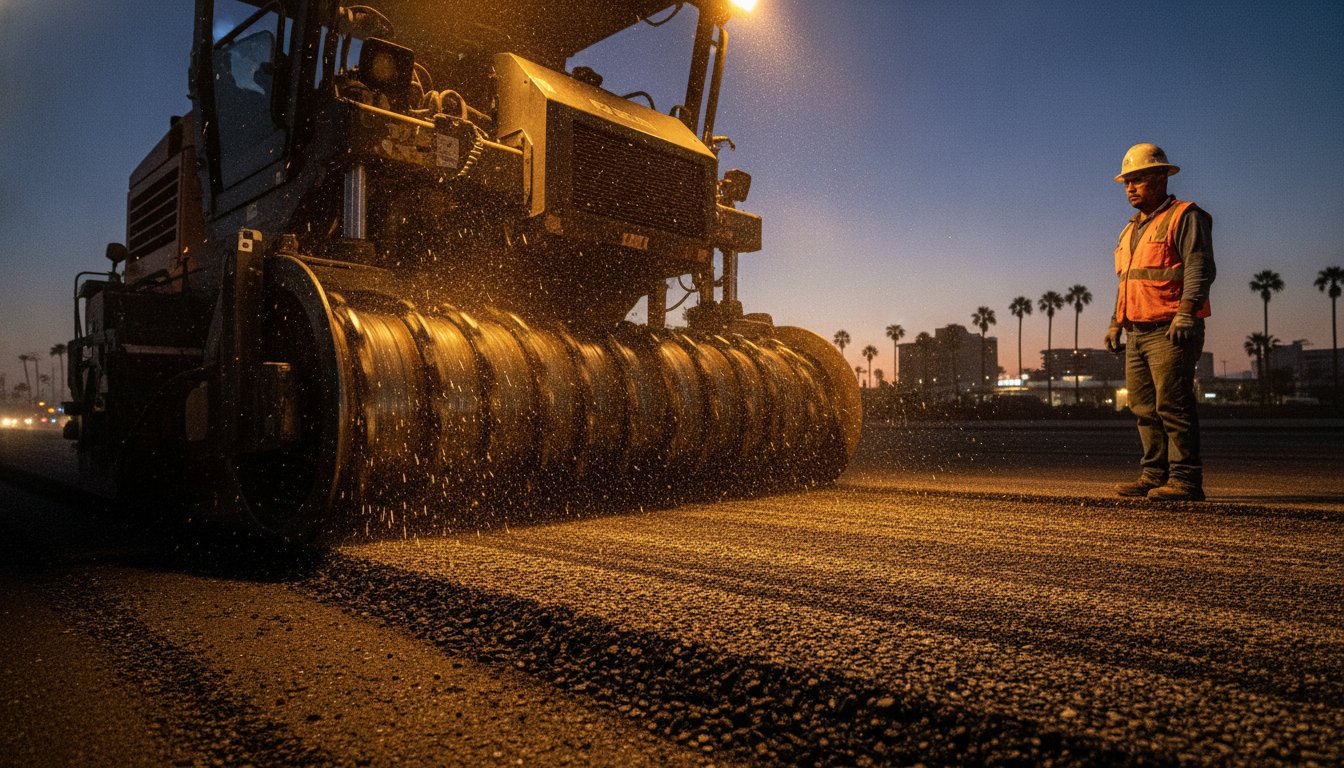
The heavy lifting of asphalt restoration happens at the drum. A self-propelled milling machine uses a high-speed rotating drum equipped with hundreds of carbide-tipped teeth. These teeth impact the pavement with massive force. They break the asphalt into manageable pieces. This cold milling process is the standard for asphalt grinding services San Diego County projects, allowing for the precise removal of damaged layers without the heat or fumes of older methods. It is a clean, mechanical strike. It leaves behind a textured pattern that’s ready for a fresh bond.
For large-scale San Diego projects, efficiency is the priority. Modern milling machines are self-propelled units that can strip thousands of square feet in a single shift. When the surface only requires a thin-lift overlay or needs improved skid resistance, we utilize micro-milling. This specialized drum configuration uses more teeth with tighter spacing. It results in a finer texture. It maximizes friction. It ensures the new layer adheres perfectly to the old.
Cold Milling vs. Pulverization: Which Do You Need?
Choosing the right method depends on the condition of your sub-base. Cold milling is a surgical strike. It removes the top 1 to 4 inches of distressed asphalt while leaving the structural base intact. It’s the go-to for fixing ruts, cracks, and drainage issues in industrial parking lots. When evaluating asphalt grinding services San Diego County providers, look for equipment that can handle both precision milling and high-volume pulverization. Pulverization, or Full Depth Reclamation (FDR), is a deeper intervention. It grinds the entire asphalt layer and blends it with the underlying base material. This creates a stabilized foundation for a completely new road. If your sub-base has failed, milling won’t save it. You need pulverization to reset the structural clock.
Following California pavement maintenance and rehabilitation standards ensures that every cut meets municipal requirements. For industrial facilities, the choice between these methods impacts both your timeline and your budget. Milling is faster. It keeps the site operational. Pulverization is a longer process but eliminates the need for imported base materials. If you’re unsure which path fits your facility, our team at SoCal Underground and Engineering can provide a site assessment to determine the most cost-effective engineering route.
Technical Specifications for Industrial Grinding
Precision is non-negotiable. We manage milling depths ranging from a 1-inch surface shave to a full-depth removal of the entire pavement section. The goal is a uniform surface texture. A consistent “milled” profile provides the mechanical interlock needed for optimal binder adhesion. Without this texture, the new overlay is prone to delamination under heavy truck loads. Recycled Asphalt Pavement (RAP) is the direct output of this process, serving as a sustainable material that is hauled to local plants and repurposed into new asphalt mixes. We mill, we haul, we recycle. It’s a closed-loop system that reduces waste and lowers project costs.
Grind and Overlay vs. Full Depth Reconstruction
Every successful project starts with a structural audit. You don’t guess; you measure. When evaluating asphalt grinding services San Diego County, the first objective is to determine if the pavement failure is skin-deep or structural. If the sub-base is sound, a grind and overlay is the most efficient path. This process acts as a surgical rehabilitation. We mill off the oxidized, cracked surface; we clean the area; we apply a fresh asphalt lift. It’s a targeted strike that restores the site without the disruption of a total excavation. However, if the foundation has failed, a surface fix is a waste of capital. We identify the failure, prescribe the fix, and execute the plan.
Full Depth Reconstruction is the heavy-duty alternative. It’s required when the pavement has reached the end of its design life or when the sub-grade has been compromised by water intrusion. For commercial facilities in San Diego County, the Return on Investment (ROI) depends on this initial diagnosis. A grind and overlay can extend pavement life by 10 to 15 years at a fraction of the cost. A reconstruction is a 20 to 30-year investment. We analyze the traffic loads, the soil conditions, and the budget to ensure you aren’t over-engineering a simple fix or under-engineering a major failure.
The Grind and Overlay Advantage
Speed and cost drive the decision for most San Diego retailers and facility managers. Grind and overlay projects offer a significantly lower cost-per-square-foot because they eliminate the need for massive excavation and new base material. The turnaround is fast. We can often mill and pave an entire parking lot section in a single day, keeping your business operational. It’s also an environmentally responsible choice. By reusing the existing base and recycling the milled asphalt, we reduce the project’s carbon footprint and minimize the hauling of waste to local landfills.
When Reconstruction is Non-Negotiable
Structural collapse doesn’t hide. If your site shows “alligator cracking”—small, interconnected cracks that resemble reptile scales—it’s a sign of sub-grade saturation. The foundation can no longer support the load. In these cases, milling is insufficient. We must remove the entire section, stabilize the sub-grade, and rebuild from the dirt up. This is critical for industrial pads that handle heavy equipment and constant freight traffic. Often, a total site rebuild requires integrating new concrete flatwork to ensure proper drainage and structural transitions. We dig, we grade, we pave. This ensures the new infrastructure stands up to the heaviest industrial demands without premature failure.
San Diego Site Logistics: Coastal Challenges and Utility Coordination
Grinding in San Diego County isn’t a “set and forget” operation. It’s a logistical chess match. High-density urban centers like Downtown or Hillcrest require a tight perimeter. Before the drum hits the ground, we execute utility potholing. This isn’t optional. We identify, mark, and protect subsurface infrastructure. A single strike on a shallow gas line or water main halts the project. It risks the site. It blows the budget. We plan the cut. We clear the path. We execute the grind.
San Diego’s microclimates dictate the pace of the work. Coastal humidity slows the cooling of the tack coat. Inland heat in East County keeps the new asphalt pliable for longer, extending the window before final compaction. Professional asphalt grinding services San Diego County teams adjust their timing based on these shifts. We monitor the temperature. We time the rollout. We hit the density specs every time. If your project requires integrated civil construction management and precision milling, our team is ready to deploy.
Managing Traffic and Public Safety
Municipal projects in San Diego demand advanced traffic control. We often execute night-shift grinding to bypass the gridlock of the I-5 or I-8 corridors. This minimizes the impact on commuters. We deploy comprehensive traffic control plans including certified flaggers, K-rail placement, and real-time signage for pedestrian detours. High-vibration milling can affect adjacent historical structures or sensitive utilities. We monitor the impact. We shield the surroundings. We keep the public safe.
Environmental Compliance and Material Recycling
San Diego County enforces strict Best Management Practices (BMPs) for storm drain protection. Grinding generates fine particulates. Without containment, these enter the watershed. We implement vacuum systems and perimeter barriers to keep the site clean. Dust control is managed in compliance with regional air quality standards through constant water suppression. Once the asphalt grinding services San Diego County project moves to the hauling phase, the RAP (Recycled Asphalt Pavement) is transported to local facilities. We clear the site. We recycle the road. We prep for the finish.
Why SoCal Underground and Engineering for Industrial Asphalt Grinding
Most paving companies stop where the dirt begins. We don’t. Pavement is merely the protective layer for the critical infrastructure buried beneath it. Choosing a partner for asphalt grinding services San Diego County requires more than just looking at a price sheet; it requires an engineering perspective. SoCal Underground and Engineering specializes in the intersection of surface restoration and subsurface integrity. We understand that a milled surface is only as good as the utility lines and sub-grade supporting it. We analyze the site, execute the grind, and secure the foundation. Our approach is built on a handshake and backed by a fleet of high-capacity machinery designed for the toughest industrial environments.
Reliability isn’t a marketing term for us. It’s a standard. We provide 24/7 emergency response for critical infrastructure failures across the county. If a utility main collapses under a primary municipal corridor, we don’t wait for business hours. We deploy the crew, manage the traffic, and restore the surface. This “straight-shooting” style of communication ensures that project managers and municipal leads are never left guessing. We provide the technical specs, we hit the deadlines, and we stand by the finality of our work. No excuses. Just results.
Integrated Underground and Surface Solutions
We offer a single-point solution for complex civil projects. Before the milling drum ever touches the asphalt, we can utilize hydro excavation to safely locate and expose sensitive utility lines. This precision digging prevents the catastrophic strikes that derail timelines. Our expertise extends far beyond the surface. We can seamlessly transition from high-volume asphalt grinding to advanced trenchless pipe bursting for sewer and water line replacement. We repair the pipe, backfill the trench, and mill the street. This integrated workflow eliminates the need for multiple subcontractors and ensures structural integrity from the pipe to the final asphalt lift.
Heavy-Duty Equipment and Expert Crews
Speed is essential for minimizing facility downtime. We utilize high-capacity milling machines that clear large-scale industrial sites and municipal roads with surgical efficiency. Our operators are trained in the specific public works standards required by San Diego County. They understand the nuances of grade control and surface texture. Every job site is a commitment to moral character and structural soundness. We don’t cut corners. We don’t hide mistakes. We deliver a finished product that meets every ADA and environmental requirement. If you need asphalt grinding services San Diego County that prioritize technical accuracy and rugged reliability, SoCal Underground and Engineering is on the job site and ready to work.
Secure Your Infrastructure with Precision Milling
Pavement is the final seal on an infrastructure project, but its longevity depends on the engineering behind the grind. We have analyzed how precision milling protects drainage profiles and why distinguishing between surface distress and sub-base failure is the key to managing your ROI. For high-density urban corridors and industrial centers, professional asphalt grinding services San Diego County teams must navigate complex traffic logistics and coastal humidity to deliver a surface that holds.
SoCal Underground and Engineering stands as an A-Licensed Civil Engineering Contractor specializing in complex municipal restoration. We don’t just shave the surface; we secure the entire site. With 24/7 emergency infrastructure support and an integrated approach to underground utility work, we provide a handshake reliability that distant corporations cannot match. Our team remains active and present on every job site to ensure the finality and quality of the output.
Request a Precision Asphalt Grinding Quote from SoCal Underground and Engineering. Let’s get to work on your site restoration today.
Frequently Asked Questions
What is the primary difference between asphalt grinding and total removal?
Asphalt grinding removes specific surface layers while leaving the stable base intact. Total removal involves excavating the entire pavement section and the sub-base beneath it. Grinding is a surgical rehabilitation for surface distress. Total removal is a complete structural reset for sites with foundation failure. We analyze the base, determine the depth, and execute the cut.
How long does a typical grind and overlay project take in San Diego?
Professional asphalt grinding services San Diego County teams complete most projects in one to three days. We mill the surface, clean the area, and pave the finish in a continuous, high-speed cycle. This efficiency minimizes operational downtime for local retailers and industrial facilities. Larger municipal street sections may require more time for phased traffic control and night-shift coordination.
Can asphalt grinding be performed at night to avoid traffic?
Yes, night-shift milling is a standard practice for high-traffic San Diego corridors. We deploy specialized lighting and advanced traffic control to execute the work while the city sleeps. This prevents gridlock on major arteries like the I-5 or I-8. It keeps your project moving without the daytime commute headache. We hit the site, we mill, we clear.
Is asphalt grinding more environmentally friendly than traditional paving?
Grinding is the most sustainable method for road restoration. It generates Recycled Asphalt Pavement (RAP) which is hauled to local plants and repurposed into new asphalt mixes. This reduces the need for virgin aggregates and keeps waste out of regional landfills. We mill the road, we haul the material, we recycle the waste. It is a closed-loop system.
How deep can an asphalt milling machine cut in a single pass?
A standard milling machine typically cuts between 1 and 4 inches in a single pass. The specific depth depends on the drum configuration and the structural goals of the project. For deeper repairs or full depth reclamation, we adjust the drum or perform multiple passes. We hit the spec every time. Precision depth control is the core of our operation.
Does asphalt grinding work on surfaces with significant drainage issues?
Precision milling is the primary tool for correcting drainage. We re-grade the surface by varying the cut depth to restore the proper slope. This ensures water moves away from foundations and toward catch basins. It eliminates standing water and prevents sub-base saturation in North County hillsides. We slope the grade, we clear the water, we protect the base.
What happens to the asphalt after it has been ground up?
The milled material is loaded directly into trucks and transported to local recycling facilities. It becomes RAP for future construction projects. This closed-loop system is a key component of the asphalt grinding services San Diego County contractors provide. It turns old waste into new infrastructure. We don’t dump material; we repurpose it for the next project.
How do I know if my San Diego parking lot needs grinding or just a seal coat?
Seal coating is for surface protection; grinding is for structural repair. If your lot has deep cracks, ruts, or drainage problems, a seal coat won’t fix the underlying issue. Look for “alligator cracking” or surface shoving. These signs indicate that the top layer has failed and requires milling to restore integrity. We identify the failure and prescribe the surgical fix.