
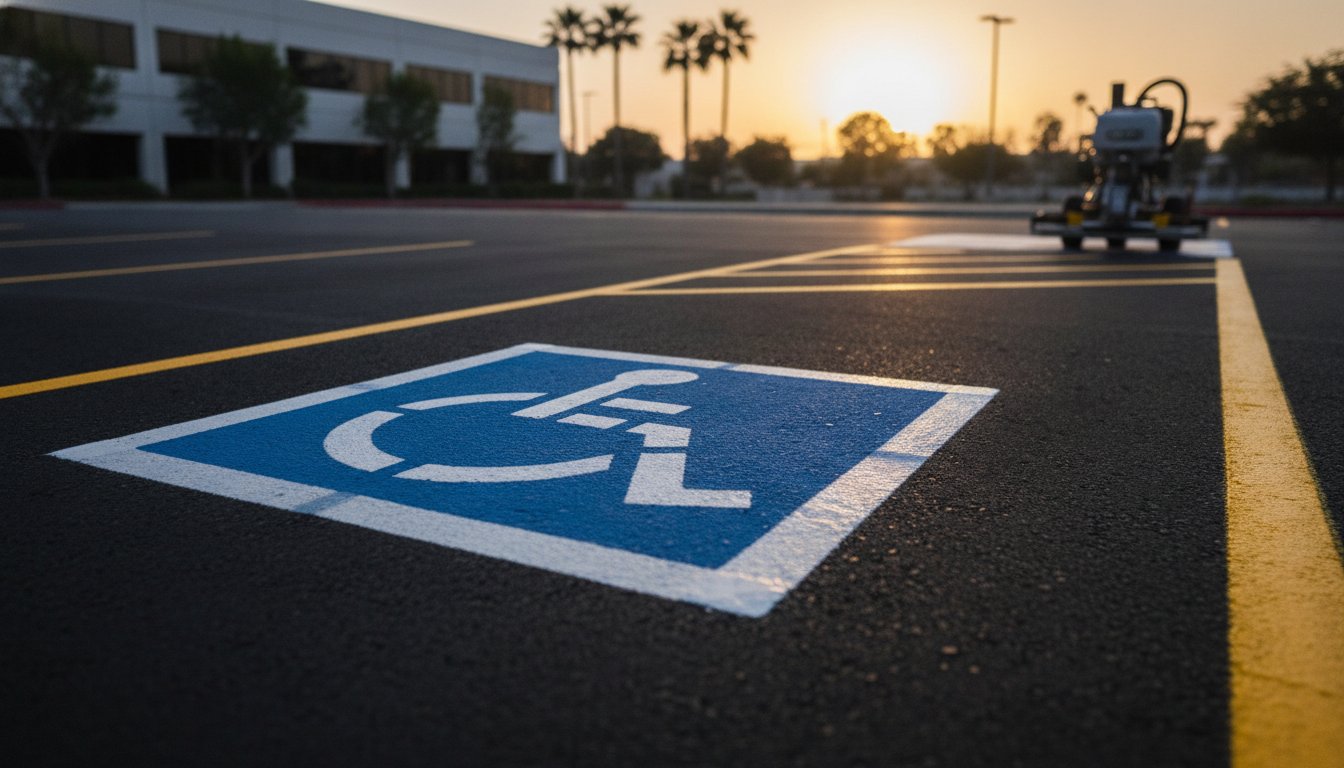
In California, a single inch of deviation in your stall dimensions isn’t just a mistake. It’s a $4,000 invitation for a predatory lawsuit under the Unruh Civil Rights Act. You’ve worked hard to build your business, but one “drive-by” inspection of your ADA compliant parking lot striping San Diego can put your entire operation at risk. It’s a high-stakes environment where federal rules and strict California Building Code Chapter 11B standards often clash. This leaves property managers in a state of constant legal uncertainty.
We understand the pressure to maintain a site that is accessible, durable, and legally bulletproof. You need a lot that looks professional and passes a CASp inspection without a second thought. This 2026 compliance checklist delivers the engineering-grade specs required for your facility. We cover exact stall widths, required white lettering stencils, and the precise slope tolerances that separate a compliant lot from a liability. Master the dimensions. Deploy the right materials. Secure your property against litigation.
Key Takeaways
- Master the rigid California Building Code standards to shield your facility from predatory accessibility litigation.
- Implement the exact 2026 technical layouts for van stalls and ADA compliant parking lot striping San Diego to pass municipal inspections.
- Identify the hidden grade violations and asphalt failures that make even the brightest paint non-compliant.
- Audit your site for precise stall counts, reflective signage heights, and mandatory 12-inch “NO PARKING” lettering.
- Deploy engineering-grade solutions from SoCal Underground and Engineering to integrate surface durability with long-term legal accessibility.
Understanding California ADA Striping Regulations and Liability
ADA compliance in Southern California isn’t a suggestion; it’s a rigid engineering requirement. The Americans with Disabilities Act of 1990 sets the federal baseline, but San Diego property owners must answer to the California Building Code (CBC) Chapter 11B. This state-level code is significantly more detailed and punitive. A single missed dimension or an incorrectly placed stencil isn’t just an accessibility barrier; it’s a legal liability that creates a permanent target for litigation.
The financial stakes are exceptionally high in San Diego County. Under the Unruh Civil Rights Act, California allows for statutory damages of $4,000 per violation, plus the plaintiff’s attorney fees. For a small business, a few non-compliant stalls can result in a settlement that exceeds the cost of a total lot rehabilitation. Many owners fall into the trap of “maintenance only” thinking. They assume that a quick restripe of existing lines keeps them safe. However, any surface work, including sealcoating or basic repainting, legally triggers the requirement to bring the entire lot up to current 2026 standards. If you paint over a mistake, you’ve just documented your own non-compliance in fresh white and blue.
The Role of CASp Inspections in San Diego
A Certified Access Specialist (CASp) provides the only reliable bridge between your current lot condition and legal safety. During an audit, a CASp inspector reviews the slope, stall layout, and signage against the latest CBC updates. Securing a CASp report before a lawsuit is filed grants your facility “qualified defendant” status. This status is a powerful legal shield that can reduce statutory damages and provide a stay in court proceedings while you perform remediation. At SoCal Underground and Engineering, we ensure that every ADA compliant parking lot striping San Diego project we execute is built to pass these high-stakes inspections on the first attempt.
Federal ADA vs. California Title 24
Confusion between federal and state rules is the leading cause of failed inspections. While federal law might allow certain tolerances, California Title 24 (CBC 11B) almost always demands a stricter standard. San Diego facilities are legally required to follow whichever regulation is more stringent. Common areas where California exceeds federal requirements include:
- Access Aisle Borders: Must be outlined in blue with hatched lines.
- Pavement Lettering: The words “NO PARKING” must be painted in 12-inch high white letters within each access aisle.
- Signage Language: Specific “Minimum Fine $250” language must be present at every stall.
There is no such thing as being “grandfathered in” when it comes to accessibility. If a barrier exists and is readily achievable to fix, the law requires action. Precision in these details is what separates a professional engineering-grade lot from a liability. We treat these regulations as a blueprint for structural integrity rather than a cosmetic preference.
Dimensions and Layout: The Technical Blueprint for Compliance
Precision is the only defense against liability. In San Diego, your parking lot layout isn’t just a convenience; it’s a technical document executed in paint and thermoplastic. To achieve ADA compliant parking lot striping San Diego, you must move beyond guesswork and adhere to the 2026 CBC Chapter 11B standards. These regulations dictate exactly how many spaces you need based on total lot capacity. For example, a lot with 1 to 25 spaces requires at least one accessible stall. As your lot grows to 51 to 75 spaces, that requirement jumps to three stalls. At least one out of every six accessible spaces must be designated as van-accessible. Measure your total inventory. Calculate the ratio. Execute the layout.
Visibility is the next priority. High-contrast markings ensure that designated areas are unmistakable for drivers and inspectors alike. California requires a specific blue and white contrast. The International Symbol of Accessibility (ISA) must be painted in white on a blue background. This isn’t just for aesthetics; it’s for rapid identification in high-traffic San Diego corridors. If your asphalt is grayed or cracked, the contrast fails. We recommend a fresh sealcoat before restriping to provide a dark, durable canvas that makes your compliance markings pop. For long-term durability, a professional parking lot maintenance program ensures these markings remain legible under heavy use.
Van Accessible Stall Requirements
Van stalls require more than just a wider footprint; they require specific engineering. Under 2026 standards, a van-accessible stall must be at least 132 inches wide. If you choose a narrower 108-inch stall, you must compensate with a wide 96-inch access aisle. These dimensions are non-negotiable. You must also include “Van Accessible” signage mounted at a minimum of 60 inches from the ground to the bottom of the sign. Refer to the ADA.gov parking guidelines to ensure your federal baseline is met before applying the stricter California overlays. Measure twice. Paint once. Avoid the courtroom.
Access Aisles and Shared Spaces
Access aisles are the most scrutinized part of any CASp inspection. These zones must be at least 60 inches wide for standard cars and 96 inches for vans. The markings must be distinct: use blue hatched lines spaced no more than 36 inches apart. Every aisle must feature the words “NO PARKING” in 12-inch high, white capital letters. This lettering acts as a clear deterrent and a legal marker. When we strip a lot, we ensure these aisles are level and clear of obstructions. It’s about more than paint; it’s about creating a safe, functional path of travel for every visitor to your facility.
Beyond the Paint: Evaluating Surface Integrity and Slope
Bright paint cannot hide a bad grade. If your parking surface exceeds a 2% slope in any direction, your facility is non-compliant. It doesn’t matter how crisp the lines are. This 1:48 slope ratio remains the primary reason for failed CASp inspections and successful lawsuits in Southern California. It’s a rigid engineering standard. We frequently see ADA compliant parking lot striping San Diego applied to surfaces where the asphalt has heaved or the concrete has settled. When the ground shifts, your legal defense disappears. You aren’t just managing a parking lot; you’re managing a civil engineering project. Measure the grade. Fix the slope. Paint the line.
Surface levelness is often dictated by the stability of what lies beneath. Shifting underground utilities or poor soil compaction leads to surface depressions. These areas collect standing water and create trip hazards. ADA regulations require a surface that is firm, stable, and slip-resistant. If your lot has “bird baths” or significant cracking, simply repainting is a waste of capital. You must address the structural failure before you pull the trigger on a striping crew. A compliant lot starts with a stable foundation, not a spray rig.
Concrete and Asphalt Leveling
Achieving a compliant base requires precision. Professional concrete flatwork is the only way to ensure stalls and access aisles remain within the 2% slope tolerance. We don’t just patch holes. We analyze the drainage, stabilize the subgrade, and pour for long-term levelness. Integrating high-quality parking lot paving ensures your striping investment lasts for years rather than months. Level the ground. Stabilize the base. Secure the site.
The Critical Path to the Entrance
Compliance doesn’t end at the stall line. The “Path of Travel” from the vehicle to the facility door must be seamless. This includes evaluating every curb ramp and transition point for slope violations. You must install truncated domes and tactile warning surfaces at hazardous vehicular areas. These yellow, raised-profile tiles provide the necessary warning for visually impaired visitors. If your curb ramps don’t meet the 8.3% maximum slope or lack the required 36-inch width, your entire accessibility strategy fails. We ensure the transition from the asphalt to the threshold is smooth, legal, and safe.

The 2026 San Diego ADA Striping Checklist
Audit the final layout against the 2026 checklist before the paint cures. This is the last line of defense against a failed CASp inspection. Start with the stall count. A lot with 1 to 25 spaces requires one accessible stall; a lot with 76 to 100 spaces requires four. If your count is off by even one space, the entire lot is non-compliant. The International Symbol of Accessibility (ISA) must be a 36-by-36-inch white profile on a blue background. Anything smaller is a technical violation. To ensure your facility stays protected, schedule an engineering-grade parking lot assessment with SoCal Underground and Engineering today.
Access aisles require strategic orientation. For van-accessible stalls, the aisle must be located on the passenger side of the vehicle to allow for ramp deployment. The paint itself must be slip-resistant and applied to a surface free of cracks. If your asphalt is failing beneath the paint, your ADA compliant parking lot striping San Diego is structurally void. We look for heaving and drainage issues that interfere with a safe path of travel during every final walkthrough. Precision is the only way to avoid the $4,000 statutory damages triggered by minor layout errors.
Signage and Vertical Markings
Signage is the most visible indicator of compliance. Every accessible stall requires an R7-8 sign. Van-accessible spots must also include the R7-8a “Van Accessible” plaque. Mounting height is non-negotiable. Signs must be positioned between 60 and 80 inches from the ground to the bottom of the sign. This ensures they remain visible even when a vehicle is parked. All signage must feature a reflective coating to maintain night-time visibility. California law also mandates a “Minimum Fine $250” sign at every entrance or stall. Whether you choose post-mounting or wall-mounting, the hardware must be secure and the placement must be precise.
Pavement Paint and Materials
San Diego heat destroys standard paint. For high-traffic lots, traffic-grade acrylic is the baseline, but thermoplastic markings offer superior longevity. Thermoplastic is a thick material that bonds to the pavement, lasting three to five years under heavy use. Within the access aisles, you must paint “NO PARKING” in 12-inch high, white capital letters. Color coding follows strict standards:
- Blue: Reserved for ADA stalls and access aisle borders.
- Red: Reserved for fire lanes and emergency access zones.
- Yellow or White: Used for standard stall lines and loading zones.
Precision in color and material selection prevents driver confusion and ensures your lot remains compliant year-round. Don’t settle for a cosmetic touch-up when your legal standing is on the line. We use industrial-grade materials that stand up to the elements and the inspectors.
Engineering-Grade Parking Lot Solutions in San Diego
We don’t just paint lines; we build infrastructure. At SoCal Underground, we treat ADA compliant parking lot striping San Diego as a civil engineering project rather than a cosmetic touch-up. A parking lot is a complex system where the surface depends entirely on the stability of the subgrade. Often, surface failures are symptoms of deeper issues. The integrity of your pavement is tied directly to the condition of underground utility systems. If your sewer or water lines are leaking, the resulting soil saturation causes the asphalt to heave or settle. This movement immediately voids your 2% slope compliance. We identify these root causes before the first drop of paint hits the ground. Our “Handshake” commitment means we own the result. We provide honesty, ethics, and professional accountability on every job site.
Our team moves rapidly from initial inquiry to final result. We don’t sit behind desks; we are active and present on the project site. This boots-on-the-ground approach ensures that every stall, aisle, and ramp meets the rugged industrial standards required for San Diego infrastructure. We view every project as a commitment to be honored. Analyze the site. Stabilize the ground. Secure the compliance. This is the lifecycle of a SoCal Underground project. We provide a formidable industry force that acts as your dependable, localized partner.
Comprehensive Parking Lot Rehabilitation
Maximum ROI requires a total rehabilitation strategy. We combine seal coating, crack filling, and precision striping into a single, cohesive workflow. This approach extends the life of your asphalt while maintaining strict legal standards. We manage complex traffic control for multi-phase projects to keep your facility operational and safe. If an infrastructure failure occurs, our 24/7 emergency response team handles the repairs immediately. We manage the full scope: demolition, grading, paving, and final traffic markings. We build it right. We keep it legal. We make it last.
Request a Strategic Compliance Audit
Stop looking for a “quote” and start looking for a professional site evaluation. A standard painting contractor might miss the subtle grade shifts that lead to a $75,000 federal fine for first-time offenses. Hiring a licensed engineering contractor is the only way to ensure your commercial or public works project meets every 2026 California Building Code standard. We provide the technical depth and moral character required for high-stakes accessibility. Secure your property. Protect your business. Get an ADA Compliance Evaluation from SoCal Underground.
Protect Your Infrastructure and Your Bottom Line
Compliance isn’t about checking a box; it’s about securing your facility against legal and structural failure. You’ve seen the 2026 requirements. You know that a 2% slope is the hard line between a legal lot and a predatory lawsuit. You understand that “just repainting” over old lines is a liability trap. As a licensed civil engineering contractor, SoCal Underground brings technical precision to every site. We don’t just spray paint. We grade, pave, and secure your property using comprehensive asphalt and concrete services.
San Diego municipal codes are strict. Our team specializes in these localized regulations to ensure your ADA compliant parking lot striping San Diego passes every CASp inspection. We handle the heavy lifting from subgrade stabilization to the final traffic markings. Don’t leave your facility’s future to a cosmetic crew. Secure your investment with a partner who understands the engineering behind the accessibility. We’re ready to get to work on your lot.
Secure Your Facility with ADA Compliant Striping from SoCal Underground
Frequently Asked Questions
How many ADA parking spaces are required for my San Diego business?
The required number of spaces depends entirely on your total lot capacity. A lot with 1 to 25 spaces requires one stall; while a lot with 76 to 100 spaces requires four. Verify your total inventory. Calculate the ratio. Ensure you meet these minimums to avoid immediate non-compliance under California law.
What is the maximum slope allowed for an ADA parking space in California?
The maximum allowable slope is 1:48 in any direction. This equals approximately 2.08% and applies to both the parking space and the adjacent access aisle. We use precision levels to verify this grade during installation. Any deviation above this limit triggers a structural violation that paint cannot fix.
Do I need to repaint my parking lot if the lines are still visible?
Visibility is only one part of the requirement. If your lines are visible but the layout doesn’t meet current 2026 CBC Chapter 11B standards, you remain liable. Any restriping project triggers the need for full ADA compliant parking lot striping San Diego. Don’t just trace old mistakes; verify the dimensions first.
What is a CASp inspector and do I need one in San Diego?
A CASp is a Certified Access Specialist who audits your site for accessibility barriers. In San Diego, hiring one provides “qualified defendant” status in court. It’s a strategic legal shield. These experts find the errors before a plaintiff’s attorney does, giving you a window to remediate violations.
Can I be sued if my parking lot striping is only slightly off?
Yes. California’s Unruh Civil Rights Act allows for $4,000 in statutory damages per violation. Precision is your only defense. A stall that is two inches too narrow is just as illegal as having no stall at all. Professional accountability means hitting the mark every time.
What color should ADA parking lines be in California?
California requires blue borders and blue hatched lines for all access aisles. The International Symbol of Accessibility must be white on a blue background. The words “NO PARKING” must be painted in 12-inch high white letters within the aisle. Stick to these specific color-coding standards to ensure legibility.
How often should a commercial parking lot be restriped for compliance?
Maintenance should occur every 12 to 24 months. High-traffic San Diego lots wear down acrylic paint quickly, which reduces the required contrast. Thermoplastic lasts longer but still requires regular inspection. Compliance is a constant obligation; it’s not a one-time event you can forget about.
Are there different rules for “Van Accessible” parking spots?
Van-accessible stalls have unique dimension requirements. They must be at least 132 inches wide, or 108 inches wide if paired with a 96-inch access aisle. You must also designate at least one out of every six accessible spaces for vans. Specific “Van Accessible” signage is mandatory for these spots.