
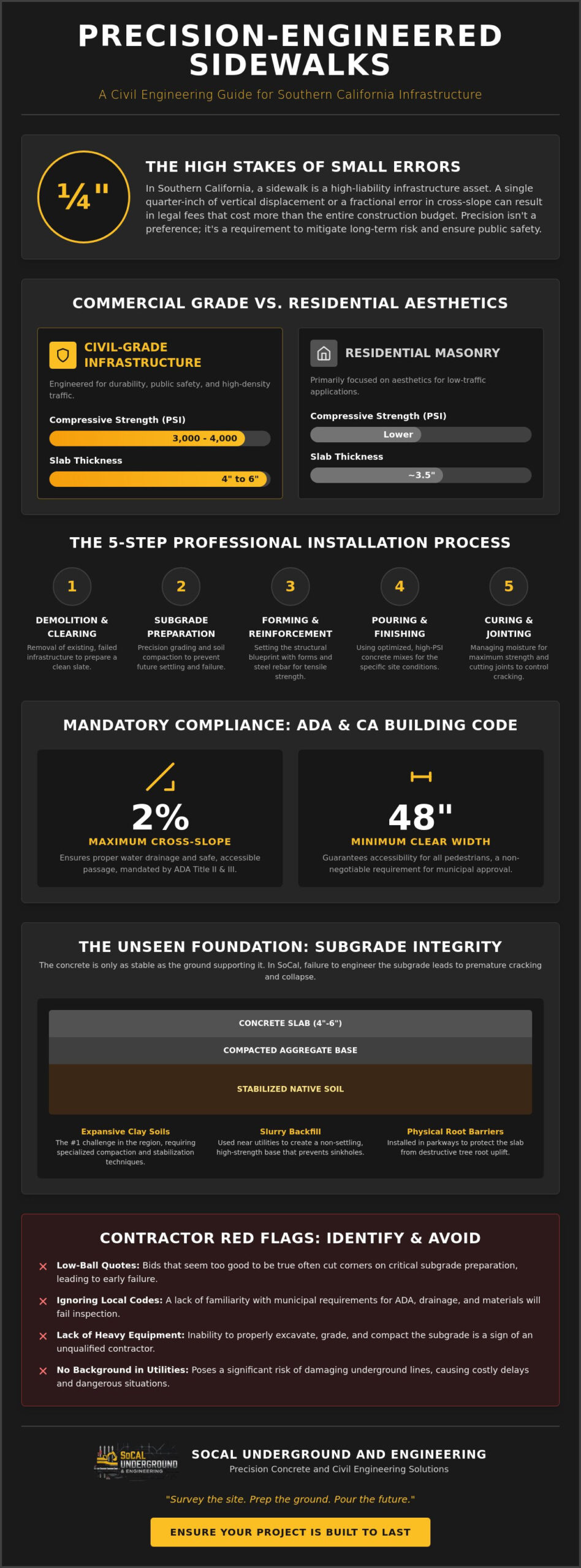
A single quarter-inch of vertical displacement or a fraction of a percentage in cross-slope can cost your operation more in legal fees than the entire construction budget. In Southern California, a sidewalk isn’t just flatwork. It’s a high-liability infrastructure asset that demands civil engineering precision. You’ve likely seen the results of shortcuts: premature cracking, pooling water, or ADA ramps that fail inspection before the yellow tape is even removed. Hiring a professional concrete sidewalk installation contractor means choosing a partner who values structural integrity over speed. We know the stakes are high, and there is no room for contractors who disappear mid-project or ignore subgrade stability.
We understand the pressure to deliver zero-defect results that withstand heavy foot traffic and strict municipal oversight. You need a crew that shows up, does the work, and stands by the finish. This guide serves as your definitive resource for selecting a high-capacity contractor capable of meeting the rigorous California Building Code, including the 48-inch clear width and 2% max cross-slope mandates. We will examine the technical requirements for durable infrastructure, the necessity of proper subgrade preparation, and the professional standards that mitigate your long-term risk. Survey the site. Prep the ground. Pour the future.
Key Takeaways
- Differentiate between standard flatwork and civil-grade infrastructure to protect your project from long-term liability.
- Learn to optimize concrete mix designs and reinforcement strategies specifically for the Southern California environment.
- Navigate the strict requirements of ADA Title II and III to ensure every ramp and walkway passes municipal inspection.
- Identify red flags in low-ball quotes and verify the equipment capacity of your concrete sidewalk installation contractor before signing a contract.
- Understand why a background in underground utility construction leads to superior precision and durability in surface-level concrete work.
Professional Concrete Sidewalk Installation Standards in Southern California
Sidewalks are the arteries of urban mobility. In Southern California, these structures face intense heat, seismic shifts, and heavy pedestrian loads. A professional Sidewalk construction standards framework ensures these paths don’t just look good on day one; they remain functional for decades. This isn’t a DIY project or a simple home improvement task. It is civil engineering. Every inch of concrete must be backed by technical data and proven methodology.
A qualified concrete sidewalk installation contractor manages a high-stakes lifecycle. Break. Clear. Build. The process starts with the demolition of existing, failed infrastructure. It moves into precision grading and subgrade stabilization. We then execute forming, pouring, and finishing with industrial-grade materials. In SoCal, our expansive clay soils demand this level of rigor. Without proper subgrade engineering, your investment will buckle, crack, and fail within two seasons. We build for the long haul.
Commercial vs. Residential Concrete Flatwork
Residential masonry focuses on aesthetics; commercial flatwork focuses on survival. Commercial projects typically require a minimum of 3,000 to 4,000 PSI concrete mixes to handle the stress of high-density traffic. Thickness is another critical differentiator. While a residential path might settle for 3.5 inches, industrial-grade installations often require 4 to 6 inches, especially at driveway approaches or heavy-use zones. Municipalities also demand specific bonding and specialized licensing. These aren’t suggestions. They are legal requirements for public safety and structural accountability. For a deeper understanding of how engineered surfaces differ from standard pours, our guide on working with a concrete flatwork contractor Southern California projects depend on covers the technical benchmarks that separate durable infrastructure from premature failure.
The Importance of Site Development and Grading
The finish is only as good as the dirt beneath it. Proper excavation prevents future settling and the tripping hazards that lead to litigation. Managing drainage is equally vital. Water must move away from the concrete base to prevent erosion and subgrade collapse. Integrating the skills of a site development contractor Southern California ensures that the entire site works in harmony. We don’t just pour concrete; we engineer the environment. Excavate. Compact. Protect. This comprehensive approach is what separates a professional concrete sidewalk installation contractor from a low-bid amateur who cuts corners on prep work.
Engineering Structural Integrity: More Than Just Flatwork
Concrete is a living chemical reaction. It expands in the SoCal heat and contracts during the cool nights. Without precise engineering, this movement leads to structural failure. A professional concrete sidewalk installation contractor understands that mix design is the foundation of longevity. We don’t use a one-size-fits-all approach. We optimize water-to-cement ratios and slump based on the specific environmental conditions of the job site. For technical specifications on high-performance slabs, we follow the industry standards for concrete design and control mixtures to ensure the final product meets its intended lifecycle.
Structural integrity is also dictated by how you manage the inevitable. Concrete will crack. The goal is to control where those cracks occur using deep-score control joints and full-depth expansion joints. These act as the safety valves of the infrastructure. We also prioritize rigorous curing protocols. We don’t just pour and walk away. We manage the moisture loss to ensure the slab reaches its maximum compressive strength without brittle surface scaling or internal voids. If your project requires a concrete sidewalk installation contractor that treats flatwork like a structural asset, our team delivers that level of precision.
Subgrade Preparation and Compaction
The slab is only as stable as the ground supporting it. We test soil density before the first yard of concrete hits the site. In areas adjacent to utility lines, we often utilize slurry backfill to provide a non-settling, high-strength base that protects underground assets. This prevents the “hollow” spots that lead to sinkholes and surface fractures. We also install physical root barriers in parkway zones to prevent environmental upheaval from maturing trees. Test. Compact. Stabilize. This is the only way to prevent premature failure.
Reinforcement and Load Distribution
Reinforcement choice depends entirely on the intended load. While wire mesh might suffice for light pedestrian paths, we utilize rebar for equipment pads, dumpster pads, and high-traffic municipal zones to ensure superior tensile strength. Proper placement is critical; steel that sits at the bottom of the pour provides zero benefit. We use chairs and spacers to keep reinforcement in the center of the slab where it can actually work. In 2026, standard municipal sidewalks in Southern California typically require a minimum compressive strength of 3,250 to 4,000 PSI depending on the specific city engineering standards. We exceed these benchmarks to guarantee a zero-defect result.
Navigating ADA Compliance and Local Municipal Codes
Compliance is not a suggestion. It is a legal mandate. In California, building codes often exceed federal ADA requirements. A sidewalk that fails a municipal inspection is a liability, not an asset. If your concrete sidewalk installation contractor doesn’t understand the nuance between Title II and Title III requirements, you are exposed to significant legal risk. We build to satisfy the inspector and the attorney. Precision is the only metric that matters on the job site.
California law requires a minimum clear width of 48 inches for accessible routes. This is a full foot wider than the federal 36-inch standard. We strictly adhere to Caltrans sidewalk construction standards to ensure every pour meets state-level quality control. From the placement of truncated domes to the exact color of detectable warning surfaces, every detail must be exact. We also monitor the 1/4 inch maximum vertical displacement rule between adjacent surfaces. Anything more is a trip hazard. Anything more is a lawsuit.
ADA Ramp Installation Best Practices
The margin for error in ramp construction is razor-thin. We maintain a maximum cross-slope of 2% and a running slope of 5% for standard walkways. If the grade exceeds 5%, it’s officially a ramp. That transition triggers a new set of requirements, including an 8.33% maximum slope and mandatory handrails. Level landings are non-negotiable. We measure twice and pour once. A failed inspection means a costly tear-out and a delayed project. We don’t take those chances. We deliver results that pass the first time.
Meeting Municipal Infrastructure Standards
Working in Los Angeles or Orange County requires a deep understanding of the Greenbook standards. This is the definitive guide for public works construction in Southern California. We coordinate directly with municipal inspectors to handle street restoration, curb work, and gutter integration. Managing the site is as important as the concrete itself. We deploy professional traffic control to keep the public safe during demolition and pouring. This level of coordination is why selecting a high-capacity concrete sidewalk installation contractor is vital for civil projects. We know the local codes. We secure the permits. We pass the inspections. Measure. Pour. Comply.
How to Evaluate a Commercial Sidewalk Contractor’s Bid
Price is a poor metric for quality. A low-ball quote from a concrete sidewalk installation contractor often hides a lack of insurance or a plan to skip critical subgrade stabilization. If the bid is significantly lower than the market average, the contractor is likely cutting corners on material PSI or labor standards. We don’t play games with your liability. Every bid we provide is backed by full liability and workers’ compensation insurance. This protects your assets and your reputation. A professional bid should be detailed, transparent, and grounded in the reality of Southern California construction costs.
Equipment capacity matters. Large-scale site development requires a specialized fleet, not a skeleton crew with hand tools. Verify that the contractor owns and maintains the machinery necessary for high-volume demolition and precision grading. Before any new concrete can be placed, the existing failed infrastructure must be removed safely and legally. Working with a qualified concrete demolition contractor Riverside projects rely on ensures that utility lines are protected, waste recycling mandates are met, and permits are secured before the first jackhammer swings. If your project involves utility-adjacent work, 24/7 emergency response is non-negotiable. Utility lines are unpredictable. If a water main or sewer lateral is compromised during excavation, you need a team capable of immediate repair. We are that team. We stay on-site until the job is done and the area is secure.
Verifying Technical Expertise
Demand proof of performance. Ask for specific data on past heavy engineering and civil works projects. A contractor who primarily handles residential masonry will struggle with the complexities of municipal inspections and public right-of-way requirements. Check references for public works contracts to ensure a history of zero-defect delivery. It is also vital to confirm their ability to function as underground utility contractors. This dual expertise ensures that your surface-level concrete work doesn’t compromise the critical infrastructure buried beneath it.
Project Management and Timeline Accountability
A project is only as good as its management. Evaluate the proposed traffic control and safety plan before the first jackhammer hits the pavement. You need a clear schedule for demolition, removal, and replacement. Delays cost money. Communication must be direct and frequent throughout the construction lifecycle. We provide a logical progression of capability and process. We show up. We do the work. We finish on time. If you need a partner who values integrity above all else, contact us for a comprehensive project evaluation today.
SoCal Underground and Engineering: Precision Concrete and Civil Engineering Solutions
Most crews look at a sidewalk and stop at the surface. SoCal Underground and Engineering looks deeper. Our expertise in underground utility construction provides a technical perspective that standard flatwork crews simply lack. We understand the critical interplay between soil compaction, pipe bedding, and surface stability. As a high-capacity concrete sidewalk installation contractor, we apply heavy engineering principles to every linear foot of concrete we pour. We build to protect the infrastructure beneath the slab as much as the slab itself. This integrated knowledge prevents the settling and shifting that often plagues less experienced contractors.
Our commitment to zero-defect municipal work is non-negotiable. We serve LA County, Orange County, and San Diego County with a focus on professional accountability and 24/7 readiness. If a municipal inspector arrives, they encounter work that meets or exceeds the highest civil standards. We handle the full spectrum of concrete work, from heavy-duty box culverts to precision decorative concrete in high-traffic plazas. We deliver finality. We deliver quality. We deliver results. Our reputation is rooted in the physical work we leave behind on every job site. We are present, active, and accountable.
Integrated Civil Construction
We remove the logistical friction of multi-trade management. SoCal Underground and Engineering handles the full lifecycle of the project: utility trenching, pipe installation, and final sidewalk restoration. This continuity ensures that curb, gutter, and cross-gutter transitions are perfectly aligned with the broader municipal site plan. Handling everything from the utility trench to the finished sidewalk requires a crew that understands both subterranean and surface-level physics. Hiring a design-build firm for concrete infrastructure provides a single point of accountability and ensures that surface improvements never compromise buried assets. We manage the logistics. You receive the results. No excuses. Just progress.
Ready to Secure Your Infrastructure?
Integrity is the foundation of our operation. We start every project with a thorough site walk and project consultation to identify potential failure points before they become liabilities. Our team is equipped for both planned site development and emergency concrete and utility repairs. We are active on the job site and available when the stakes are high. Our 24/7 accountability means we are there when you need us, not just when it’s convenient. Contact SoCal Underground and Engineering for a professional bid and a partner who treats your infrastructure like a permanent commitment. Build. Protect. Persist.
Build Infrastructure That Lasts
A sidewalk is the final layer of a site’s civil integrity. Throughout this guide, we’ve analyzed the technical rigor required for ADA compliance, the engineering behind high-PSI mix designs, and the critical importance of subgrade stabilization. Your choice of a concrete sidewalk installation contractor determines whether your infrastructure becomes a long-term asset or a recurring liability. Don’t leave your public right-of-way to crews who lack the heavy engineering background necessary for Southern California’s complex soil and regulatory environment.
SoCal Underground and Engineering brings a specialized perspective to every project, merging underground utility expertise with precision surface work. We offer a 24/7 Emergency Response Team and a proven track record in municipal infrastructure and public works. We don’t just pour concrete; we deliver comprehensive underground and surface improvement solutions that stand the test of time. Request a Professional Concrete Bid from SoCal Underground and Engineering to start your project. Build with confidence. Protect your investment. Honor the commitment.
Frequently Asked Questions
How long does a professional concrete sidewalk installation take?
Most commercial sidewalk projects follow a three to five day cycle. Day one involves demolition and removal of the old material. Day two is dedicated to subgrade stabilization and forming. Day three is the pour. Larger civil projects or those requiring complex traffic control may extend this timeline. We prioritize efficiency to minimize the impact on your business operations.
What is the standard concrete thickness for commercial sidewalks in California?
Commercial sidewalks in Southern California are typically 4 inches thick. In areas where the sidewalk intersects with a driveway approach or handles heavy equipment loads, thickness increases to 6 or 8 inches. These dimensions ensure the slab withstands intense foot traffic and environmental stress. We verify all local municipal requirements before setting the first form.
Do I need a permit to replace the sidewalk in front of my business?
Yes. Any work within the public right-of-way requires a permit from the local municipality. In cities like Los Angeles, this usually involves an A-Permit or an encroachment permit. A professional concrete sidewalk installation contractor handles the permit coordination with public works. We ensure all legal requirements are met before the first jackhammer hits the ground.
How do I ensure my new sidewalk is ADA compliant?
Compliance is achieved through exact adherence to slope, width, and surface requirements. We maintain a 2% maximum cross-slope and a 48-inch minimum clear width as mandated by California code. We also integrate truncated domes at all transition points. We use digital levels to verify every grade. This eliminates the risk of municipal rejection and legal liability.
What causes concrete sidewalks to crack so quickly?
Premature cracking usually results from poor subgrade preparation or improper joint placement. If the soil isn’t compacted or the water-to-cement ratio is incorrect, the concrete will fail. We use deep-score control joints to manage the inevitable movement of the slab. This prevents random fracturing. Proper curing protocols further ensure the slab reaches its intended compressive strength.
Can you install concrete sidewalks over existing underground utilities?
We frequently build surface improvements over active underground utilities. This requires careful excavation and the use of slurry backfill to protect buried lines. Our background in underground utility construction allows us to install sidewalks without compromising the integrity of sewers or water mains. We bridge the gap between surface work and buried infrastructure.
What is the difference between a masonry contractor and a civil engineering contractor?
How soon can foot traffic resume after a concrete pour?
Foot traffic can generally resume within 24 to 48 hours after the finish is applied. However, the concrete takes approximately 28 days to reach its full design strength. We keep the area cordoned off until the surface is hard enough to resist scuffing. Heavy equipment or vehicles must stay off the slab for at least seven to ten days to prevent structural damage.